





/NASA’s%20Artemis%20III%20Announcement%20(Official%20NASA%20Trailer)~thumb.jpg)

An animated GIF showing Uranus' magnetic field.
Ver en NASA ↗🚀 Biblioteca espacial oficial
Imágenes y vídeos de NASA
Explora el catálogo multimedia público de NASA sin salir de TuPortalNews.
Explora temas destacados
Selecciona un tema o realiza una búsqueda personalizada.
125 resultados en NASA
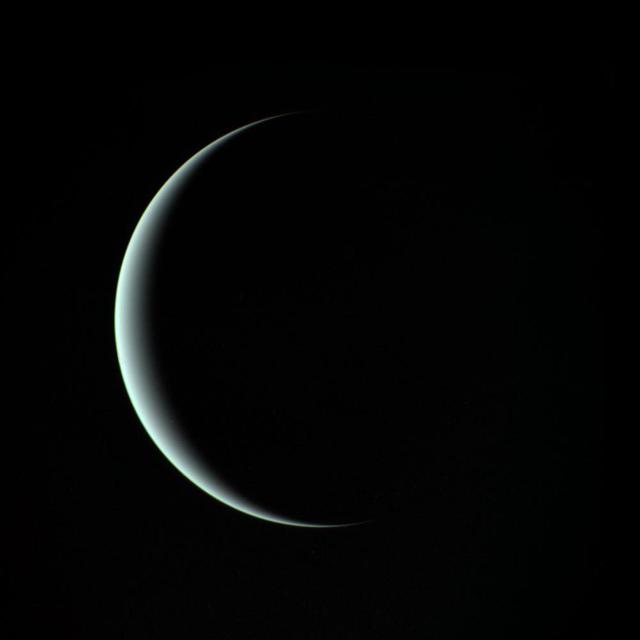
A sliver of Uranus is seen by NASA Voyager 2. This image was taken through three color filters and recombined to produce the color image.
Ver en NASA ↗Processing brings out Uranus atmosphere in this image taken by NASA Voyager 2.
Ver en NASA ↗This view of pale blue-green Uranus was recorded by NASA Voyager 2 on Jan 25, 1986, as the spacecraft left the planet behind. The thin crescent of Uranus is seen here between the spacecraft, the planet and the Sun.
Ver en NASA ↗This is an image of the planet Uranus taken by the spacecraft Voyager 2 in 1986.
Ver en NASA ↗This image shows a crescent Uranus, a view that Earthlings never witnessed until Voyager 2 flew near and then beyond Uranus on Jan 24, 1986.
Ver en NASA ↗A latitude-longitude grid superimposed on this false color image obtained by NASA Voyager 2 in 1986 shows that Uranus atmosphere circulates in the same direction as the planet rotates.
Ver en NASA ↗This computer enhancement of a NASA Voyager 2 image, emphasizes the high-level haze in Uranus upper atmosphere. Clouds are obscured by the overlying atmosphere.
Ver en NASA ↗NASA Hubble Space Telescope peered deep into Uranus atmosphere to see clear and hazy layers created by a mixture of gases. Using infrared filters, Hubble captured detailed features of three layers of Uranus atmosphere.
Ver en NASA ↗The energized particles around Uranus defied scientist's understanding of how magnetic fields work to trap particle radiation.
Ver en NASA ↗This false-color picture of Uranus, obtained by NASA Voyager on Jan. 14, 1986, shows a discrete cloud seen as a bright streak near the planet limb.
Ver en NASA ↗These two images of Uranus, one in true color and the other in false color, were compiled from images returned in 1986, by the narrow-angle camera of NASA's Voyager 2.
Ver en NASA ↗This NASA Hubble Space Telescope image of the planet Uranus reveals the planet rings and bright clouds and a high altitude haze above the planet south pole.
Ver en NASA ↗These time-lapse images of Uranus. taken by NASA Voyager 2 on Jan. 14, 1986, show the movement of two small, bright, streaky clouds -- the first such features ever seen on the planet.
Ver en NASA ↗This NASA Hubble Space Telescope image of the planet Uranus reveals the planet rings, at least five of the inner moons, and bright clouds in the planet southern hemisphere.
Ver en NASA ↗Taken in 1997, NASA Hubble Space Telescope, using visible light, detected clouds in the northern hemisphere of Uranus.
Ver en NASA ↗These three NASA Hubble Space Telescope images of the planet Uranus reveal the motion of a pair of bright clouds in the planet southern hemisphere, and a high altitude haze that forms a cap above the planet south pole.
Ver en NASA ↗Taking its first peek at Uranus, NASA Hubble Space Telescope Near Infrared Camera and Multi-Object Spectrometer NICMOS detected six distinct clouds in images taken July 28,1997.
Ver en NASA ↗New modeling shows that there likely is an ocean layer in four of Uranus' major moons: Ariel, Umbriel, Titania, and Oberon. Miranda is too small to retain enough heat for an ocean layer.
Ver en NASA ↗A recent NASA Hubble Space Telescope view reveals Uranus surrounded by its four major rings and by 10 of its 17 known satellites.
Ver en NASA ↗These two pictures of Uranus were compiled from images recorded by NASA Voyager 2 on Jan. 1O, 1986. This view is toward the planet pole of rotation, which lies just left of center. The image on the right is a false-color image.
Ver en NASA ↗This is a composite image of Uranus by Voyager 2 and two different observations made by Hubble — one for the ring and one for the auroras. Ever since Voyager 2 beamed home spectacular images of the planets in the 1980s, planet-lovers have been hooked on auro…
Ver en NASA ↗Uranus Moon - 1985U1
Ver en NASA ↗Contenido y metadatos proporcionados por la NASA Image and Video Library.