





/NASA’s%20Artemis%20III%20Announcement%20(Official%20NASA%20Trailer)~thumb.jpg)

Short promo for Sun-Earth Day 2009 featuring scientists and students talking about the most fascinating things they've learned about our sun.
Ver en NASA ↗🚀 Biblioteca espacial oficial
Imágenes y vídeos de NASA
Explora el catálogo multimedia público de NASA sin salir de TuPortalNews.
Explora temas destacados
Selecciona un tema o realiza una búsqueda personalizada.
6.929 resultados en NASA
Second short promo for Sun-Earth Day 2009 featuring more people talking about what they find interesting about the sun.
Ver en NASA ↗Watching a particularly beautiful movie of the sun helps show how the lines between science and art can sometimes blur. But there is more to the connection between the two disciplines: science and art techniques are often quite similar, indeed one may inform …
Ver en NASA ↗Why does the Parker Solar Probe have such a long and complex orbit to get close to the Sun? Why doesn't it just fall right toward it? Turns out it's a lot harder to approach the Sun than you might think. This video explains why.
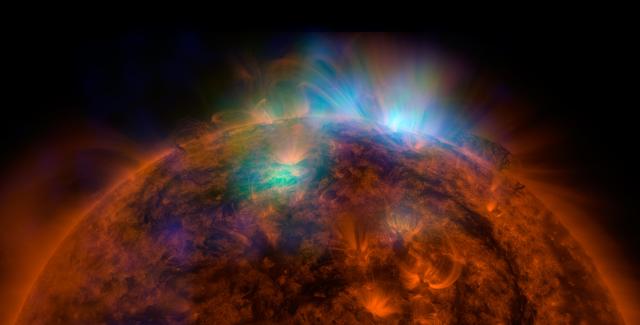
Ver en NASA ↗X-rays stream off the sun in this first picture of the sun, overlaid on a picture taken by NASA Solar Dynamics Observatory SDO, taken by NASA NuSTAR. The field of view covers the west limb of the sun.
Ver en NASA ↗Narrated video about discovering the boundary between the corona - the sun's outermost layer - and solar wind - the continuous stream of particles emanating from the sun.
Ver en NASA ↗An abridged version about the corona, the Sun's outer atmosphere.
Ver en NASA ↗This frame from an animation shows how the magnetic field lines emanating from our sun spiral out into the solar system as the sun rotates. NASA Voyager 1 is in an area scientists are calling the stagnation region, at the outer layer of the heliosphere.
Ver en NASA ↗The dark region seen on the face of the sun at the end of March 2013 is a coronal hole just above and to the right of the middle of the picture, which is a source of fast solar wind leaving the sun in this image from NASA Solar Dynamic Observatory.
Ver en NASA ↗Is the Sun a ball of fire? And why does NASA send missions to the Sun? NASA’s Heliophysics Director Nicky Fox explains NASA’s latest solar science findings. The Parker Solar Probe mission is revolutionizing our understanding of the Sun, where changing conditi…
Ver en NASA ↗This composite image of the Sun includes high-energy X-ray data from NASA's NuSTAR shown in blue; lower energy X-ray data from the XRT on the JAXA's Hinode mission shown in green; and ultraviolet light detected by the AIA on NASA's SDO shown in red.
Ver en NASA ↗This graphic shows the relative size of the Sun, upper left, compared to the two stars in the system known as Wolf-Rayet 140. The O-type star is roughly 30 times the mass of the Sun, while its companion is about 10 times the mass of the Sun.
Ver en NASA ↗Flaring, active regions of our sun are highlighted in this image combining observations from NASA's NuSTAR. During the observations, microflares went off, which are smaller versions of the larger flares that also erupt from the sun surface.
Ver en NASA ↗Facing the Sun
Ver en NASA ↗Filtering the Sun
Ver en NASA ↗Humans have always wanted to learn about the Sun, but our understanding of our favorite star has changed through the centuries. In prepartion for Sun360, when the STEREO spacecrafts will provide the first uninterrupted view of the Sun, this video is a condens…
Ver en NASA ↗The sun emitted an X1.8-class solar flare, peaking at 7:24 p.m. EST on Dec. 19, 2014.
Ver en NASA ↗Something mysterious is going on at the Sun. In defiance of all logic, its atmosphere gets much, much hotter the farther it stretches from the Sun’s blazing surface. Temperatures in the corona — the Sun’s outer atmosphere — spike to 3 million degrees Fahrenh…
Ver en NASA ↗Telescopes help distant objects appear bigger, but this is only one of their advantages. Telescopes can also collect light in ranges that our eyes alone cannot see, providing scientists ways of observing a whole host of material and processes that would other…
Ver en NASA ↗Submit your name and it will be included in a memory card that will fly aboard Parker Solar Probe spacecraft.
Ver en NASA ↗NASA's Solar Dynamics Observatory sees the sun has been virtually spotless, as in no sunspots, a 11-day spotless stretch not seen since the last solar minimum many years ago.
Ver en NASA ↗Several times a day for a few days the Earth completely blocked the Sun for about an hour due to NASA's Solar Dynamics Observatory orbital path Feb. 15, 2017.
Ver en NASA ↗Contenido y metadatos proporcionados por la NASA Image and Video Library.