









/NASA’s%20Artemis%20III%20Announcement%20(Official%20NASA%20Trailer)~thumb.jpg)


This animation of Pluto and its largest moon, Charon, was taken by NASA New Horizons spacecraft as it raced toward Pluto in July 2014.
Ver en NASA ↗🚀 Biblioteca espacial oficial
Imágenes y vídeos de NASA
Explora el catálogo multimedia público de NASA sin salir de TuPortalNews.
Explora temas destacados
Selecciona un tema o realiza una búsqueda personalizada.
548 resultados en NASA
Two different versions of an image of Pluto haze layers, taken by NASA New Horizons as it looked back at Pluto dark side nearly 16 hours after close approach, from a distance of 480,000 miles 770,000 kilometers.
Ver en NASA ↗These images, taken by New Horizons Long Range Reconnaissance Imager LORRI, show four different faces of Pluto as it rotates about its axis with a period of 6.4 days.
Ver en NASA ↗This near-true color, Pluto-centric movie from NASA New Horizons mission show Pluto and its largest moon, Charon, and the complex orbital dance of the two bodies, known as a double planet.
Ver en NASA ↗This image of Pluto from NASA New Horizons spacecraft, processed in two different ways, shows how Pluto bright, high-altitude atmospheric haze produces a twilight that softly illuminates the surface before sunrise and after sunset.
Ver en NASA ↗After a 9.5-year voyage covering more than three billion miles, NASA's New Horizons flew through the Pluto system on July 14, 2015, coming within 7,800 miles 12,500 kilometers of Pluto itself.
Ver en NASA ↗This frame from an animation is a dramatic view of the Pluto system is as NASA New Horizons spacecraft saw it in July 2015.
Ver en NASA ↗This image-based surface map of Pluto was assembled by computer image processing software from four separate images of Pluto disk taken with the European Space Agency Faint Object Camera aboard NASA Hubble Space Telescope.
Ver en NASA ↗NASA New Horizons mission science team has produced this updated panchromatic black-and-white global map of Pluto. The map includes all resolved images of Pluto surface acquired between July 7-14, 2015.
Ver en NASA ↗Pluto nearly fills the frame in this image from NASA New Horizons spacecraft, taken on July 13, 2015. This is the last and most detailed image sent to Earth before the spacecraft closest approach to Pluto on July 14.
Ver en NASA ↗The Long Range Reconnaissance Imager on NASA New Horizons acquired images of the Pluto field three days apart in late September 2006, in order to see Pluto motion against a dense background of stars.
Ver en NASA ↗This image demonstrates the first detection of Pluto using the high-resolution mode on the NASA New Horizons Long-Range Reconnaissance Imager. The mode provides a clear separation between Pluto and numerous nearby background stars.
Ver en NASA ↗This image of haze layers above Pluto limb was taken by NASA New Horizons spacecraft. About 20 haze layers are seen.
Ver en NASA ↗This image was made just 15 minutes after NASA New Horizons spacecraft closest approach to Pluto on July 14, 2015, as the spacecraft looked back at Pluto toward the sun.
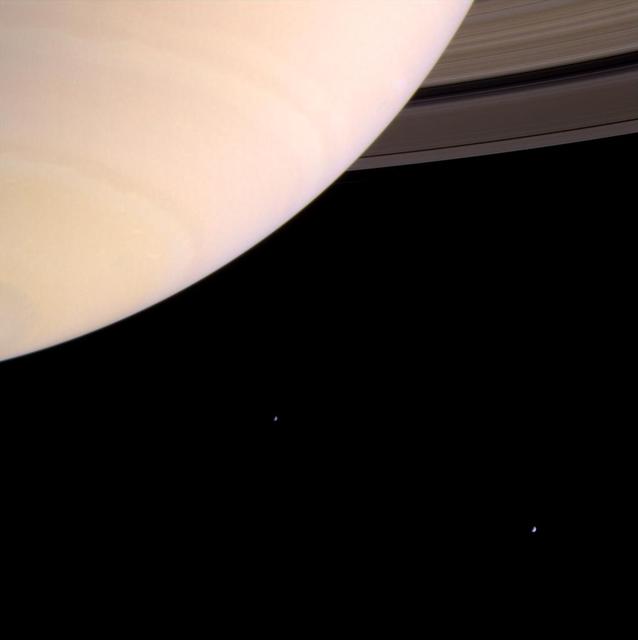
Ver en NASA ↗As one NASA spacecraft sailed past the distant ice world of Pluto, collecting never-before-seen vistas and invaluable science data, NASA Cassini spacecraft turned its gaze in that direction from its outpost at Saturn.
Ver en NASA ↗This image of Pluto was taken by NASA New Horizons spacecraft at 4:18 UT on July 9, 2015, from a range of 3.9 million miles 6.3 million kilometers reveals new details on the surface of Pluto.
Ver en NASA ↗This detailed global mosaic color map of Pluto is based on a series of three color filter images obtained NASA's New Horizons during the spacecraft close flyby of Pluto in July 2015.
Ver en NASA ↗Global stereo mapping of Pluto surface is now possible, as images taken from multiple directions are downlinked from NASA New Horizons spacecraft. You will need 3D glasses to view this image showing an ancient, heavily cratered region of Pluto.
Ver en NASA ↗NASA New Horizons spacecraft took this image of Pluto vast nitrogen ice plain informally named Sputnik Planum.
Ver en NASA ↗Pluto nearly fills the frame in this image from NASA New Horizons, taken on July 13, 2015. This is the last and most detailed image sent to Earth before the spacecraft closest approach to Pluto on July 14.
Ver en NASA ↗Four images from NASA New Horizons were combined with color data from the Ralph instrument to create this global view of Pluto. The lower right edge of Pluto in this view currently lacks high-resolution color coverage.
Ver en NASA ↗This synthetic perspective view of Pluto, based on the latest high-resolution images to be downlinked from NASA New Horizons spacecraft, shows what you would see if you were above Pluto equatorial area, looking over Cthulhu Regio.
Ver en NASA ↗NASA New Horizons scientists believe that the informally named feature Wright Mons, located south of Sputnik Planum on Pluto, and another, Piccard Mons, could have been formed by the cryovolcanic eruption of ices from beneath Pluto surface.
Ver en NASA ↗A white arrow marks Pluto in this NASA New Horizons Long Range Reconnaissance Imager picture taken Sept. 21, 2006. Pluto is little more than a faint point of light among a dense field of stars.
Ver en NASA ↗Contenido y metadatos proporcionados por la NASA Image and Video Library.