





/NASA’s%20Artemis%20III%20Announcement%20(Official%20NASA%20Trailer)~thumb.jpg)


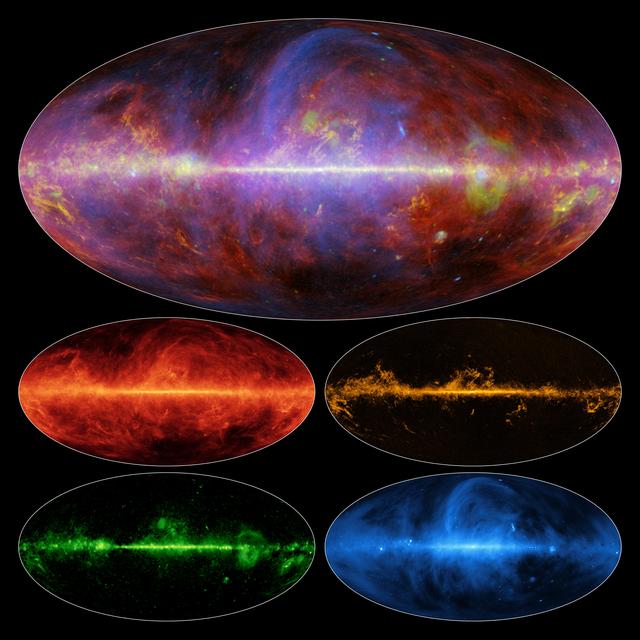
A new, dynamic portrait of our Milky Way galaxy shows a frenzy of gas, charged particles and dust as seen by the European Space Agency Planck mission.
Ver en NASA ↗🚀 Biblioteca espacial oficial
Imágenes y vídeos de NASA
Explora el catálogo multimedia público de NASA sin salir de TuPortalNews.
Explora temas destacados
Selecciona un tema o realiza una búsqueda personalizada.
629 resultados en NASA
A contingent of stars and star-forming clouds was found jutting out from the Milky Way's Sagittarius Arm. The inset shows the size of the structure and distance from the Sun.
Ver en NASA ↗Images of the Milky Way and the Large Magellanic Cloud (LMC) are overlaid on a map of the surrounding galactic halo. The smaller structure is a wake created by the LMC's motion through this region.
Ver en NASA ↗This composite image comes from the ESA Planck shows a festive portrait of our Milky Way galaxy shows a mishmash of gas, charged particles and several types of dust.
Ver en NASA ↗In visible light, the bulk of our Milky Way galaxy stars are eclipsed behind thick clouds of galactic dust and gas. But to the infrared eyes of NASA Spitzer Space Telescope, distant stars and dust clouds shine with unparalleled clarity and color.
Ver en NASA ↗Our Milky Way is a dusty place. So dusty that we cannot see the center of the galaxy in visible light. Thanks to NASA Spitzer Space Telescope excellent resolution, the dusty features within the galactic center are seen in unprecedented detail.
Ver en NASA ↗More than 444,580 frames from NASA Spitzer Space Telescope were stitched together to create this portrait of the raging star-formation occurring in the inner Milky Way.
Ver en NASA ↗More than 800,000 frames from NASA Spitzer Space Telescope were stitched together to create this infrared portrait of dust and stars radiating in the inner Milky Way.
Ver en NASA ↗Our Milky Way galaxy is ablaze with dust in this new all-sky map from Planck, a European Space Agency mission with important NASA contributions. The towers of fiery colors are actually dust in the galaxy and beyond that has been polarized.
Ver en NASA ↗This artist concept illustrates the new view of the Milky Way. The galaxy two major arms can be seen attached to the ends of a thick central bar, while the two now-demoted minor arms are less distinct and located between the major arms.
Ver en NASA ↗The Milky Way appears in the vastness of space behind the dimly lit SpaceX Dragon Endeavour spacecraft docked to the Harmony module's space-facing port on the International Space Station.
Ver en NASA ↗This image shows the star-studded center of the Milky Way towards the constellation of Sagittarius. The crowded center of our galaxy contains numerous complex and mysterious objects that are usually hidden at optical wavelengths by clouds of dust — but many a…
Ver en NASA ↗The magnetic field of our Milky Way galaxy as seen by ESA Planck satellite. This image was compiled from the first all-sky observations of polarized light emitted by interstellar dust in the Milky Way.
Ver en NASA ↗Astronomers using data from NASA WISE are helping to trace the shape of our Milky Way galaxy spiral arms. Here, WISE data revealed clusters of young stars shrouded in dust, called embedded clusters, which are known to reside in spiral arms.
Ver en NASA ↗This picture from NASA NuSTAR is one of the most detailed ever taken of the center of our galaxy in high-energy X-rays. The X-ray light, normally invisible to our eyes, has been assigned the color magenta.
Ver en NASA ↗This dazzling infrared image from NASA Spitzer Space Telescope shows hundreds of thousands of stars crowded into the swirling core of our spiral Milky Way galaxy.
Ver en NASA ↗This image from NASA Galaxy Evolution Explorer shows NGC 6744, one of the galaxies most similar to our Milky Way in the local universe.
Ver en NASA ↗NASA Spitzer Space Telescope whizzes in front of a brilliant, infrared view of the Milky Way galaxy plane in this artistic depiction.
Ver en NASA ↗Our Milky Way galaxy and its small companions are surrounded by a giant halo of million-degree gas (seen in blue in this artists' rendition) that is only visible to X-ray telescopes in space. University of Michigan astronomers discovered that this massive hot…
Ver en NASA ↗This infrared image from NASA Spitzer Space Telescope shows three baby stars in the bustling center of our Milky Way galaxy. The three stars are the first to be discovered in the region.
Ver en NASA ↗Caption: Artist's view of night sky from a hypothetical planet within a young Milky Way-like galaxy 10 billion years ago, the sky are ablaze with star birth. Pink clouds of gas harbor newborn stars, and bluish-white, young star clusters litter the landscape. …
Ver en NASA ↗A team of volunteers from the general public has pored over observations from NASA Spitzer Space Telescope and discovered more than 5,000 bubbles in the disk of our Milky Way galaxy.
Ver en NASA ↗NASA’s Hubble Space Telescope captured two festive-looking nebulas, situated so as to appear as one. They reside in the Small Magellanic Cloud, a dwarf galaxy that is a satellite of our Milky Way galaxy. Intense radiation from the brilliant central stars is h…
Ver en NASA ↗NASA image release Thursday, May 31, 2012 To view a video from this Hubble release go to: www.flickr.com/photos/gsfc/7309212940 Caption: This illustration shows a stage in the predicted merger between our Milky Way galaxy and the neighboring Andromeda gala…
Ver en NASA ↗Contenido y metadatos proporcionados por la NASA Image and Video Library.