





/NASA’s%20Artemis%20III%20Announcement%20(Official%20NASA%20Trailer)~thumb.jpg)

NASA Dawn asteroid lithograph of Eros and other asteroids.
Ver en NASA ↗🚀 Biblioteca espacial oficial
Imágenes y vídeos de NASA
Explora el catálogo multimedia público de NASA sin salir de TuPortalNews.
Explora temas destacados
Selecciona un tema o realiza una búsqueda personalizada.
3.592 resultados en NASA
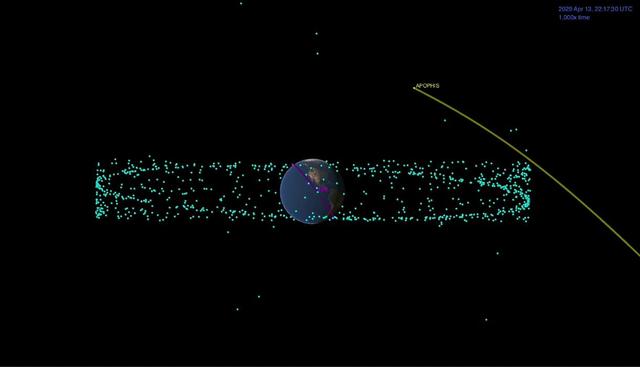
This animation shows the distance between the Apophis asteroid and Earth at the time of the asteroid's closest approach.
Ver en NASA ↗This illustration shows asteroid 2020 QG's trajectory bending during its close approach to Earth. The asteroid is the closest known non-impacting asteroid ever detected.
Ver en NASA ↗This diagram shows the orbit of binary asteroid Didymos around the Sun.
Ver en NASA ↗These three radar images of near-Earth asteroid 2003 SD220 were obtained on Dec. 15-17. This will be the asteroid's closest approach in more than 400 years and the closest until 2070.
Ver en NASA ↗Artist graphic of the asteroid belt, part of Dawn Mission Art series.
Ver en NASA ↗These two radar images of near-Earth asteroid 2003 SD220 were obtained on Dec. 18 and 19. The radar images reveal the asteroid is at least one mile (1.6 kilometers) long.
Ver en NASA ↗The circled streak in the center of this image is asteroid 2020 QG, which came closer to Earth than any other non-impacting asteroid on record.
Ver en NASA ↗This illustration, created in March 2021, depicts the 140-mile-wide (226-kilometer-wide) asteroid Psyche, which lies in the main asteroid belt between Mars and Jupiter.
Ver en NASA ↗This illustration, created in March 2021, depicts the 140-mile-wide (226-kilometer-wide) asteroid Psyche, which lies in the main asteroid belt between Mars and Jupiter.
Ver en NASA ↗This illustration shows how NASA's Psyche spacecraft will explore asteroid Psyche, starting with a high-altitude Orbit A and gradually lowering into Orbit D as it conducts its science investigation.
Ver en NASA ↗Artist's illustration of the trajectory of asteroid 2017 YE5 through the solar system. At its closest approach to Earth, the asteroid came to within 16 times the distance between Earth and the moon.
Ver en NASA ↗Artists concept of NASA's Asteroid Redirect Robotic (ARM) Mission capturing an asteroid boulder before redirecting it to a astronaut-accessible orbit around Earth's moon.
Ver en NASA ↗The asteroid Euphrosyne glides across a field of background stars in this time-lapse view from NASA WISE spacecraft. Euphrosyne is quite dark in visible light, but glows brightly at infrared wavelengths.
Ver en NASA ↗This animation depicts the motion of small near-Earth asteroid 2024 PT5 as it orbits the Sun.
Ver en NASA ↗This collage of radar images of near-Earth asteroid 1999 JD6 was collected by NASA scientists on July 25, 2015. The asteroid is between 660-980 feet 200-300 meters in diameter.
Ver en NASA ↗Illustrated in this artist concept are two possible structures for asteroid 2011 MD. NASA Spitzer infrared camera helped reveal that this asteroid consists of about two-thirds empty space.
Ver en NASA ↗Observations of infrared light from NASA Spitzer Space Telescope coming from asteroids provide a better estimate of their true sizes than visible-light measurements.
Ver en NASA ↗The six red dots in this composite picture indicate the location of the first new near-Earth asteroid, called 2013 YP139, as seen by NASA NEOWISE.
Ver en NASA ↗This radar image of asteroid 1999 RQ36 was obtained NASA Deep Space Network antenna in Goldstone, Calif. on Sept 23, 1999. NASA detects, tracks and characterizes asteroids and comets passing close to Earth using both ground- and space-based telescopes.
Ver en NASA ↗This image shows asteroids observed so far by NASA Wide-field Infrared Survey Explorer. An animation is available at the Photojournal.
Ver en NASA ↗These images and animation represent NASA radar observations of 4660 Nereus on December 10, 2021, before the asteroid's close approach on December 11, when it came within 2.5 million miles (4 million kilometers) of Earth.
Ver en NASA ↗The 230-foot 70-meter DSS-14 antenna at Goldstone, Ca. obtained these radar images of asteroid 2015 TB145 on Oct. 31, 2015.
Ver en NASA ↗This frame from a movie made from radar images of asteroid 1999 JD6, obtained on July 25, 2015. The asteroid is approximately 1.2 miles 2 kilometers on its long axis.
Ver en NASA ↗Contenido y metadatos proporcionados por la NASA Image and Video Library.