





/NASA’s%20Artemis%20III%20Announcement%20(Official%20NASA%20Trailer)~thumb.jpg)

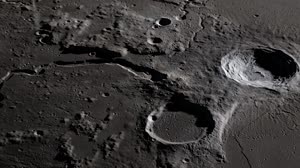
NASA MESSENGER spacecraft continued to speed toward Mercury, preparing for its closest approach to the planet on Monday, January 14, 2008.
Ver en NASA ↗🚀 Biblioteca espacial oficial
Imágenes y vídeos de NASA
Explora el catálogo multimedia público de NASA sin salir de TuPortalNews.
Explora temas destacados
Selecciona un tema o realiza una búsqueda personalizada.
2.907 resultados en NASA
This depiction of a simulated Mercury magnetosphere shows representations of the distortions of the planetary magnetic field lines blue by the solar wind.
Ver en NASA ↗President John F. Kennedy (left) visits Mercury's Flight Control Area a few days after John Glenn's flight in February 1962. To Kennedy's right are Glenn and astronaut Alan Shepard.
Ver en NASA ↗This high-resolution NAC image shows a view of Mercury dawn terminator, the division between the sunlit dayside and dark nightside of the planet, as seen as the MESSENGER spacecraft departed the planet during the mission second Mercury flyby.
Ver en NASA ↗The MASCS instrument onboard NASA MESSENGER spacecraft was designed to study both the exosphere and surface of Mercury in order to learn more about the minerals and surface processes on Mercury.
Ver en NASA ↗This image mosaic from NASA MESSENGER spacecraft shows an unnamed ridge in the northern volcanic plains of Mercury. Wrinkle ridges like this are interpreted to be tectonic in origin and are usually only found in volcanic plains.
Ver en NASA ↗NASA Mariner 10 took this picture of the densely cratered surface of Mercury when the spacecraft was 18,200 kilometers 8085 miles from the planet on March 29, 1974.
Ver en NASA ↗NASA MESSENGER prepares to perform the Mercury orbit insertion burn in this animated artist concept.
Ver en NASA ↗The scarp cutting through this crater was imaged as NASA MESSENGER approached the planet during the mission second Mercury flyby.
Ver en NASA ↗This frame from an animation shows a conceptual sketch of Mercury magnetosphere at the time of NASA MESSENGER spacecraft flyby.
Ver en NASA ↗This visible-infrared image shows an incoming view of Mercury, about 80 minutes before NASA MESSENGER spacecraft closest pass of the planet on January 14, 2008, from a distance of about 27,000 kilometers 17,000 miles.
Ver en NASA ↗During its flyby of Mercury, NASA MESSENGER spacecraft acquired high-resolution images of the planet surface. This image was obtained on January 14, 2008.
Ver en NASA ↗On January 14, 2008, NASA MESSENGER flew by Mercury and snapped images of a large portion of the surface that had not been previously seen by spacecraft including numerous craters.
Ver en NASA ↗This photograph shows the installation of a Mercury capsule and escape system on top of a booster prior to test firing of the Mercury-Redstone at Marshall Space Flight Center's (MSFC's) Redstone Test Stand. Assembled by MSFC, the Mercury-Redstone was designed…
Ver en NASA ↗Installation of the Mercury capsule on Redstone booster at the Redstone Test Stand. Assembled at the Marshall Space Flight Center (MSFC), the Mercury-Redstone launch vehicle was designed to place a marned space capsule into orbital flight around the Earth and…
Ver en NASA ↗Mercury Surface Has More Iron + Titanium Than Previously Thought
Ver en NASA ↗Mercury Izquierdo: An Impact Basin Newly Named for the Mexican Painter
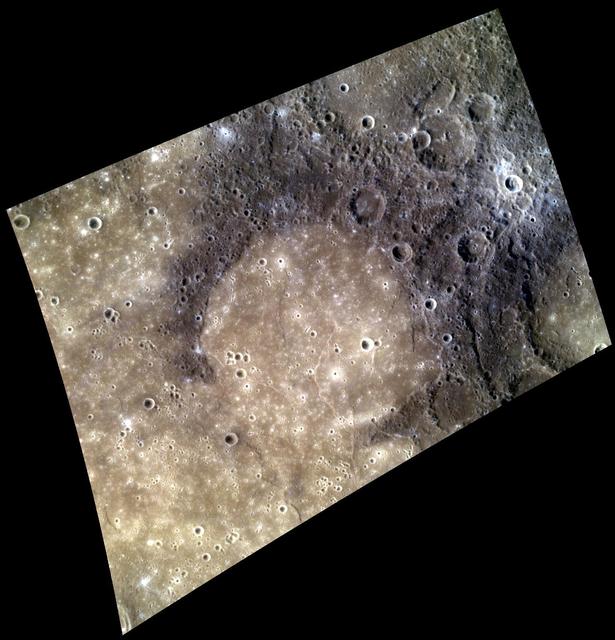
Ver en NASA ↗Peak-Ring Basin Close-Up from the Second Mercury Flyby
Ver en NASA ↗Mercury Flyby 3 Reveals a Highly Diminished Sodium Tail
Ver en NASA ↗First Mercury Laser Altimeter MLA Results from Orbit
Ver en NASA ↗Enwonwu: A Young Crater on Mercury Named for an African Modernist Artist
Ver en NASA ↗Mercury Caloris Basin, One of the Largest Impact Basins in the Solar System
Ver en NASA ↗The Highest-resolution Image from MESSENGER Second Mercury Flyby
Ver en NASA ↗MESSENGER Explores Interactions between Mercury Magnetosphere and the Solar Wind
Ver en NASA ↗Contenido y metadatos proporcionados por la NASA Image and Video Library.