





/NASA’s%20Artemis%20III%20Announcement%20(Official%20NASA%20Trailer)~thumb.jpg)
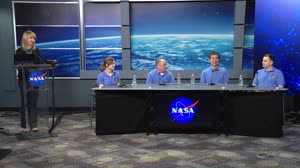

Panelists, from left, Jim Green, director, Planetary Science Division, NASA Headquarters, Washington, Carey Lisse, senior astrophysicist, Johns Hopkins University Applied Physics Laboratory, Laurel, Maryland, Kelly Fast, program scientist, Planetary Science D…
Ver en NASA ↗🚀 Biblioteca espacial oficial
Imágenes y vídeos de NASA
Explora el catálogo multimedia público de NASA sin salir de TuPortalNews.
Explora temas destacados
Selecciona un tema o realiza una búsqueda personalizada.
1.036 resultados en NASA
Panelists, from left, Jim Green, director, Planetary Science Division, NASA Headquarters, Washington, Carey Lisse, senior astrophysicist, Johns Hopkins University Applied Physics Laboratory, Laurel, Maryland, Kelly Fast, program scientist, Planetary Science D…
Ver en NASA ↗Panelists, from left, Jim Green, director, Planetary Science Division, NASA Headquarters, Washington, Carey Lisse, senior astrophysicist, Johns Hopkins University Applied Physics Laboratory, Laurel, Maryland, Kelly Fast, program scientist, Planetary Science D…
Ver en NASA ↗Five images of comet Siding Spring taken within a 35-minute period as it passed near Mars on Oct. 19, 2014, provide information about the size of the comet nucleus. The images were acquired by the HiRISE camera on NASA Mars Reconnaissance Orbiter.
Ver en NASA ↗This image shows the surface of comet Tempel 1 before and after NASA Deep Impact mission sent a probe into the comet in 2005. The region was imaged by Deep Impact before the collision left, then six years later on by NASA Stardust-NExT mission.
Ver en NASA ↗Superficially resembling a skyrocket, Comet ISON is hurtling toward the Sun at a whopping 48,000 miles per hour in this still from a Hubble animation.
Ver en NASA ↗This infrared image from NASA Spitzer Space Telescope shows the broken Comet 73P/Schwassman-Wachmann 3 skimming along a trail of debris left during its multiple trips around the sun.
Ver en NASA ↗This artist conception illustrates a storm of comets around a star near our own, called Eta Corvi. Evidence for this barrage comes from NASA Spitzer Space Telescope infrared detectors.
Ver en NASA ↗This very long exposure was taken by NASA Deep Space 1 to show detailed structures in the faint parts of comet Borrelly inner coma. As a result, the nucleus has been greatly over-exposed and its shape appears distorted.
Ver en NASA ↗These images from NASA Spitzer Space Telescope of C/2012 S1 Comet ISON were taken on June 13, when ISON was 310 million miles about 500 million kilometers from the sun.
Ver en NASA ↗This image illustrates one of several ways scientists have begun extracting comet particles from NASAa Stardust spacecraft collector. First, a particle and its track are cut out of the collector material, called aerogel.
Ver en NASA ↗ISS038-E-007980 (23 Nov. 2013) --- A close inspection of this image, photographed by one of the Expedition 38 crew members aboard the International Space Station, reveals a pin-head sized view of an object which is actually the comet ISON, seen just to the ri…
Ver en NASA ↗An image of the Comet C/2020 F3 NEOWISE (Comet NEOWISE) captured above the tree line of Lone Pine Lake, located on the Mount Whitney Trail in the Eastern Sierra Nevada Mountains in California. The photo was taken at 4:59 am on July 14, 2020. Visiting from the…
Ver en NASA ↗Dwayne Brown, NASA public affairs officer, left, moderates a media briefing where panelist, seated from left, Jim Green, director, Planetary Science Division, NASA Headquarters, Washington, Carey Lisse, senior astrophysicist, Johns Hopkins University Applied …
Ver en NASA ↗A comparison of two radargrams from the SHARAD instrument on NASA Mars Reconnaissance Orbiter shows effects on the Martian ionosphere from the close passage of a comet.
Ver en NASA ↗This is a composite photo, assembled from separate images of Jupiter and comet Shoemaker-Levy 9, as imaged by the NASA/ESA Hubble Space Telescope in 1994.
Ver en NASA ↗This graph of data from NASA Spitzer Space Telescope demonstrates that the dust around a nearby star called HD 69830 upper line has a very similar composition to that of Comet Hale-Bopp.
Ver en NASA ↗Over 1300 energy spectra taken on September 22, 2001 from the ion and electron instruments on NASA Deep Space 1 span a region of 1,400,000 kilometers 870,000 miles centered on the closest approach to the nucleus of comet Borrelly.
Ver en NASA ↗The solid nucleus of comet Borrelly is barely resolved in this image from NASA Deep Space 1, enhanced to reveal the highly collimated dust extending towards the bottom left corner of the picture.
Ver en NASA ↗This image, taken by NASA Deep Space 1 on September 22, 2001, has been enhanced to reveal dust being ejected from the nucleus of comet Borrelly. As a result, the nucleus is bright white in the image.
Ver en NASA ↗S73-37264 (November 1973) --- Graphical representation of Skylab instrumentation relationship of Comet Kohoutek to Spectral emissions. Photo credit: NASA
Ver en NASA ↗This artist concept illustrates a comet being torn to shreds around a dead star, or white dwarf, called G29-38. NASA Spitzer Space Telescope observed a cloud of dust around this white dwarf that may have been generated from comet disruption.
Ver en NASA ↗This graph shows changes in apparent brightness of comet C/2013 A1 Siding Spring as it approached and receded from Mars, as seen by the HiRISE camera on NASA Mars Reconnaissance Orbiter. The pattern suggests the comet rotates once every eight hours.
Ver en NASA ↗This artist concept shows NASA Mars orbiters lining up behind the Red Planet for their duck and cover maneuver to shield them from comet dust that may result from the close flyby of comet Siding Spring C/2013 A1 on Oct. 19, 2014.
Ver en NASA ↗Contenido y metadatos proporcionados por la NASA Image and Video Library.