





/NASA’s%20Artemis%20III%20Announcement%20(Official%20NASA%20Trailer)~thumb.jpg)

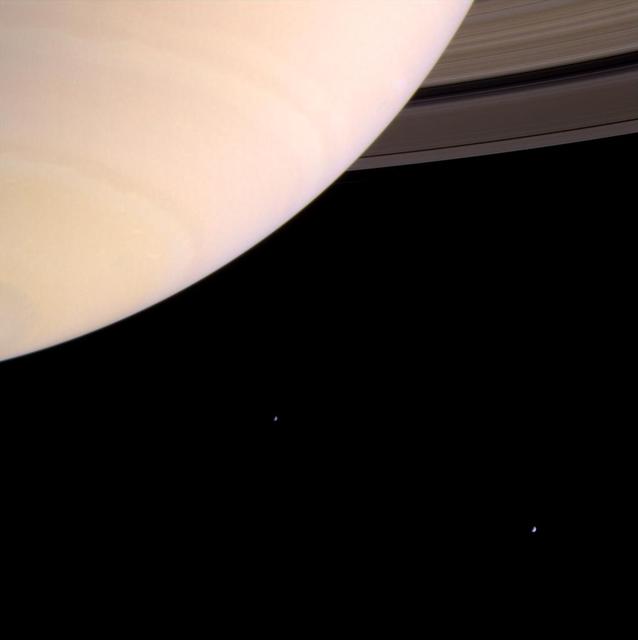
Saturn rings and small moon Prometheus obscure NASA Cassini spacecraft view of the planet second largest moon, Rhea. Prometheus can be seen just below the center of the image, in front of Rhea.
Ver en NASA ↗🚀 Biblioteca espacial oficial
Imágenes y vídeos de NASA
Explora el catálogo multimedia público de NASA sin salir de TuPortalNews.
Explora temas destacados
Selecciona un tema o realiza una búsqueda personalizada.
19.951 resultados en NASA
NASA Cassini spacecraft captures a mutual event between Titan and Mimas in front of a backdrop of the planet rings. This image was snapped shortly before Saturn largest moon passed in front of and occulted the small moon Mimas.
Ver en NASA ↗These six images from NASA Mars rover Curiosity show the two moons of Mars moments before left three and after right three the larger moon, Phobos, occulted Deimos on Aug. 1, 2013.
Ver en NASA ↗NASA Cassini spacecraft looks toward the dark region of Belet on Saturn largest moon, Titan. This large region on the moon has a low albedo, meaning it diffusely reflects little light.
Ver en NASA ↗Saturn fourth-largest moon, Dione, can be seen through the haze of the planet largest moon, Titan, in this view of the two posing before the planet and its rings from NASA Cassini spacecraft.
Ver en NASA ↗The oblate shape of the moon Iapetus is particularly noticeable in this portrait; the two-toned surface of the moon Iapetus also stands out against the darkness of space in this image taken by NASA Cassini spacecraft.
Ver en NASA ↗The small moon Janus overtakes the larger moon Rhea in a dance played out before Saturn and its rings in this image taken by NASA Cassini spacecraft. Go to the Photojournal to view the animation.
Ver en NASA ↗Two moons orbit serenely before Saturn while large storms churn through the planet southern hemisphere in this image taken by NASA Cassini spacecraft. The moon Mimas is on the right. Dione is on the left.
Ver en NASA ↗This plot shows the variation in brightness of the plume of material, composed of all the geysers erupting from the south polar terrain of Saturn moon Enceladus, as a function of the moon orbital position around Saturn.
Ver en NASA ↗Saturn moon Tethys, with its stark white icy surface, peeps out from behind the larger, hazy, colorful Titan in this view of the two moons obtained by NASA Cassini spacecraft. Saturn rings lie between the two.
Ver en NASA ↗Saturn moon Dione hangs in front of Saturn rings in this view taken by NASA Cassini spacecraft during the inbound leg of its last close flyby of the icy moon.
Ver en NASA ↗Saturn rings occupy the foreground of this image captured by NASA Cassini spacecraft. The small moon Janus appears to hover above, while the far larger moon Rhea is partially obscured by the rings.
Ver en NASA ↗Saturn rings, partially darkened by the planet shadow, cut a striking figure before Saturn largest moon, Titan. The moon Mimas is near the bottom of this image taken by NASA Cassini spacecraft.
Ver en NASA ↗Saturn moon Mimas peeks out from behind the night side of the larger moon Dione in this image captured by NASA Cassini spacecraft during the Dione flyby of Dec. 12, 2011.
Ver en NASA ↗Saturn rings cast wide shadows on the planet, and the shadow of a moon also graces the gas giant in this scene from NASA Cassini spacecraft. The moon Enceladus is not shown in this view, but it does cast a small, elongated shadow.
Ver en NASA ↗NASA New Horizons spacecraft captured these images of Pluto moon Nix which shows a reddish spot that has attracted the interest of the mission scientists left, and the small, irregularly shaped moon Hydra right.
Ver en NASA ↗The small moon Janus is almost hidden between the planet rings and the larger moon Rhea in this image captured by NASA Cassini spacecraft. The northern part of Janus can be seen peeking above the rings.
Ver en NASA ↗NASA Cassini spacecraft watches Pandora, one of the F ring two shepherding moons, orbiting beyond the thin ring; the small moon can be seen on the left of this image.
Ver en NASA ↗Saturn small, potato-shaped moon Prometheus appears embedded within the planet rings near the center of this view from NASA Cassini spacecraft while the larger moon Mimas orbits beyond the rings.
Ver en NASA ↗NASA Cassini imaging scientists processed this view of Saturn moon Hyperion, taken during a close flyby on May 31, 2015. This flyby marks the mission final close approach to Saturn largest irregularly shaped moon.
Ver en NASA ↗NASA Cassini spacecraft composition features Saturn rings top of image, its second largest moon, Rhea on right of image, and one of the planet tiny moons, Telesto near the middle of image appears as a bright speck.
Ver en NASA ↗Pandora and Prometheus, the shepherding moons of the F ring, orbit inside and outside the thin ring. The elongated, potato-like shapes of the two moons are both visible in this image taken by NASA Cassini spacecraft.
Ver en NASA ↗Earth observation taken by the Expedition 35 crew aboard the ISS. The Moon and Canadarm2 Space Station Remote Manipulator System (SSRMS) are in view.
Ver en NASA ↗CAPE CANAVERAL, Fla. -- The Astronaut Scholarship Foundation helps celebrate the 40th anniversary of Apollo 16's lunar landing, which occurred April 20, 1972, with a soiree at the Kennedy Space Center Visitor Complex's Saturn V Center. Panel members who addre…
Ver en NASA ↗Contenido y metadatos proporcionados por la NASA Image and Video Library.