





/NASA’s%20Artemis%20III%20Announcement%20(Official%20NASA%20Trailer)~thumb.jpg)

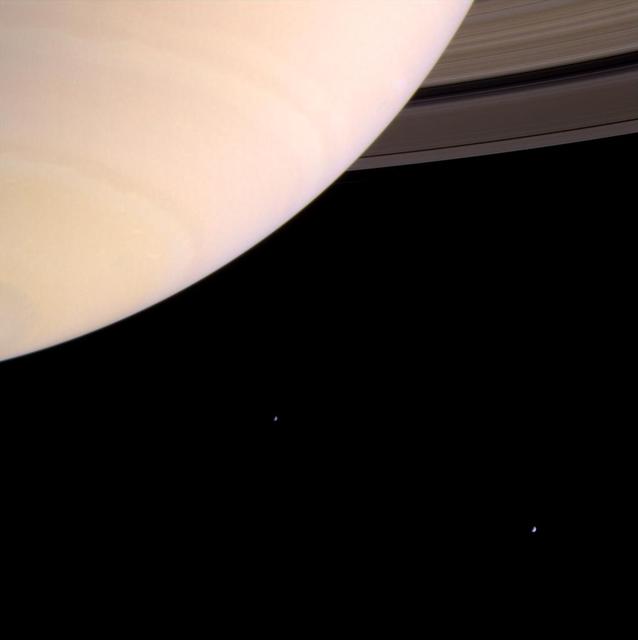
Saturn moon Tethys with its prominent Odysseus Crater silently slips behind Saturn largest moon Titan and then emerges on the other side in this image taken by NASA Cassini spacecraft.
Ver en NASA ↗🚀 Biblioteca espacial oficial
Imágenes y vídeos de NASA
Explora el catálogo multimedia público de NASA sin salir de TuPortalNews.
Explora temas destacados
Selecciona un tema o realiza una búsqueda personalizada.
19.951 resultados en NASA
Saturn rings lie between a pair of moons in this view from NASA Cassini spacecraft that features Mimas and Prometheus. Mimas is the more noticeable of the two moons at top left, Prometheus is near the center of image and closest to Cassini.
Ver en NASA ↗NASA Cassini spacecraft takes a close look at a row of craters on Saturn moon Tethys during the spacecraft April 14, 2012, flyby of the moon. Three large craters are visible along the terminator between day and night on Tethys.
Ver en NASA ↗While the moon Epimetheus passes by, beyond the edge of Saturn main rings, the tiny moon Daphnis carries on its orbit within the Keeler gap of the A ring in this image from NASA Cassini spacecraft.
Ver en NASA ↗Subtle color differences on Saturn moon Mimas are apparent in this false-color view of Herschel Crater captured during NASA Cassini spacecraft on its closest-ever flyby of that moon.
Ver en NASA ↗This view from NASA Cassini spacecraft look toward the south polar region of Saturn largest moon, Titan, and show a depression within the moon orange and blue haze layers near the south pole.
Ver en NASA ↗During its examination of the asteroid Ida, NASA Galileo spacecraft returned images of a second object, Dactyl--the first confirmed satellite or moon of an asteroid; the much smaller moon is visible to the right of Ida.
Ver en NASA ↗These three enhanced-color views of an equatorial region on Saturn moon Rhea were made from data obtained by NASA Cassini spacecraft. The colors have been enhanced to show colorful splotches and bands on the icy moon surface.
Ver en NASA ↗Small water ice particles fly from fissures in the south polar region of Saturn moon Enceladus in this image taken during the Aug. 13, 2010, flyby of the moon by NASA Cassini spacecraft.
Ver en NASA ↗Saturn moon Dione coasts along in its orbit appearing in front of its parent planet in this view from NASA Cassini spacecraft. The wispy terrain on the trailing hemisphere of Dione can be seen on the left of the moon here.
Ver en NASA ↗NASA Cassini spacecraft stared toward Saturn two-toned moon Iapetus for about a week in early 2015, in a campaign motivated in part to investigate subtle color differences within the moon bright terrain.
Ver en NASA ↗Saturn moon Enceladus, seen beyond the outline of the planet night side, spews water ice from its south polar region. The plumes can be faintly seen at the bottom of the moon in this image from NASA Cassini spacecraft.
Ver en NASA ↗The shepherd moon Pan orbits Saturn in the Encke gap while the A ring surrounding the gap displays wave features created by interactions between the ring particles and Saturnian moons in this image from NASA Cassini spacecraft.
Ver en NASA ↗Relatively dark regions below bright crater walls and streaks on some of the walls are seen in this mosaic of Saturn moon Mimas, created from images taken by NASA Cassini spacecraft during its closest flyby of the moon.
Ver en NASA ↗In this view captured by NASA Cassini spacecraft on its closest-ever flyby of Saturn moon Mimas, large Herschel Crater dominates Mimas, making the moon look like the Death Star in the movie Star Wars.
Ver en NASA ↗The irregularly shaped moon Janus keeps up its lonely orbit as seen by NASA Cassini spacecraft. Even though Janus shares its orbit with the moon Epimetheus, they never get very close to one another.
Ver en NASA ↗NASA Cassini imaging scientists processed this view of Saturn moon Hyperion, taken during a close flyby on May 31, 2015. This flyby marks the mission final close approach to Saturn largest irregularly shaped moon.
Ver en NASA ↗This enhanced-color view of Saturn moon Mimas was made from images obtained by NASA Cassini spacecraft. It highlights the bluish band around the icy moon equator. The large round gouge on the surface is Herschel Crater.
Ver en NASA ↗The famed wispy terrain on Saturn moon Dione is front and center in this recent image captured by NASA Cassini spacecraft. The wisps are fresh fractures on the trailing hemisphere of the moon icy surface.
Ver en NASA ↗Artist rendering of NASA Galileo spacecraft flying past Jupiter moon Io. Galileo made multiple close approaches to the volcanically active moon during its time at Jupiter.
Ver en NASA ↗Saturn moon Enceladus brightly reflects sunlight before a backdrop of the planet rings and the rings shadows cast onto the planet. NASA Cassini spacecraft captured this snapshot during its flyby of the moon on Nov. 30, 2010.
Ver en NASA ↗Titan, Saturn largest moon and Mimas in the foreground are seen together in this view from Cassini. Titan gravity is weaker than Earth, so the moon atmosphere is quite extended -- a quality hinted at in this view
Ver en NASA ↗Saturn moon Dione, in the foreground of this image from NASA Cassini spacecraft, appears darker than the moon Tethys. Tethys appears brighter because it has a higher albedo than Dione, meaning Tethys reflects more sunlight.
Ver en NASA ↗A crescent Enceladus appears with Saturn rings in this view of the moon from NASA Cassini spacecraft. The famed jets of water ice emanating from the south polar region of the moon are faintly visible here.
Ver en NASA ↗Contenido y metadatos proporcionados por la NASA Image and Video Library.