





/NASA’s%20Artemis%20III%20Announcement%20(Official%20NASA%20Trailer)~thumb.jpg)

This stunning false-color view of Saturn moon Hyperion reveals crisp details across the strange, tumbling moon surface. The view was obtained during NASA Cassini close flyby on Sept. 26, 2005.
Ver en NASA ↗🚀 Biblioteca espacial oficial
Imágenes y vídeos de NASA
Explora el catálogo multimedia público de NASA sin salir de TuPortalNews.
Explora temas destacados
Selecciona un tema o realiza una búsqueda personalizada.
19.951 resultados en NASA
The moon Enceladus passes behind the larger moon Tethys, as seen in this pair of images taken by NASA Cassini spacecraft. The image on the left was taken a little more than a minute before the image on the right.
Ver en NASA ↗The brightly reflective moon Enceladus appears before Saturn rings while the larger moon Titan looms in the distance. Jets of water ice and vapor emanating from the south pole of Enceladus hinting at subsurface sea rich in organics.
Ver en NASA ↗Saturn moon Rhea passes in front of Dione, as seen from NASA Cassini spacecraft. These images are part of a mutual event sequence in which one moon passes close to, or in front of, another.
Ver en NASA ↗The moon Rhea moves behind Saturn largest moon, Titan, in this mutual event imaged by NASA Cassini spacecraft. Part of Rhea southern hemisphere is also visible here through the haze of Titan atmosphere.
Ver en NASA ↗This cutaway view of Saturn moon Enceladus is an artist rendering that depicts possible hydrothermal activity that may be taking place on and under the seafloor of the moon subsurface ocean, based on published results from NASA Cassini mission.
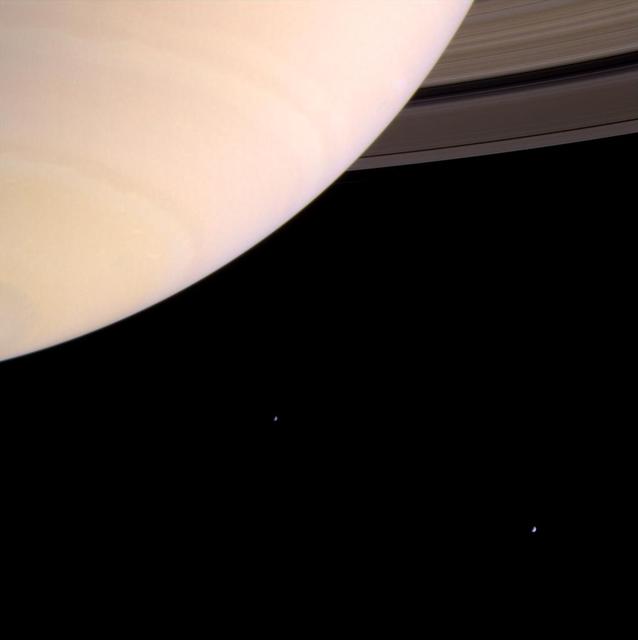
Ver en NASA ↗Two moons, Rhea and Dione, join the planet and its rings in this view from NASA Cassini spacecraft. Rhea and Dione are respectively the second and fourth largest moons of Saturn, but they are tiny compared to the planet.
Ver en NASA ↗This view of Jupiter moon Europa features several regional-resolution mosaics overlaid on a lower resolution global view for context. The regional views were obtained during several different flybys of the moon by NASA Galileo mission.
Ver en NASA ↗The great basin that interrupts the contours of this moon crescent identifies the satellite unmistakably as Mimas. The giant crater Herschel 130 kilometers, or 80 miles wide is this moon most obvious feature
Ver en NASA ↗From a distant perspective, NASA Cassini spacecraft sees hints of the unusual surface of Saturn moon Enceladus, a moon where new terrain is created around a geologically active south polar region.
Ver en NASA ↗NASA Cassini spacecraft captured this view of Saturn moon Epimetheus 116 kilometers, or 72 miles across during a moderately close flyby on Dec. 6, 2015. This is one of Cassini highest resolution views of the small moon.
Ver en NASA ↗Saturn small, ring-embedded moon Pan, on the extreme right of this NASA Cassini spacecraft image, can be seen interacting with the ringlets that share the Encke Gap of the A ring with this moon.
Ver en NASA ↗NASA Cassini spacecraft looks toward Saturn largest moon, Titan, and spies the huge Kraken Mare in the moon north. Kraken Mare, a large sea of liquid hydrocarbons, is visible as a dark area near the top of the image.
Ver en NASA ↗It difficult not to think of an egg when looking at Saturn moon Methone, seen here during NASA Cassini flyby of the small moon. The relatively smooth surface adds to the effect created by the oblong shape.
Ver en NASA ↗Saturn moon Rhea looms over a smaller and more distant Epimetheus against a striking background of planet and rings. The two moons arent actually close to each other.
Ver en NASA ↗NASA Cassini spacecraft peers through the atmosphere of Saturn largest moon, Titan, to examine the dark region Belet. This large region on the moon surface has a low albedo, meaning it reflects little light.
Ver en NASA ↗The shadow of Saturn moon Mimas is elongated across the planet in this image from NASA Cassini spacecraft. The moon itself is not shown, but the shadow appears just above the ringplane on the right of the image.
Ver en NASA ↗The south polar region of Saturn active, icy moon Enceladus awaits NASA Cassini spacecraft in this view, acquired on approach to the mission deepest-ever dive through the moon plume of icy spray.
Ver en NASA ↗Saturn moon Daphnis, appearing as a tiny speck in the Keeler Gap of the A ring on the far right of this NASA Cassini spacecraft image, is almost lost among the moon attendant edge waves.
Ver en NASA ↗NASA Cassini spacecraft looks toward the dark side of Saturn largest moon as a circle of light is produced by sunlight scattering through the periphery of Titan atmosphere. A detached, high-altitude global haze layer encircles the moon.
Ver en NASA ↗Darkness sweeps over Iapetus as the Cassini spacecraft watches the shadow of Saturn B ring engulf the dichotomous moon. The image at left shows the unshaded moon, while at right, Iapetus sits in the shadow of the densest of Saturn rings
Ver en NASA ↗The small moon Mimas passes in front of the larger moon Rhea which is partly obscured by Saturn rings in this image from NASA Cassini spacecraft. Go to the Photojournal to view the animation.
Ver en NASA ↗Hemispheric color differences on Saturn moon Rhea are apparent in this false-color view from NASA Cassini spacecraft. This image shows the side of the moon that always faces the planet.
Ver en NASA ↗An illuminated quarter of the moon Tethys is imaged near a swath of Saturn rings. Though the moon appears to be hanging directly below the rings, Tethys is actually farther from NASA Cassini spacecraft, and the rings are in the foreground.
Ver en NASA ↗Contenido y metadatos proporcionados por la NASA Image and Video Library.