






/NASA’s%20Artemis%20III%20Announcement%20(Official%20NASA%20Trailer)~thumb.jpg)

NASA’s Space Launch System (SLS) rocket with the Orion spacecraft aboard is seen atop the mobile launcher at Launch 39B at NASA’s Kennedy Space Center in Florida. Artemis I mission is the first integrated test of the agency’s deep space exploration systems: t…
Ver en NASA ↗🚀 Biblioteca espacial oficial
Imágenes y vídeos de NASA
Explora el catálogo multimedia público de NASA sin salir de TuPortalNews.
Explora temas destacados
Selecciona un tema o realiza una búsqueda personalizada.
19.951 resultados en NASA
NASA’s Space Launch System (SLS) rocket with the Orion spacecraft aboard is seen atop the mobile launcher at Launch 39B at NASA’s Kennedy Space Center in Florida. Artemis I mission is the first integrated test of the agency’s deep space exploration systems: t…
Ver en NASA ↗NASA’s Space Launch System (SLS) rocket with the Orion spacecraft aboard is seen atop the mobile launcher at Launch 39B at NASA’s Kennedy Space Center in Florida. Artemis I mission is the first integrated test of the agency’s deep space exploration systems: t…
Ver en NASA ↗NASA’s Space Launch System (SLS) rocket with the Orion spacecraft aboard is seen atop the mobile launcher at Launch 39B at NASA’s Kennedy Space Center in Florida. Artemis I mission is the first integrated test of the agency’s deep space exploration systems: t…
Ver en NASA ↗A golden sunrise surrounds NASA’s Space Launch System and Orion spacecraft for Artemis I on the pad at Launch Complex 39B at NASA’s Kennedy Space Center in Florida on Aug. 22, 2022. Launch of Artemis I is scheduled for no earlier than Aug. 29, 2022, at 8:33 a…
Ver en NASA ↗A sunrise view of NASA’s Space Launch System and Orion spacecraft for Artemis I on the pad at Launch Complex 39B at NASA’s Kennedy Space Center in Florida on Aug. 22, 2022. Launch of Artemis I is scheduled for no earlier than Aug. 29, 2022, at 8:33 a.m. EDT. …
Ver en NASA ↗A sunrise view of NASA’s Space Launch System and Orion spacecraft for Artemis I on the pad at Launch Complex 39B at NASA’s Kennedy Space Center in Florida on Aug. 22, 2022. Launch of Artemis I is scheduled for no earlier than Aug. 29, 2022, at 8:33 a.m. EDT. …
Ver en NASA ↗Artemis II deputy lunar science lead, Jacob Richardson, celebrates with a dance after hearing astronauts describe seeing impact flashes on the Moon during their lunar flyby on April 6, 2026. Richardson was monitoring the flyby from the Science Evaluation Room…
Ver en NASA ↗A half Moon illuminates the sky after the launch of NASA’s Space Launch System and Orion spacecraft on Artemis I from Launch Complex 39B at Kennedy Space Center in Florida on Nov. 16, 2022. Liftoff was at 1:47 a.m. EST. The first in a series of increasingly c…
Ver en NASA ↗CAPE CANAVERAL, Fla. – At Astrotech Space Operations in Titusville, Fla., technicians begin placing the protective bag around the Lunar Reconnaissance Orbiter, or LRO, before it is mated with NASA's Lunar CRater Observation and Sensing Satellite, known as LC…
Ver en NASA ↗CAPE CANAVERAL, Fla. – At Astrotech Space Operations in Titusville, Fla., technicians place the protective bag around the Lunar Reconnaissance Orbiter, or LRO, before it is mated with NASA's Lunar CRater Observation and Sensing Satellite, known as LCROSS, spa…
Ver en NASA ↗CAPE CANAVERAL, Fla. – At Astrotech Space Operations in Titusville, Fla., technicians remove the bag that will be placed over the Lunar Reconnaissance Orbiter, or LRO, before it is mated with NASA's Lunar CRater Observation and Sensing Satellite, known as LC…
Ver en NASA ↗CAPE CANAVERAL, Fla. – At Astrotech Space Operations in Titusville, Fla., technicians complete placing the protective bag around the Lunar Reconnaissance Orbiter, or LRO, before it is mated with NASA's Lunar CRater Observation and Sensing Satellite, known as…
Ver en NASA ↗This image is a simulation of how NASA's Europa Clipper will understand which areas of the Jovian moon Europa are warm and active by studying the moon's thermal emissions.
Ver en NASA ↗NASA Cassini spacecraft captured a three-dimensional view of the large Herschel Crater on Saturn moon Mimas during its closest-ever flyby of the moon. 3D glasses are needed to view this image.
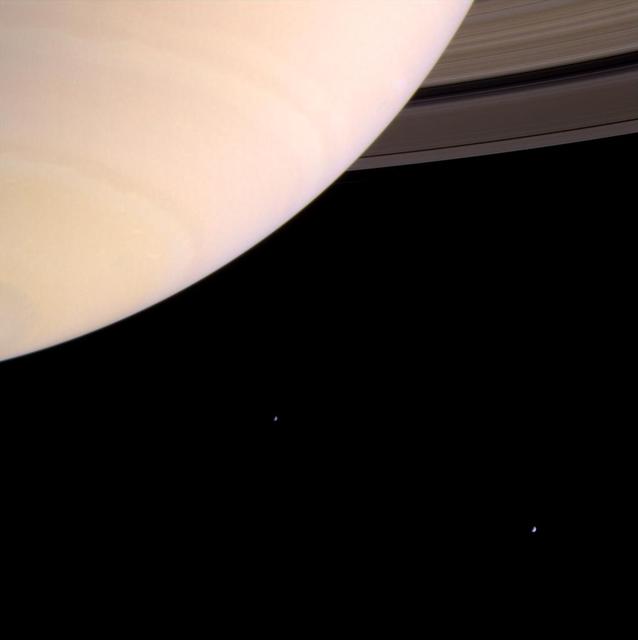
Ver en NASA ↗Saturn second largest moon Rhea pops in and out of view behind the planet rings in this image from NASA Cassini spacecraft, which includes the smaller moon Epimetheus.
Ver en NASA ↗The shadow of Saturn moon Dione, cast onto the planet, is elongated in dramatic fashion in this image captured by NASA Cassini spacecraft. The moon itself does not appear here, but the shadow can be seen south of the ringplane.
Ver en NASA ↗This series of images from NASA Cassini spacecraft shows changes on the surface of Saturn moon Titan, as the transition to northern spring brings methane rains to the moon equatorial latitudes.
Ver en NASA ↗The Encke Gap moon, Pan, has left its mark on a scalloped ringlet of the Encke Gap. The moon creates these perturbations as it sweeps through the 325-kilometer 200-mile gap in the A ring
Ver en NASA ↗Contenido y metadatos proporcionados por la NASA Image and Video Library.