





/NASA’s%20Artemis%20III%20Announcement%20(Official%20NASA%20Trailer)~thumb.jpg)

NASA's Curiosity Mars rover captured these sun rays shining through clouds at sunset on Feb. 2, 2023. It was the first time that sun rays, also known as crepuscular rays, have been viewed so clearly on Mars.
Ver en NASA ↗🚀 Biblioteca espacial oficial
Imágenes y vídeos de NASA
Explora el catálogo multimedia público de NASA sin salir de TuPortalNews.
Explora temas destacados
Selecciona un tema o realiza una búsqueda personalizada.
6.531 resultados en NASA
NASA's Solar Dynamics Observatory observed a small eruption on Oct. 18, 2017. The source of the blast was just out of sight beyond the edge of the sun.
Ver en NASA ↗NASA's Solar Dynamics Observatory observed s sheet of plasma blasted out into space from just behind the edge of the sun on July 28, 2017.
Ver en NASA ↗These banana-shaped loops are part of a computer-generated snapshot of our sun's magnetic field. The solar magnetic-field lines loop through the sun's corona, break through the sun's surface, and cornect regions of magnetic activity, such as sunspots. This im…
Ver en NASA ↗This image from NASA's Solar Dynamics Observatory shows a prominence at the sun's edge shifted and slithered back and forth over a one-day period on Nov. 29-30, 2017.
Ver en NASA ↗NASA's Solar Dynamics Observatory captured these images showing the sun from its surface to its upper atmosphere in order of temperature, all taken at about the same time on Oct. 27, 2017.
Ver en NASA ↗The panoramic camera on NASA Opportunity combines the first photographs of solar eclipses by Mars two moons, Deimos and Phobos. Deimos appears as a speck in front of the Sun and Phobos grazes its edge.
Ver en NASA ↗A large, dark coronal hole at the bottom of the Sun has been the most dominant feature this week Jan. 29, 2014 as seen by NASA GSFC Solar Dynamics Observatory.
Ver en NASA ↗The sun emitted a mid-level solar flare, peaking at 3:01 p.m. EDT on Oct. 2, 2014. NASA's Solar Dynamics Observatory, which watches the sun 24-hours a day, captured images of the flare. Solar flares are powerful bursts of radiation. Harmful radiation from a f…
Ver en NASA ↗Comet ISON makes its appearance into the higher-resolution HI-1 camera on the STEREO-A spacecraft. The dark "clouds" coming from the right are density enhancements in the solar wind, causing all the ripples in comet Encke's tail. These kinds of sola…
Ver en NASA ↗A prominence at the edge of the sun provided NASA's Solar Dynamics Observatory with a splendid view of solar plasma as it churned and streamed over less than one day (June 25-26, 2017).
Ver en NASA ↗NASA's Solar Dynamics Observatory shows the Sun's rotation bringing a new active region into view, revealing the dynamic arches and twisting streams of its magnetic field (Oct. 10-11, 2018).
Ver en NASA ↗Vandenberg Air Force Base, Calif. – Inside a processing facility at Vandenberg Air Force Base in California, technicians prepare the wing for a fit check with the Orbital Sciences Pegasus XL launch vehicle. NASA’s Interface Region Imaging Spectrograph, or …
Ver en NASA ↗Vandenberg Air Force Base, Calif. – Inside a processing facility at Vandenberg Air Force Base in California, technicians prepare the wing for a fit check with the Orbital Sciences Pegasus XL launch vehicle. NASA’s Interface Region Imaging Spectrograph, or …
Ver en NASA ↗NASA's Solar Dynamics Observatory captured an elongated coronal hole rotated across the face of the sun this past week so that it is now streaming solar wind towards Earth Jan. 2-5, 2017.
Ver en NASA ↗A small prominence observed in profile arched up and sent streams of plasma curling back into the sun over a 30-hour period on Dec. 13-14, 2017 by NASA's Solar Dynamics Observatory.
Ver en NASA ↗Between Jan. 30-Feb. 2, 2017, NASA's Solar Dynamics Observatory saw a substantial coronal hole rotating across the face of the sun this past week and is again streaming solar wind towards Earth.
Ver en NASA ↗Two good-sized coronal holes have rotated around to the center of the sun where they will be spewing solar wind towards Earth were observed by NASA's Solar Dynamics Observatory on Nov. 8-9, 2016.
Ver en NASA ↗NASA's Solar Dynamics Observatory observed a solar prominence gathering itself into a twisting cone, then rose up and broke apart in a delicate dance of plasma above the sun on Feb. 20, 2017.
Ver en NASA ↗Several times a day for a few days this week the Earth completely blocked the Sun for about an hour due to NASA's Solar Dynamics Observatory orbital path Aug. 25, 2016.
Ver en NASA ↗NASA's Solar Dynamics Observatory observes two relatively small prominences above the Sun's surface twisted and streamed charged particles over a 20-hour period July 30-31, 2018.
Ver en NASA ↗NASA's Solar Dynamics Observatory observed a prominence rising up above the sun, sending an arch of plasma to link up magnetically with an active region over a one-day period (Jan, 9-10, 2017).
Ver en NASA ↗NASA's Solar Dynamics Observatory observed a small prominence hovered above the sun's surface over a two-day period June 12-14, 2018, before breaking off into space.
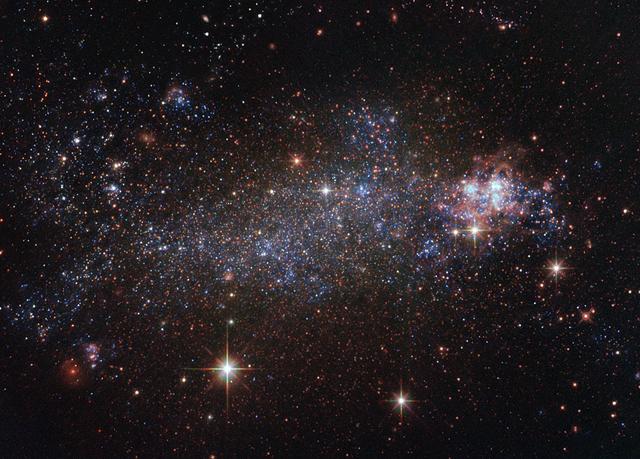
Ver en NASA ↗This image, taken by NASA Hubble Space Telescope, shows the colorful last hurrah of a star like our Sun. The star is ending its life by casting off its outer layers of gas, which formed a cocoon around the star remaining core.
Ver en NASA ↗Contenido y metadatos proporcionados por la NASA Image and Video Library.