






/NASA’s%20Artemis%20III%20Announcement%20(Official%20NASA%20Trailer)~thumb.jpg)

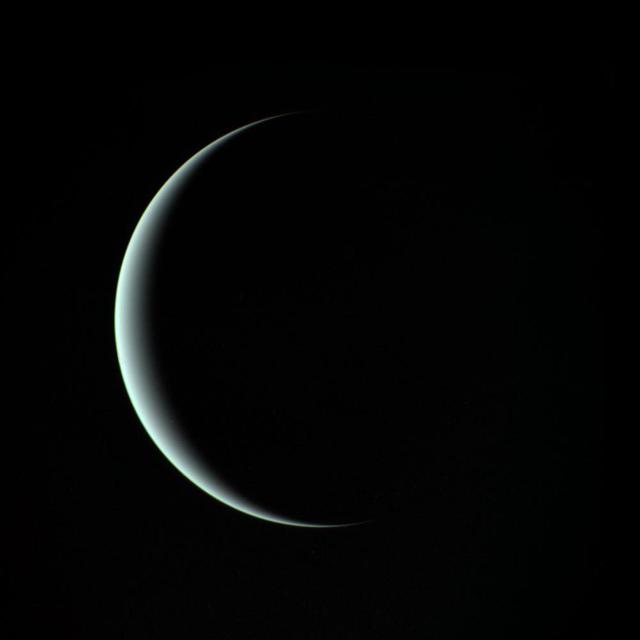
Saturn, which appears as only a thin, lit crescent, broken only by the shadows of its rings, poses gracefully for NASA Cassini spacecraft cameras.
Ver en NASA ↗🚀 Biblioteca espacial oficial
Imágenes y vídeos de NASA
Explora el catálogo multimedia público de NASA sin salir de TuPortalNews.
Explora temas destacados
Selecciona un tema o realiza una búsqueda personalizada.
4.237 resultados en NASA
Brooding Saturn seems to be missing its rings, but their shadows on the planet betray their presence. The inner rings are in fact contained within this scene, but they are so tenuous as to be nearly invisible
Ver en NASA ↗Surely one of the most gorgeous sights the solar system has to offer, Saturn sits enveloped by the full splendor of its stately rings
Ver en NASA ↗NASA's Cassini spacecraft took a series of exposures of Saturn and its rings and moons on February 9, 2004, which were composited to create this stunning, color image. At the time, Cassini was 69.4 million kilometers (43.1 million miles) from Saturn.
Ver en NASA ↗Like a giant eye for the giant planet, Saturn great vortex at its north pole appears to stare back at Cassini as NASA Cassini spacecraft stares at it.
Ver en NASA ↗Although only a sliver of Saturn sunlit face is visible in this view, the mighty gas giant planet still dominates the view captured by NASA's Cassini spacecraft.
Ver en NASA ↗This illustration depicts the shearing of an initially circular cloud of debris as a result of the particles in the cloud having differing orbital speeds around Saturn.
Ver en NASA ↗This false-color composite image, constructed from data obtained by NASA Cassini spacecraft, shows Saturn rings and southern hemisphere.
Ver en NASA ↗This collage includes about 1,600 images submitted by members of the public as part of the NASA Cassini mission Wave at Saturn campaign.
Ver en NASA ↗This animation depicts the shearing of an initially circular cloud of debris as a result of the particles in the cloud having differing orbital speeds around Saturn.
Ver en NASA ↗This chart provides a launch summary of the Saturn IB launch vehicle as of 1973. Developed by the Marshall Space Flight Center (MSFC) as an interim vehicle in MSFC's "building block" approach to the Saturn rocket development, the Saturn IB utilized Saturn I t…
Ver en NASA ↗This 1968 chart depicts the various mission configurations for the Saturn IB launch vehicle. Developed by the Marshall Space Flight Center (MSFC) as an interim vehicle in MSFC's "building block" approach to the Saturn rocket development, the Saturn IB utilize…
Ver en NASA ↗This 1968 chart illustrates the characteristics and proposed missions for the Saturn IB launch vehicle. Developed by the Marshall Space Flight Center (MSFC) as an interim vehicle in MSFC's "building block" approach to the Saturn rocket development, the Saturn…
Ver en NASA ↗This view captured by NASA's Cassini spacecraft shows Saturn northern hemisphere in 2016, as that part of the planet nears its northern hemisphere summer solstice in May 2017. Saturn year is nearly 30 Earth years long.
Ver en NASA ↗Saturn many cloud patterns, swept along by high-speed winds, look as if they were painted on by some eager alien artist in this image from NASA Cassini spacecraft.
Ver en NASA ↗Bands and spots in Saturn's atmosphere, including a dark band south of the equator with a scalloped border, are visible in this image from NASA's Cassini-Huygens spacecraft.
Ver en NASA ↗Saturn's graceful lanes of orbiting ice (its iconic rings) wind their way around the planet to pass beyond the horizon in this view from NASA's Cassini spacecraft.
Ver en NASA ↗Saturn moon Mimas casts a elliptical shadow on the planet south of the larger, wider shadows cast by the planet rings. Mimas and the rings are not shown in this image captured by NASA Cassini spacecraft.
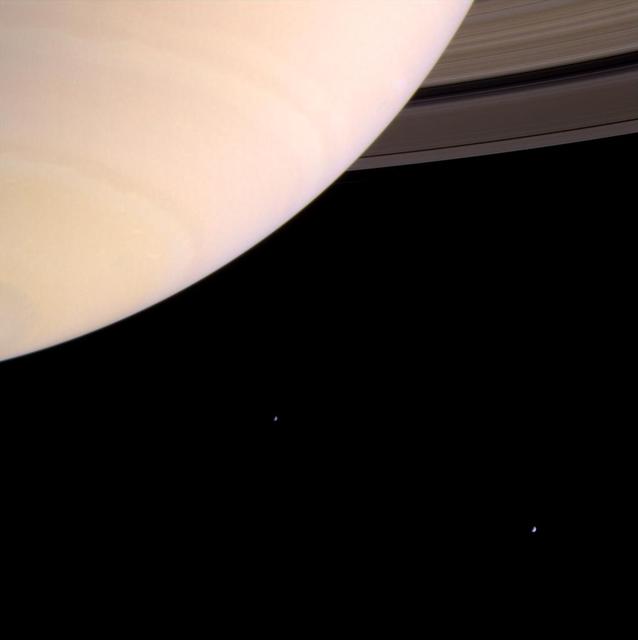
Ver en NASA ↗Compared to the gas giant, the two moons shown on either side of Saturn seem particularly small in this view from NASA Cassini spacecraft. Tethys and Pandora are also present but barely visible.
Ver en NASA ↗The Cassini spacecraft takes an angled view toward Saturn, showing the southern reaches of the planet with the rings on a dramatic diagonal. The moon Enceladus appears as a small, bright speck in the lower left of the image.
Ver en NASA ↗The night skies of Saturn are graced by the planet dazzling rings, but as this image shows, one view could be very different depending on the season and from which hemisphere one gazes up
Ver en NASA ↗Saturn, stately and resplendent in this natural color view taken by NASA Cassini spacecraft, dwarfs the icy moon Rhea. Rhea orbits beyond the rings on the right of the image. Tethys shadow is visible on the planet on the left of the image.
Ver en NASA ↗Saturn winds race furiously around the planet, blowing at high speeds which form distinct belts and zones which encircle the planet pole, as well as its famous hexagon as seen in this image from NASA Cassini spacecraft.
Ver en NASA ↗This undated chart provides a description of the Saturn IB and Saturn V's Instrument Unit (IU) and its major components. Designed by NASA at the Marshall Space Flight Center (MSFC), the Instrument Unit, sandwiched between the S-IVB stage and the Apollo spacec…
Ver en NASA ↗Contenido y metadatos proporcionados por la NASA Image and Video Library.