





/NASA’s%20Artemis%20III%20Announcement%20(Official%20NASA%20Trailer)~thumb.jpg)

KENNEDY SPACE CENTER, FLA. - In NASA Kennedy Space Center’s Payload Hazardous Servicing Facility, workers finish removing the protective cover around the New Horizons spacecraft. The spacecraft will be moved to a work stand for a checkout. New Horizons will…
Ver en NASA ↗🚀 Biblioteca espacial oficial
Imágenes y vídeos de NASA
Explora el catálogo multimedia público de NASA sin salir de TuPortalNews.
Explora temas destacados
Selecciona un tema o realiza una búsqueda personalizada.
265 resultados en NASA
KENNEDY SPACE CENTER, FLA. - At NASA Kennedy Space Center’s Payload Hazardous Servicing Facility, human power is employed to moved the shipping container inside. The container holds the New Horizons spacecraft. New Horizons is designed to help us understan…
Ver en NASA ↗KENNEDY SPACE CENTER, FLA. - At NASA Kennedy Space Center’s Payload Hazardous Servicing Facility, the shipping container with the New Horizons spacecraft inside is offloaded from the transporter. The spacecraft will be moved into the facility and uncrated. …
Ver en NASA ↗Spacecraft: The Kennedy Space Center has processed and launched many scientific missions to study Earth, the moon, other planets, and the space environment, which has greatly expanded our knowledge and understanding of the solar system. These automated machi…
Ver en NASA ↗Range : 6.1 million km ( 3.8 million miles) This image of clouds in Neptune's atmosphere is the first that tests the accuracy of the weather forecast that was made eight days earlier to select targets for the Voyager narrow-angle camer. Three of the four ta…
Ver en NASA ↗KENNEDY SPACE CENTER, FLA. - In NASA Kennedy Space Center’s Payload Hazardous Servicing Facility, workers begin checking out the New Horizons spacecraft, which rests on a work stand. New Horizons will make the first reconnaissance of Pluto and Charon - a 'd…
Ver en NASA ↗KENNEDY SPACE CENTER, FLA. - At NASA Kennedy Space Center, transporters carrying the New Horizons spacecraft and other equipment arrive at the Payload Hazardous Servicing Facility. New Horizons is designed to help us understand worlds at the edge of our sola…
Ver en NASA ↗KENNEDY SPACE CENTER, FLA. - At NASA Kennedy Space Center’s Shuttle Landing Facility, the shipping container with the New Horizons spacecraft inside is placed on a transporter. It will be moved to the Payload Hazardous Servicing Facility. New Horizons is de…
Ver en NASA ↗KENNEDY SPACE CENTER, FLA. - In NASA Kennedy Space Center’s Payload Hazardous Servicing Facility, workers finish securing the New Horizons spacecraft onto a work stand where it will be checked out. New Horizons will make the first reconnaissance of Pluto an…
Ver en NASA ↗This image from NASA Mars Reconnaissance Orbiter spacecraft shows Solis Planum, a huge mound south of Valles Marineris. Like Earth water table, Mars has an ice table.
Ver en NASA ↗Dr. John Spencer, senior scientist at the Southwest Research Institute, left, Dr. Jeffrey Moore, senior scientist at NASA Ames Researh Center, center, and Dr. David H. Grinspoon, senior scientist at the Plentary Science Institute, left, are seen during a pane…
Ver en NASA ↗KENNEDY SPACE CENTER, FLA. - In NASA Kennedy Space Center’s Payload Hazardous Servicing Facility, workers remove the protective cover around the New Horizons spacecraft. The spacecraft will be moved to a work stand for a checkout. New Horizons will make the…
Ver en NASA ↗KENNEDY SPACE CENTER, FLA. - In NASA Kennedy Space Center’s Payload Hazardous Servicing Facility, the New Horizons spacecraft is ready to be moved to a work stand for a checkout. New Horizons will make the first reconnaissance of Pluto and Charon - a 'doub…
Ver en NASA ↗Range : 30 million km. ( 18.6 million miles ) P-34628 C The south pole of Neptune is at the center of this polar projection made from five color images taken by Voyager 2 over the course of one Neptunian day-- about 18 hours. Latitude lines are concentric cir…
Ver en NASA ↗KENNEDY SPACE CENTER, FLA. - A U.S. Air Force C-17 cargo plane sits on NASA Kennedy Space Center’s Shuttle Landing Facility. Inside is the New Horizons spacecraft and affiliated ground support equipment that will be offloaded and transported to the Payload…
Ver en NASA ↗Range : 530,000 km (330,000 mi.) This color photo of Neptune's large satellite Triton has a resolution of about 10 km (6.2 mi), sufficient to begin to show topographic detail. The image was made from pictures taken through the green, violet and ultraviolet …
Ver en NASA ↗KENNEDY SPACE CENTER, FLA. - In NASA Kennedy Space Center’s Payload Hazardous Servicing Facility, the New Horizons spacecraft rests on a work stand. New Horizons will make the first reconnaissance of Pluto and Charon - a 'double planet' and the last planet…
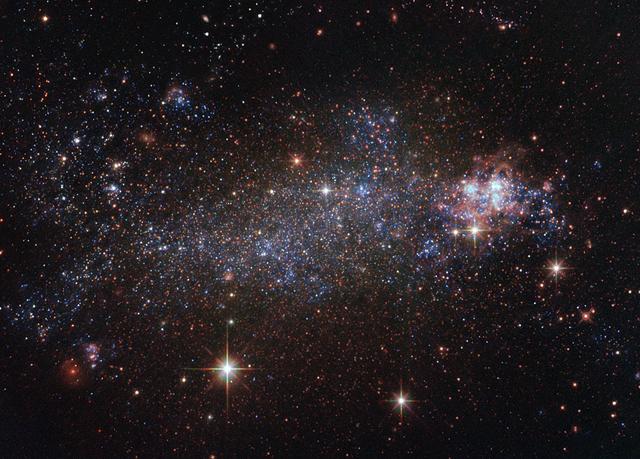
Ver en NASA ↗This image shows the dusty disk of planetary material surrounding the young star HD 141569, located 380 light-years away from Earth.
Ver en NASA ↗This artist concept shows the K2-138 system, the first multi-planet system discovered by citizen scientists.
Ver en NASA ↗Range : 4.2 million km. ( 2.6 million miles ) P-34649 This photograph of Neptune's southern hemisphere taken by Voyager 2's narrow angle camera, through the green and clear filters. The smallest feature that can be seen are 38 km ( 24 miles ) across. the al…
Ver en NASA ↗NASA Spitzer Space Telescope observed a proposed helium planet, GJ 436b.This diagram illustrates how hypothetical helium atmospheres might form. These would be on planets about the mass of Neptune, or smaller.
Ver en NASA ↗A new Discovery mission proposal, Trident would explore Neptune's largest moon, Triton, which is potentially an ocean world with liquid water under its icy crust.
Ver en NASA ↗KENNEDY SPACE CENTER, FLA. - At NASA Kennedy Space Center’s Shuttle Landing Facility, the shipping container with the New Horizons spacecraft inside is moved away from the U.S. Air Force C-17 cargo plane. The spacecraft will be placed on a transporter and m…
Ver en NASA ↗The filters on NASA's Roman Space Telescope Coronagraph Instrument's Color Filter Assembly each block all but a specific wavelength of light. Many of the filters appear dark in this photo because they are transparent only to infrared light.
Ver en NASA ↗Contenido y metadatos proporcionados por la NASA Image and Video Library.