






/NASA’s%20Artemis%20III%20Announcement%20(Official%20NASA%20Trailer)~thumb.jpg)

015B0351.NEF
Ver en NASA ↗🚀 Biblioteca espacial oficial
Imágenes y vídeos de NASA
Explora el catálogo multimedia público de NASA sin salir de TuPortalNews.
Explora temas destacados
Selecciona un tema o realiza una búsqueda personalizada.
19.951 resultados en NASA
The Gateway space station will operate in a near-rectilinear halo orbit (NRHO) around the Moon, providing substantial capabilities and opportunities for Artemis missions.
Ver en NASA ↗019A0012.NEF
Ver en NASA ↗This illustration shows Saturn's icy moon Enceladus with the plume of ice particles, water vapor and organic molecules that sprays from fractures in the moon's south polar region.
Ver en NASA ↗Apollo 8,Moon, Latitude 15 degrees South,Longitude 170 degrees West. Camera Tilt Mode: High Oblique. Direction: Southeast. Sun Angle 17 degrees. Original Film Magazine was labeled E. Camera Data: 70mm Hasselblad; F-Stop: F-5.6; Shutter Speed: 1/250 second. Fi…
Ver en NASA ↗AS13-60-8635 (April 1970) --- An oblique view of the International Astronomical Union Crater No. 302 on the lunar farside as photographed from the Apollo 13 spacecraft during its pass around the moon. This large crater is located at 162 degrees east longitude…
Ver en NASA ↗Iapetus is a moon of extreme contrasts. The light and dark features give the moon a distinctive yin and yang appearance in this image from NASA Cassini spacecraft.
Ver en NASA ↗NASA Cassini spacecraft snapped this image of Saturn moon Helene while completing the mission second-closest encounter of the moon on June 18, 2011.
Ver en NASA ↗Saturn largest moon, Titan, appears deceptively small paired here with Dione, Saturn fourth-largest moon, in this view from NASA Cassini spacecraft.
Ver en NASA ↗Saturn moon Janus casts a shadow on the F and A rings while the moon Prometheus, seen on the left of the image, creates a streamer-channel in the thin F ring.
Ver en NASA ↗NASA Cassini spacecraft captured a propeller-shaped disturbance in one of Saturn rings created by a moon that is too small to be seen here. The moon is invisible at the center of the image.
Ver en NASA ↗Saturn wispy moon Dione lies in front of the cratered surface of the moon Tethys, as seen by NASA Cassini spacecraft. Dione is closest to the spacecraft here.
Ver en NASA ↗NASA Cassini spacecraft shows a new view of Saturn moon Enceladus in a whole-disk mosaic of the geologically active moon leading, or western, hemisphere.
Ver en NASA ↗The moon Prometheus casts a shadow on the thin F ring marked with streamer-channels created by the moon in this image taken as Saturn approaches its August 2009 equinox.
Ver en NASA ↗During a flyby of Saturn moon Enceladus on Oct. 1, 2011, NASA Cassini spacecraft snapped this portrait of the moon joined by its sibling Epimetheus and the planet rings.
Ver en NASA ↗The Cassini spacecraft examines the dark region of Senkyo on Saturn largest moon, Titan. Senkyo is in the center of the image, and it lies just south of the moon equator.
Ver en NASA ↗This graphic of Jupiter moon Europa maps a relationship between the amount of energy deposited onto the moon from charged-particle bombardment and chemical contents of ice deposits.
Ver en NASA ↗Myriad shadows cover the pitted surface of Saturn small moon Hyperion in this image captured by NASA Cassini spacecraft, which shows the moon south pole on the right.
Ver en NASA ↗This animation show two crescent moons dance around Saturn as far-off Dione slips behind its sibling moon Rhea
Ver en NASA ↗As part of a multi-mission campaign, NASA Curiosity rover is observing Martian moon transits, the first of which involved the moon Phobos grazing the sun disk.
Ver en NASA ↗The Cassini spacecraft looks at Saturn largest moon, Titan, revealing its halo-like ring formed in the upper hazes of the moon extensive atmosphere.
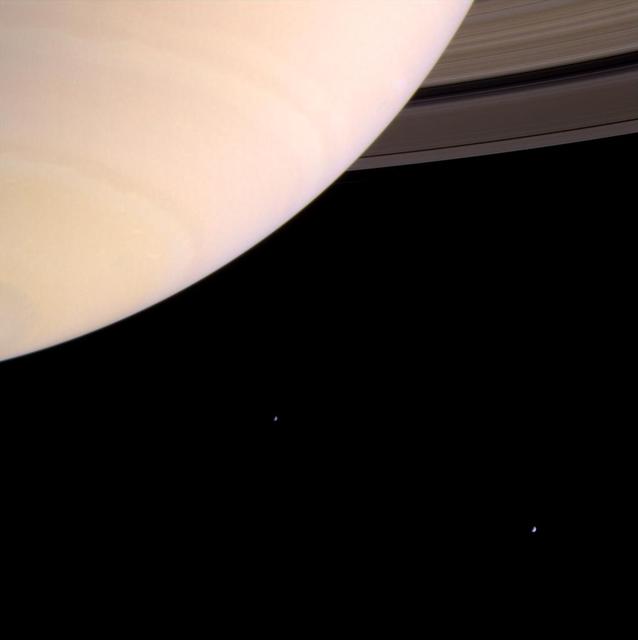
Ver en NASA ↗Resembling ornaments hanging from Saturn rings, two moons accent this portrait of the planet captured by NASA Cassini spacecraft. The moon Enceladus is on the right. Dione is on the left.
Ver en NASA ↗The surface of Saturn moon Rhea bears witness to its violent history. Each crater seen here by NASA Cassini spacecraft records an impact in the moon past.
Ver en NASA ↗This mosaic provides the best view yet obtained by Cassini cameras, showing terrain on the moon sub-Saturn hemisphere -- the side of the moon that always faces toward Saturn
Ver en NASA ↗Contenido y metadatos proporcionados por la NASA Image and Video Library.