





/NASA’s%20Artemis%20III%20Announcement%20(Official%20NASA%20Trailer)~thumb.jpg)

Miranda Dyal (9) views a partial solar eclipse in Washington, DC, Monday, April 8, 2024. A total solar eclipse swept across a narrow portion of the North American continent from Mexico’s Pacific coast to the Atlantic coast of Newfoundland, Canada. A partial s…
Ver en NASA ↗🚀 Biblioteca espacial oficial
Imágenes y vídeos de NASA
Explora el catálogo multimedia público de NASA sin salir de TuPortalNews.
Explora temas destacados
Selecciona un tema o realiza una búsqueda personalizada.
6.543 resultados en NASA
Brian Wolly and Kayla Randall view a partial solar eclipse in Washington, DC, Monday, April 8, 2024. A total solar eclipse swept across a narrow portion of the North American continent from Mexico’s Pacific coast to the Atlantic coast of Newfoundland, Canada.…
Ver en NASA ↗A man uses his smart phone to photograph a partial solar eclipse in Washington, on Monday, April 8, 2024. A total solar eclipse swept across a narrow portion of the North American continent from Mexico’s Pacific coast to the Atlantic coast of Newfoundland, Ca…
Ver en NASA ↗Spectators on the National Mall during a partial solar eclipse in Washington, DC, Monday, April 8, 2024. A total solar eclipse swept across a narrow portion of the North American continent from Mexico’s Pacific coast to the Atlantic coast of Newfoundland, Can…
Ver en NASA ↗People are seen as they watch a total solar eclipse through protective glasses at the Indianapolis Motor Speedway, Monday, April 8, 2024, in Indianapolis, Indiana. A total solar eclipse swept across a narrow portion of the North American continent from Mexico…
Ver en NASA ↗Camila (right), and Cameron (center), with their father Cameron Dyal view a partial solar eclipse in Washington, DC, Monday, April 8, 2024. A total solar eclipse swept across a narrow portion of the North American continent from Mexico’s Pacific coast to the …
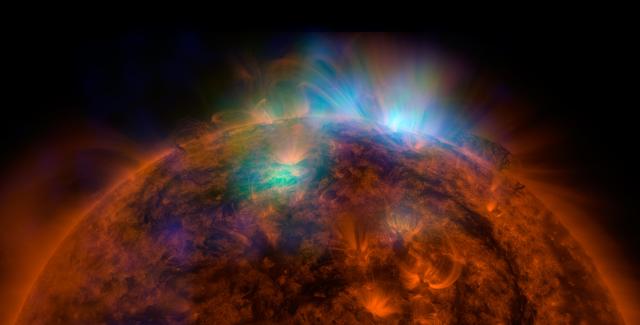
Ver en NASA ↗On May 23-25, 2018, NASA's Solar Dynamics Observatory observed an active region that rotated into view and sputtered with numerous small flares and towering magnetic field lines that stretched out many times the diameter of Earth.
Ver en NASA ↗A total solar eclipse is seen from San Millán de los Caballeros, Spain, Wednesday, Aug. 12, 2026. A total solar eclipse swept across parts of Greenland, Iceland, northern Russia, the Atlantic Ocean, Spain, and a small corner of Portugal. A partial eclipse was…
Ver en NASA ↗A total solar eclipse is seen from San Millán de los Caballeros, Spain, Wednesday, Aug. 12, 2026. A total solar eclipse swept across parts of Greenland, Iceland, northern Russia, the Atlantic Ocean, Spain, and a small corner of Portugal. A partial eclipse was…
Ver en NASA ↗A total solar eclipse is seen from San Millán de los Caballeros, Spain, Wednesday, Aug. 12, 2026. A total solar eclipse swept across parts of Greenland, Iceland, northern Russia, the Atlantic Ocean, Spain, and a small corner of Portugal. A partial eclipse was…
Ver en NASA ↗A total solar eclipse is seen from San Millán de los Caballeros, Spain, Wednesday, Aug. 12, 2026. A total solar eclipse swept across parts of Greenland, Iceland, northern Russia, the Atlantic Ocean, Spain, and a small corner of Portugal. A partial eclipse was…
Ver en NASA ↗A total solar eclipse is seen from San Millán de los Caballeros, Spain, Wednesday, Aug. 12, 2026. A total solar eclipse swept across parts of Greenland, Iceland, northern Russia, the Atlantic Ocean, Spain, and a small corner of Portugal. A partial eclipse was…
Ver en NASA ↗On April 30, NASA's Hubble Space Telescope observed Comet ISON again. The comet is in the upper middle, showing the long tail. Various galaxies and stars appear behind it. In this image, Hubble trained its telescope on the stars instead of following the com…
Ver en NASA ↗iss061e029039 (Nov. 4, 2019) --- Baja California, with the Sun's glint beaming off the Gulf of California, is pictured as the International Space Station orbited 256 miles above the Pacific Ocean southwest of Tijuana, Mexico.
Ver en NASA ↗Silhouette view of Jonas Jonsson with the Alta-X Unmanned Aerial Vehicle (UAV) on the landing pad as the sun sets at the Monterey Bay Academy Airport near Watsonville, California.
Ver en NASA ↗A pigment (phthalocyanine) is studied at the Marshall Materials and Processes Lab. The pigment has the ability to protect spacecraft against the harmful effects of the Sun's ultraviolet rays, and to increase the efficiency and life of solar cells.
Ver en NASA ↗iss060e052554 (Sept. 2, 2019) --- The northeastern Chinese port city of Tianjin is pictured with the Sun's glint beaming off the Bohai Sea as the International Space Station orbited 263 miles above the Asian continent.
Ver en NASA ↗iss067e238148 (Aug. 4, 2022) --- The sun sets illuminating the cloud tops and highlighting Earth's atmosphere in this photograph from the International Space Station as it orbited 258 mile above the Atlantic Ocean.
Ver en NASA ↗iss070e022731 (Nov. 11, 2023) --- The sun's first rays begin illuminating Earth's atmosphere in this photograph from the International Space Station as it orbited 262 miles above the Pacific Ocean off the coast of California.
Ver en NASA ↗ISS042E311037 (03/02/2015) --- A waning sun, splayed its light across the planet and created this serene scene. US astronauts aboard the International Space Station snapped this Earth Observation on Mar 2, 2015.
Ver en NASA ↗iss065e048359 (May 18, 2021) --- The sun's glint beams off the Tasman Sea on the southeastern coast of New South Wales, Australia, as the International Space Station orbited 269 miles above Adelaide, the capital city of South Australia.
Ver en NASA ↗iss068e023088 (Nov. 18, 2022) --- The sun's last rays illuminate Earth's thin atmosphere during an orbital sunset in this photograph from the International Space Station as it orbited 258 miles above the Atlantic Ocean.
Ver en NASA ↗iss065e002960 (April 24, 2021) --- The sun's glint beams off a cloudy Atlantic Ocean 264 miles below as the SpaceX Crew Dragon Endeavour approached the International Space Station.
Ver en NASA ↗iss063e050668 (July 18, 2020) --- The sun's glint beams off a partly cloudy South Pacific as the International Space Station's orbital track took it halfway between Australia and South America.
Ver en NASA ↗Contenido y metadatos proporcionados por la NASA Image and Video Library.