





/NASA’s%20Artemis%20III%20Announcement%20(Official%20NASA%20Trailer)~thumb.jpg)

The Apollo 11 mission, the first manned lunar mission, launched from the Kennedy Space Center, Florida via a Saturn V launch vehicle on July 16, 1969 and safely returned to Earth on July 24, 1969. The Saturn V vehicle was developed by the Marshall Space Fligh…
Ver en NASA ↗🚀 Biblioteca espacial oficial
Imágenes y vídeos de NASA
Explora el catálogo multimedia público de NASA sin salir de TuPortalNews.
Explora temas destacados
Selecciona un tema o realiza una búsqueda personalizada.
19.951 resultados en NASA
This is a view of a roadway near the NASA Kennedy Space Center (KSC), shortly before dawn, where spectators from all over the world jammed into KSC to watch the liftoff of Apollo 11, the first manned lunar landing mission. Apollo 11 launched from KSC via the …
Ver en NASA ↗The early morning sun found hundreds of spectators on the beaches and roadways near the NASA Kennedy Space Center (KSC) where they had camped the night before to witness history by watching the epic beginning of the journey of Apollo 11. The first manned luna…
Ver en NASA ↗A total lunar eclipse begins as the full moon is shadowed by the Earth on the arrival of the winter solstice, Tuesday, December 21, 2010 in Arlington, VA. From beginning to end, the eclipse will last about three hours and twenty-eight minutes. Photo Credit:…
Ver en NASA ↗The first known proposal for a marned-satellite appeared in a story by Edward Everett Hale entitled "The Brick Moon." The story involved a group of young Bostonians who planned to put an artificial satellite into polar orbit for sailors to use to determine lo…
Ver en NASA ↗A nearly total lunar eclipse is seen as the full moon is shadowed by the Earth on the arrival of the winter solstice, Tuesday, December 21, 2010 in Arlington, VA. From beginning to end, the eclipse will last about three hours and twenty-eight minutes. Photo…
Ver en NASA ↗NASA engineer Dave Coan (left) and NASA astronaut Jessica Watkins (right) sit inside Intuitive Machines’ Moon RACER lunar terrain vehicle evaluating the crew compartment during testing at NASA’s Johnson Space Center. Image Credit: NASA/James Blair
Ver en NASA ↗A total lunar eclipse is seen as the full moon is shadowed by the Earth on the arrival of the winter solstice, Tuesday, December 21, 2010 in Arlington, VA. From beginning to end, the eclipse will last about three hours and twenty-eight minutes. Photo Credit…
Ver en NASA ↗The Washington Monument is seen as the full moon is shadowed by the Earth during a total lunar eclipse on the arrival of the winter solstice, Tuesday, December 21, 2010 in Washington. From beginning to end, the eclipse lasted about three hours and twenty-eig…
Ver en NASA ↗Saturn moon Epimetheus moves in front of the larger moon Janus as seen by NASA Cassini spacecraft. The moons are lit by sunlight on the left and light reflected off Saturn on the right.
Ver en NASA ↗NASA Cassini spacecraft February 2010 encounter with Calypso yielded this incredibly detailed view of this Trojan moon. Irregularly shaped Calypso is one of two Trojan moons of the larger moon Tethys.
Ver en NASA ↗Saturn rings occupy the space between two of the planet moons in this image, taken by NASA Cassini spacecraft, which shows the highly reflective moon Enceladus in the background and the smaller moon Janus in the fore.
Ver en NASA ↗NASA Cassini spacecraft looks past the cratered south polar area of Saturn moon Rhea to spy the moon Dione and the planet rings in the distance. Dione wispy terrain can be seen on the trailing hemisphere of that moon.
Ver en NASA ↗Two of Saturn icy moons pass each other in a mutual event recorded by NASA Cassini spacecraft. The smaller moon Enceladus passes in front of the larger moon Rhea.
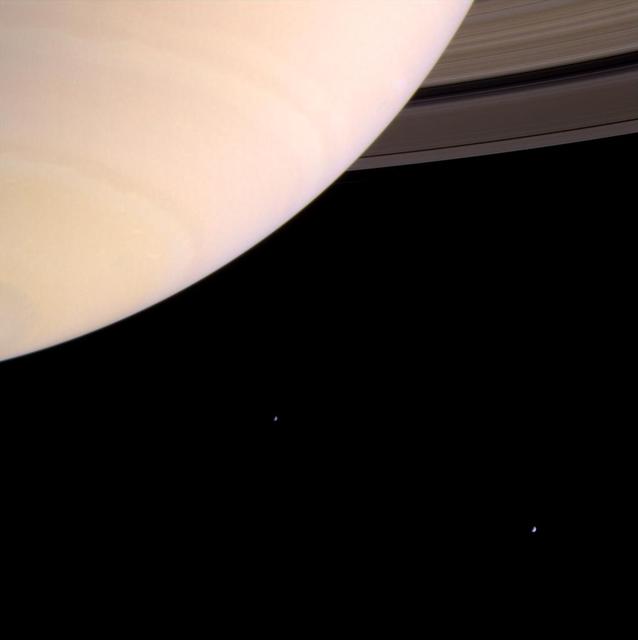
Ver en NASA ↗Four of Saturn moons join the planet for a well balanced portrait. Titan, Saturn largest moon, is in the lower left. Tethys appears in upper right. The smaller moons Pandora and Epimetheus are barely visible here.
Ver en NASA ↗NASA Cassini spacecraft looks past the cratered south polar area of Saturn moon Rhea to spy the moon Dione and the planet rings in the distance. Dione wispy terrain can be seen on the trailing hemisphere of that moon.
Ver en NASA ↗NASA Cassini spacecraft imaged the surface of Saturn moon Helene as the it flew by the moon on Jan. 31, 2011. Helene is a Trojan moon of Dione, named for the Trojan asteroids that orbit 60 degrees ahead of and behind Jupiter as it circles the Sun.
Ver en NASA ↗A quartet of Saturn moons, from tiny to huge, surround and are embedded within the planet rings in this Cassini composition. Saturn largest moon, Titan, in the background, and the moon north polar hood is clearly visible.
Ver en NASA ↗The tortured terrain of Saturn moon Dione is documented in this NASA Cassini spacecraft image. The wispy fractures on the moon trailing hemisphere can be seen on the left, and cratered terrain on the moon anti-Saturn side dominates the center.
Ver en NASA ↗Saturn moon Dione dwarfs the moon Telesto in this image captured by NASA Cassini spacecraft image. Dione is the fourth largest of Saturn moons, and it dominates this view. Tiny Telesto can be seen below and to the left of Dione.
Ver en NASA ↗Saturn moon Dione passes in front of the larger moon Titan, as seen from NASA Cassini spacecraft. This image is part of a mutual event sequence in which one moon passes close to or in front of another.
Ver en NASA ↗The Saturn V launch vehicle, developed by the Marshall Space Flight Center (MSFC) under the direction of Dr. Wernher von Braun, lifts off from the Kennedy Space Center (KSC), Florida carrying the Apollo 11 spacecraft and crew. The massive rocket hurled the sp…
Ver en NASA ↗In preparation of the nation’s first lunar landing mission, Apollo 11, crew members underwent training to practice activities they would be performing during the mission. In this photograph Neil Armstrong approaches the helicopter he flew to practice landing …
Ver en NASA ↗art001e002998 (Dec. 10, 2022) On flight day 25 of the Artemis I mission, Orion captured this photo of the Moon from a camera mounted on one of its solar arrays. The spacecraft is now closer to Earth than to the Moon, and will splash down on Sunday, Dec. 11.
Ver en NASA ↗Contenido y metadatos proporcionados por la NASA Image and Video Library.