






/NASA’s%20Artemis%20III%20Announcement%20(Official%20NASA%20Trailer)~thumb.jpg)

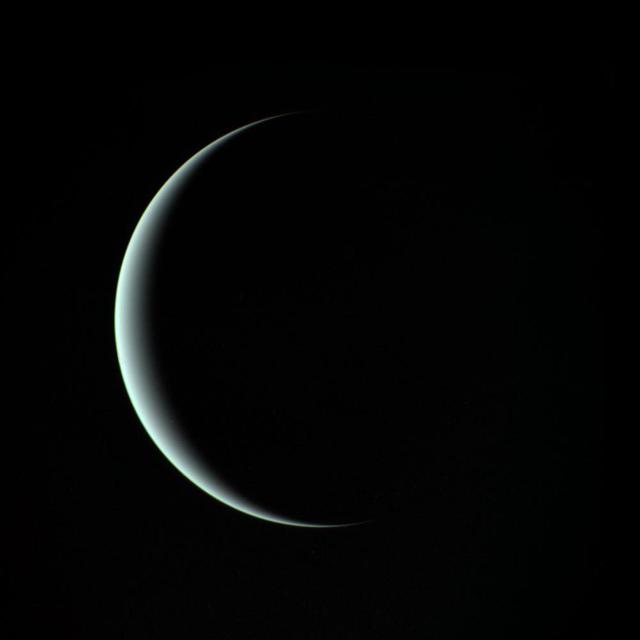
Saturn appears to NASA Cassini cameras as a thin, sunlit crescent in this unearthly view. Citizens of Earth, being so much closer to the Sun than Saturn, never get to enjoy a view of Saturn like this without the aid of our robot envoys.
Ver en NASA ↗🚀 Biblioteca espacial oficial
Imágenes y vídeos de NASA
Explora el catálogo multimedia público de NASA sin salir de TuPortalNews.
Explora temas destacados
Selecciona un tema o realiza una búsqueda personalizada.
4.237 resultados en NASA
Roughly a quarter of majestic Saturn is illuminated in this view captured while NASA Cassini spacecraft was orbiting near the planet equatorial plane.
Ver en NASA ↗While cruising around Saturn in early October 2004, Cassini captured a series of images that have been composed into the largest, most detailed, global natural color view of Saturn and its rings ever made.
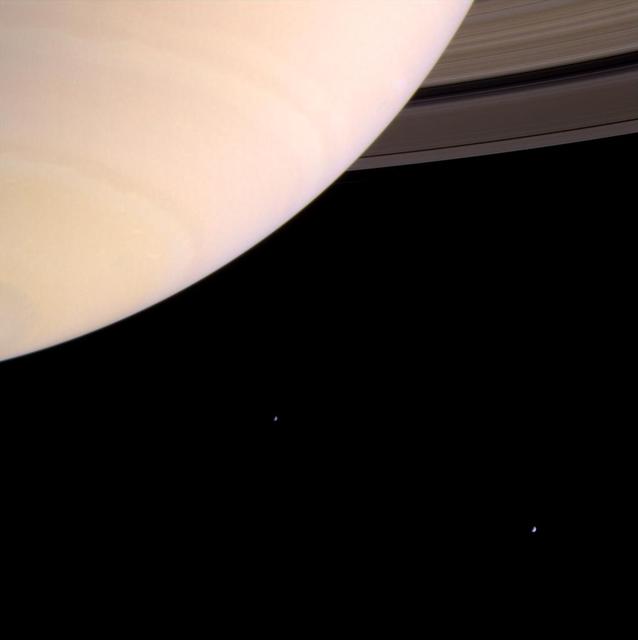
Ver en NASA ↗NASA Cassini orbiter shows Saturn is circled by its rings nearly edge-on in this image, as well as by the moons Tethys the large bright body near the lower right corner and Mimas seen as a slight crescent against Saturn disk above the rings.
Ver en NASA ↗A 3-D View of Saturn Clouds and Hazes
Ver en NASA ↗Saturn from Far and Near Hubble Space Telescope
Ver en NASA ↗Infrared Movie of Saturn North Polar Region
Ver en NASA ↗Hubble Provides Clear Images of Saturn Aurora
Ver en NASA ↗Hubble Discovery Image of New Moon Orbiting Saturn
Ver en NASA ↗Hubble again views Saturn Rings Edge-on
Ver en NASA ↗Saturn from Far and Near Cassini-Huygens
Ver en NASA ↗Saturn North Pole Hot Spot and Hexagon
Ver en NASA ↗Artists Conception of Cassini Saturn Orbit Insertion
Ver en NASA ↗Hubble Views Saturn Ring-Plane Crossing
Ver en NASA ↗Saturn and its rings completely fill the field of view of NASA's Cassini's narrow angle camera in this natural color image taken on March 27, 2004. This is the last single 'eyeful' of Saturn and its rings.
Ver en NASA ↗This image illustrates the basic differences between the three Saturn launch vehicles developed by the Marshall Space Flight Center. The Saturn I, consisted of two stages, the S-I (eight H-1 engines) and the S-IV (six RL-10 engines). The Saturn IB (center) al…
Ver en NASA ↗NASA's Cassini gazed toward high southern latitudes near Saturn's south pole to observe ghostly curtains of dancing light, Saturn's southern auroras, or southern lights.
Ver en NASA ↗Saturn 1 Launch summary of research and development flights and operational flights. NASA's initial development plan for the Saturn program had called for the Saturn I to serve as a stepping stone to the development of larger Saturn vehicles ultimately known …
Ver en NASA ↗This set of images from NASA Cassini mission shows the turbulent power of a monster Saturn storm. The visible-light image in the back, obtained on Feb. 25, 2011 shows the turbulent clouds churning across the face of Saturn.
Ver en NASA ↗This image obtained by NASA Cassini spacecraft around the time it went into orbit around Saturn in 2004 shows a short trail of icy particles dragged out from Saturn F ring.
Ver en NASA ↗One of the glittering trails caused by small objects punching through Saturn F ring is highlighted in this image from NASA Cassini spacecraft. These trails show how the F ring, the outermost of Saturn main rings, is constantly changing.
Ver en NASA ↗Saturn oblateness, the varying opacity of its rings and the shadows cast by those rings, sometimes creates elaborate and complicated patterns from NASA Cassini perspective.
Ver en NASA ↗Saturn's magnetosphere is seen for the first time in this image taken by NASA's Cassini spacecraft on June 21, 2004.
Ver en NASA ↗NASA's Cassini gazes across the icy rings of Saturn toward the icy moon Tethys, whose night side is illuminated by Saturnshine, or sunlight reflected by the planet.
Ver en NASA ↗Contenido y metadatos proporcionados por la NASA Image and Video Library.