





/NASA’s%20Artemis%20III%20Announcement%20(Official%20NASA%20Trailer)~thumb.jpg)

Dr. David H. Grinspoon, senior scientist at the Planetary Science Institute, speaks about working on NASA's Voyager team while serving as moderator for a panel discussion at the "NASA's New Horizons Pluto Mission: Continuing Voyager's Legacy of Exploration" e…
Ver en NASA ↗🚀 Biblioteca espacial oficial
Imágenes y vídeos de NASA
Explora el catálogo multimedia público de NASA sin salir de TuPortalNews.
Explora temas destacados
Selecciona un tema o realiza una búsqueda personalizada.
265 resultados en NASA
Audience members view images of Neptune taken by Voyager while scientists discuss how the first images of Pluto and its moons will be captured during the "New Horizons: The First Mission to the Pluto System and the Kuiper Belt" Event at NASA Headquarters in W…
Ver en NASA ↗Dr. Fran Bagenal, senior scientist at the University of Colorado, speaks during a panel discussion at the "NASA's New Horizons Pluto Mission: Continuing Voyager's Legacy of Exploration" event on Monday, August, 25, 2014, in the James E. Webb Auditorium at NAS…
Ver en NASA ↗Dr. Bonnie Buratti, senior scientist at NASA's Jet Propultion Laboratory, speaks during a panel discussion at the "NASA's New Horizons Pluto Mission: Continuing Voyager's Legacy of Exploration" event on Monday, August, 25, 2014, in the James E. Webb Auditoriu…
Ver en NASA ↗Dr. Alan Stern, Principal Investigator on NASA's New Horizons Mission, left, delivers closing remarks following a panel discussion at the "NASA's New Horizons Pluto Mission: Continuing Voyager's Legacy of Exploration" event on Monday, August, 25, 2014, in the…
Ver en NASA ↗Range : 4.7 million km (2.9 million mi.) Nereid, the last satellite of Neptune to be discovered before Voyager's recent discoveries, was first seen by Gerard Kuiper in 1949. Until this Voyager 2 image was obtained, all that was known about Nereid was its or…
Ver en NASA ↗When a planet such as K2-33b passes in front of its host star, it blocks some of the star light.shown in this frame from an animation as discovered by NASA's Kepler Space Telescope.
Ver en NASA ↗Dr. Alan Stern, Principal Investigator on NASA's New Horizons Mission, delivers closing remarks following a panel discussion at the "NASA's New Horizons Pluto Mission: Continuing Voyager's Legacy of Exploration" event on Monday, August, 25, 2014, in the James…
Ver en NASA ↗Dr. John Spencer, senior scientist at the Southwest Research Institute in Boulder, Colorado, speaks during a panel discussion at the "NASA's New Horizons Pluto Mission: Continuing Voyager's Legacy of Exploration" event on Monday, August, 25, 2014, in the Jame…
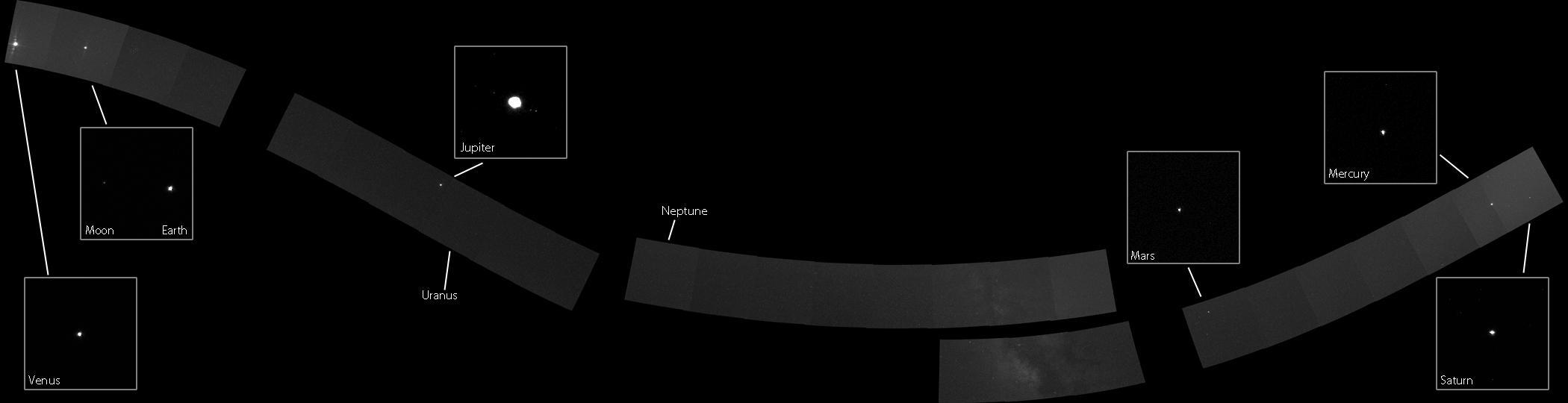
Ver en NASA ↗The cameras of Voyager 1 on Feb. 14, 1990, pointed back toward the sun and took a series of pictures of the sun and the planets, making the first ever portrait of our solar system as seen from the outside.
Ver en NASA ↗Photo by Voyager 2 (jpl) These images show changes in the clouds around Neptune's Great Dark Spot (GDS) over a four and one-half-day period. From top to bottom the images show successive rotations of the planet -- an interval of about 18 hours. The GDS is at…
Ver en NASA ↗Range : 8.6 million kilometers (5.3 million miles) The Voyager took this 61 second exposure through the clear filter with the narrow angle camera of Neptune. The Voyager cameras were programmed to make a systematic search for faint ring arcs and new satelli…
Ver en NASA ↗Range : 280,000 km. ( 170,000 miles ) P-34726 BW Two 10 minute exposures of Neptune's rings clearly show the two main rings , as well as the inner faint ring and the faint band that extends planetward from roughly halfway between the two bright rings. Both b…
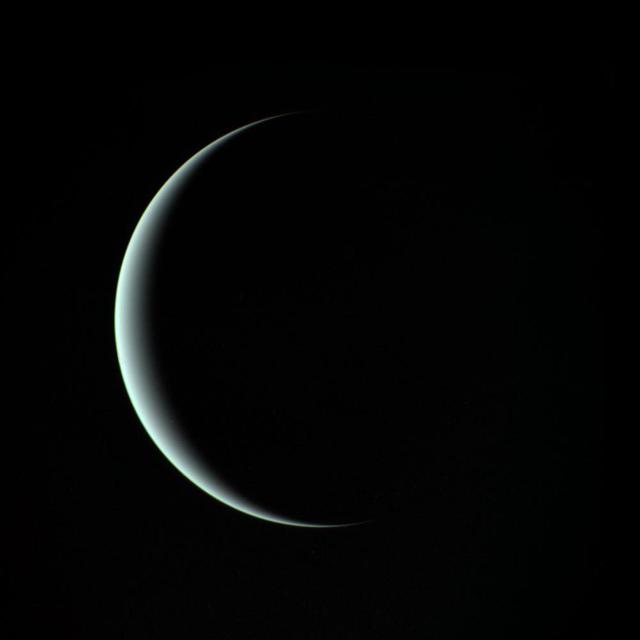
Ver en NASA ↗Range : 1 illion km. ( 600,000 mi. ) Resolution : 140 km. ( 90 mi. ) P-29539C This Voyager 2 image of Uranus was captured as the spacecraft was leaving Uranus behind on its cruise to Neptune. The image is a color composite of three photographs taken through…
Ver en NASA ↗August 17 to 19, 1989 Range : 11.5 million km (7.1 million mi.) to 7.9 million km (4.9 million mi.) Four black and white images of Neptune's largest satellite, Triton, show it's rotation between the first (upper left) image and the last (lower right). Resol…
Ver en NASA ↗Voyager II Imagery, Neptune: This is one of the most detailed views of the surface of Triton taken by Voyager 2 on its flyby of the large satellite of Neptune early in the morning of August 25, 1989. The picture was stored on the tape recorder and relayed to …
Ver en NASA ↗Range : 660,000 km. ( 412,000 miles ) P-34711 This Voyager 2 wide angle photograph shows the shadow of Neptune on the rings. Because Neptune's shadow casts a curved profile on the rings which does not quite reach out to the outermost ring at about 38,000 km.…
Ver en NASA ↗P-34705 This false-color photograph of Neptune was made from Voyager 2 images taken through three filters: blue, green, and a filter that passes light at a wavelength that is absorbed by methane gas. Thus, regions that appear white or bright red are those tha…
Ver en NASA ↗P-34764 Voyager 2 obtained this high resolution color image of Neptune's large satellite Triton during its close flyby. Approximately a dozen individual images were combined to produce this comprehensive view of the Neptune-facing hemisphere of Triton. Fine…
Ver en NASA ↗P-34540 Range: 37.3 million kilometers (23.6 million miles) This image captured by the Voyager 2 spacecraft was used to confirm the discovery of three new satellites orbiting Neptune. The 46-second exposure was taken with the narrow angle camera and shows the…
Ver en NASA ↗P-34707 Range: 720,000 kilometers (446,400 miles) The Voyager spacecraft took this picture after closest approach to Neptune using the clear filter of the wide-angle camera with an exposure time of 255 seconds. The view back towards Neptune at a phase angle o…
Ver en NASA ↗This global color mosaic of Triton, taken in 1989 by NASAs Voyager 2 shows Triton, the largest satellite of Neptune. Triton has the coldest surface known anywhere in the solar system; it is so cold that most of Triton nitrogen is condensed as frost.
Ver en NASA ↗KENNEDY SPACE CENTER, FLA. — A truck delivers the Atlas V rocket to the Atlas Space Operations Center. The Atlas V is the launch vehicle for the New Horizons spacecraft. New Horizons is designed to help us understand worlds at the edge of our solar system…
Ver en NASA ↗KENNEDY SPACE CENTER, FLA. - In NASA Kennedy Space Center’s Payload Hazardous Servicing Facility, the New Horizons spacecraft is moved toward a work stand (behind it) for a checkout. New Horizons will make the first reconnaissance of Pluto and Charon - a 'd…
Ver en NASA ↗Contenido y metadatos proporcionados por la NASA Image and Video Library.