





/NASA’s%20Artemis%20III%20Announcement%20(Official%20NASA%20Trailer)~thumb.jpg)
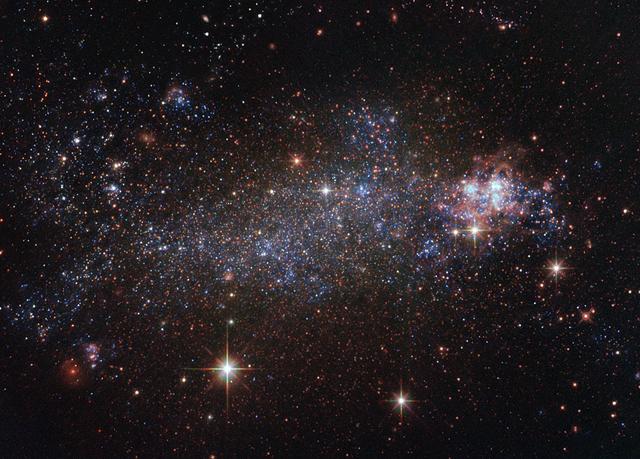


These images from NASA GALEX and NuSTAR is of Andromeda, a spiral galaxy like our Milky Way but larger in size. It lies 2.5 million light-years away in the Andromeda constellation.
Ver en NASA ↗🚀 Biblioteca espacial oficial
Imágenes y vídeos de NASA
Explora el catálogo multimedia público de NASA sin salir de TuPortalNews.
Explora temas destacados
Selecciona un tema o realiza una búsqueda personalizada.
629 resultados en NASA
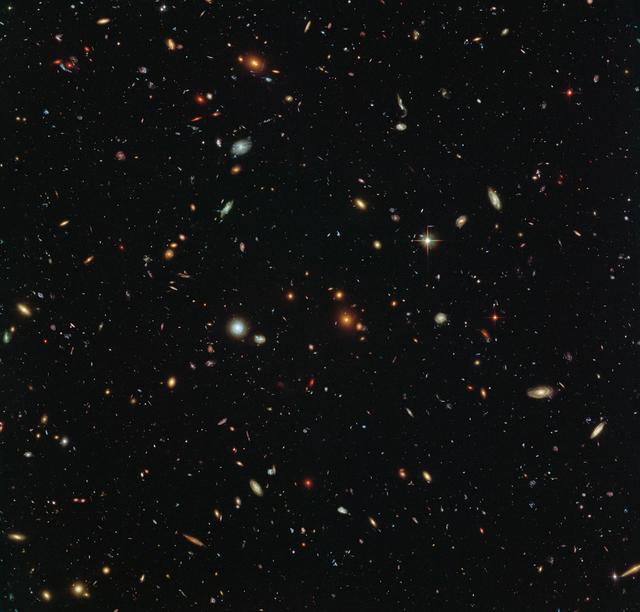
Peering deep inside a cluster of several hundred thousand stars, NASA Hubble Space Telescope has uncovered the oldest burned-out stars in our Milky Way Galaxy, giving astronomers a fresh reading on the age of the universe.
Ver en NASA ↗This image from NASA Wide-field Infrared Survey Explorer, or WISE, is a view within the constellation Cassiopeia of another portion of the vast star forming complex that makes up part of the Perseus spiral arm of the Milky Way Galaxy.
Ver en NASA ↗NASA Wide-field Infrared Survey Explorer captured this colorful image of the nebula BFS 29 surrounding the star CE-Camelopardalis, found hovering in the band of the night sky comprising the Milky Way.
Ver en NASA ↗Using the unique orbit of NASA Spitzer Space Telescope and a depth-perceiving trick called parallax, astronomers have determined the distance to an invisible Milky Way object called OGLE-2005-SMC-001.
Ver en NASA ↗This infrared image from NASA Spitzer Space Telescope shows the nebula nicknamed the Dragonfish. This turbulent region, jam-packed with stars, is home to some of the most luminous massive stars in our Milky Way galaxy.
Ver en NASA ↗This infrared image from NASA Wide-field Infrared Survey Explorer shows the Lambda Centauri nebula, a star-forming cloud in our Milky Way galaxy, also known as the Running Chicken nebula.
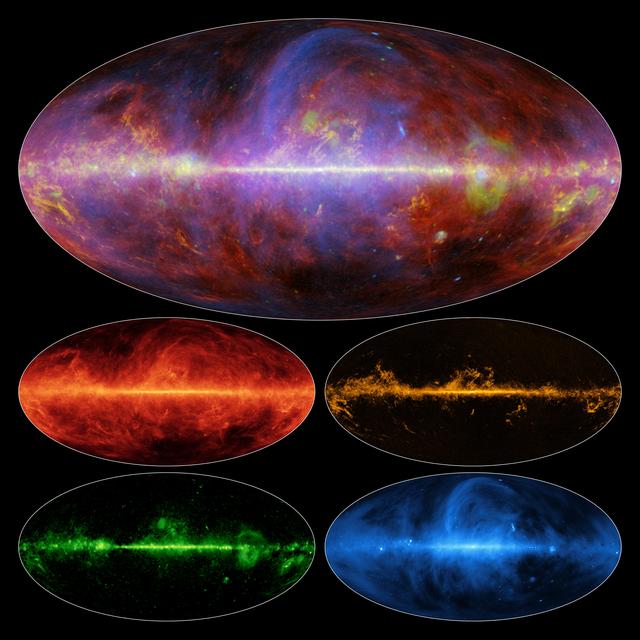
Ver en NASA ↗This is a mosaic of the images covering the entire sky as observed by NASA Wide-field Infrared Survey Explorer WISE, part of its All-Sky Data Release. In this mosaic, the Milky Way Galaxy runs horizontally across the map.
Ver en NASA ↗The center of the Milky Way galaxy imaged by NASA Spitzer Space Telescope is displayed on a quarter-of-a-billion-pixel, high-definition 23-foot-wide 7-meter LCD science visualization screen at NASA Ames Research Center.
Ver en NASA ↗This mosaic reveals a panorama of the Milky Way from NASA Spitzer Space Telescope. This picture covers only about three percent of the sky, but includes more than half of the galaxy stars and the majority of its star formation activity.
Ver en NASA ↗This image is from NASA Galaxy Evolution Explorer is an observation of the large galaxy in Andromeda, Messier 31. The Andromeda galaxy is the most massive in the local group of galaxies that includes our Milky Way.
Ver en NASA ↗The galaxy NGC 4395 is shown here in infrared light, captured by NASA Spitzer Space Telescope. This dwarf galaxy is relatively small in comparison with our Milky Way galaxy, which is nearly 1,000 times more massive.
Ver en NASA ↗This enormous section of the Milky Way galaxy is a mosaic of images from NASA Wide-field Infrared Survey Explorer. The constellations Cassiopeia and Cepheus are featured in this 1,000-square degree expanse.
Ver en NASA ↗Resembling an opulent diamond tapestry, this image from NASA Hubble Space Telescope shows a glittering star cluster that contains a collection of some of the brightest stars seen in our Milky Way galaxy called Trumpler 14.
Ver en NASA ↗This infrared view of the whole sky highlights the flat plane of our Milky Way galaxy line across middle of image. NASA WISE, will take a similar infrared census of the whole sky, only with much improved resolution and sensitivity.
Ver en NASA ↗New data from NASA Cassini spacecraft suggest that the shape of our solar system moving through the local Milky Way galaxy looks like a bubble -- or a rat -- traveling through a boa constrictor belly.
Ver en NASA ↗The galaxy Messier 101 is a swirling spiral of stars, gas, and dust. Messier 101 is nearly twice as wide as our Milky Way galaxy in this image as seen by NASA Spitzer Space Telescope.
Ver en NASA ↗The Milky Way and other galaxies in the universe harbor many young star clusters and associations that each contain hundreds to thousands of hot, massive, young stars known as O and B stars.
Ver en NASA ↗The color scale in this image from the Planck mission represents the emission from dust, a minor but crucial component that pervades our Milky Way galaxy. The texture indicates the orientation of the galactic magnetic field.
Ver en NASA ↗On the morning of February 1, 2011, NASA Wide-field Infrared Survey Explorer, or WISE, took its last snapshot of the sky. WISE final picture shows thousands of stars in a patch of the Milky Way galaxy in the constellation Perseus.
Ver en NASA ↗Yellow balls -- which are several hundred to thousands times the size of our solar system -- are pictured here in the center of this image taken by NASA Spitzer Space Telescope.
Ver en NASA ↗This mosaic image from NASA Wide-field Infrared Survey Explorer is located in a constellation in the southern sky, Pavo, which is Latin for peacock.
Ver en NASA ↗This image from NASA's Spitzer Space telescope shows the star-forming nebula W51, one of the largest star factories in the Milky Way galaxy.
Ver en NASA ↗This map of the entire sky was captured by the European Space Agency Planck mission. The band running through the middle corresponds to dust in our Milky Way galaxy.
Ver en NASA ↗Contenido y metadatos proporcionados por la NASA Image and Video Library.