





/NASA’s%20Artemis%20III%20Announcement%20(Official%20NASA%20Trailer)~thumb.jpg)

In the Kennedy Space Center’s Operations Support Building II, Dr. Eugene Parker, a pioneer in heliophysics and S. Chandrasekhar distinguished service professor emeritus for the Department of Astronomy and Astrophysics at the University of Chicago, speaks to m…
Ver en NASA ↗🚀 Biblioteca espacial oficial
Imágenes y vídeos de NASA
Explora el catálogo multimedia público de NASA sin salir de TuPortalNews.
Explora temas destacados
Selecciona un tema o realiza una búsqueda personalizada.
6.543 resultados en NASA
VANDENBERG AIR FORCE BASE, Calif. – At Vandenberg Air Force Base in California, technicians install the wing on the Orbital Sciences Corp. Pegasus XL rocket which will launch the Interface Region Imaging Spectrograph, or IRIS, spacecraft. Scheduled for l…
Ver en NASA ↗Vandenberg Air Force Base, Calif. – At Vandenberg Air Force Base in California, technicians install the avionics shelf on the third stage of the Orbital Sciences Corp. Pegasus XL rocket which will launch the Interface Region Imaging Spectrograph, or IRIS, spa…
Ver en NASA ↗VANDENBERG AIR FORCE BASE, Calif. -- The Interface Region Imaging Spectrograph, or IRIS, is being readied for mating to the Orbital Sciences Corp. Pegasus XL rocket that will launch the spacecraft. A fairing will be fitted to the nose of the Pegasus to protec…
Ver en NASA ↗VANDENBERG AFB, Calif. – Engineers unwrap NASA's IRIS spacecraft after its connection to the nose of an Orbital Sciences Pegasus XL rocket that will lift the solar observatory into orbit in June. The work is taking place in a hangar at Vandenberg Air Force Ba…
Ver en NASA ↗Orbital Sciences engineers connect the payload fairing over NASA's IRIS spacecraft. The fairing connects to the nose of the Orbital Sciences Pegasus XL rocket that will lift the solar observatory into orbit in June. The work is taking place in a hangar at Van…
Ver en NASA ↗VANDENBERG AFB – Engineers move the payload fairing into place for NASA's IRIS spacecraft. The fairing connects to the nose of the Orbital Sciences Pegasus XL rocket that will lift the solar observatory into orbit in June. The work is taking place in a hangar…
Ver en NASA ↗VANDENBERG ABF, Calif. - The Orbital Sciences launch team monitors the Pegasus XL rocket that will lift NASA's IRIS solar observatory into orbit as the rocket and payload are moved from a hangar onto a transporter at Vandenberg Air Force Base. IRIS, short for…
Ver en NASA ↗VANDENBERG AIR FORCE BASE, Calif. – At Vandenberg Air Force Base in California, technicians install the wing on the Orbital Sciences Corp. Pegasus XL rocket which will launch the Interface Region Imaging Spectrograph, or IRIS, spacecraft. Scheduled for l…
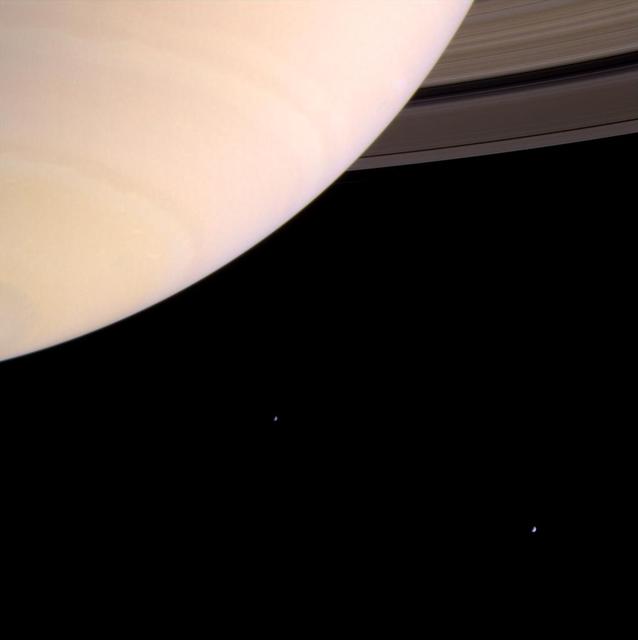
Ver en NASA ↗NASA Cassini orbiter shows Saturn main rings, seen here on their lit face, appear much darker than normal. That because they tend to scatter light back toward its source -- in this case, the Sun.
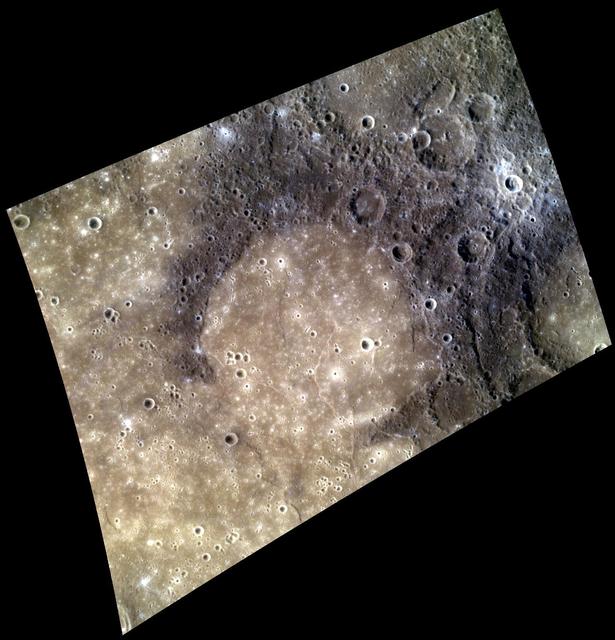
Ver en NASA ↗This mosaic from NASA's MESSENGER of Caloris basin is an enhanced-color composite overlain on a monochrome mosaic. It is made up of images obtained when both the spacecraft and the Sun were overhead, conditions best for discerning variations in albedo.
Ver en NASA ↗The potential planet-forming disk or protoplanetary disk of a sun-like star is being violently ripped away by the powerful winds of a nearby hot O-type star in this image from NASA's Spitzer Space Telescope.
Ver en NASA ↗NASA's Ingenuity helicopter captured this view on Nov. 3, 2023, of its parking spot during Mars solar conjunction – a period when the Sun is between Earth and Mars, limiting communications.
Ver en NASA ↗NASA's Perseverance Mars rover used its Mastcam-Z camera to capture Mercury – seen as a tiny speck – passing in front of the Sun on Oct. 28, 2023.
Ver en NASA ↗On Friday, May 18, 2018, at the Astrotech processing facility in Titusville, Florida, near NASA's Kennedy Space Center, a computer chip is installed on NASA's Parker Solar Probe. Throughout its seven-year mission, NASA’s Parker Solar Probe will swoop through …
Ver en NASA ↗On Friday, May 18, 2018, at the Astrotech processing facility in Titusville, Florida, near NASA's Kennedy Space Center, scientists and engineers from the Applied Physics Laboratory at Johns Hopkins University install a computer chip on NASA's Parker Solar Pro…
Ver en NASA ↗On Friday, May 18, 2018, at the Astrotech processing facility in Titusville, Florida, near NASA's Kennedy Space Center, scientists and engineers from the Applied Physics Laboratory at Johns Hopkins University install a computer chip on NASA's Parker Solar Pro…
Ver en NASA ↗STEREO (Behind) captured this magnificent coronal mass ejection (associated with an M-class flare) that flung a long stream of plasma into space (Aug. 24, 2014). We have combined a view of the Sun in extreme UV light with a broader visible light view of the S…
Ver en NASA ↗ISS031-E-035310 (15 May 2012) --- Sunglint and clouds off Western South America are featured in this image photographed by an Expedition 31 crew member on the International Space Station. The setting sun highlights cloud patterns above the Pacific Ocean, as w…
Ver en NASA ↗STEREO (Behind) captured this magnificent coronal mass ejection (associated with an M-class flare) that flung a long stream of plasma into space (Aug. 24, 2014). We have combined a view of the Sun in extreme UV light with a broader visible light view of the S…
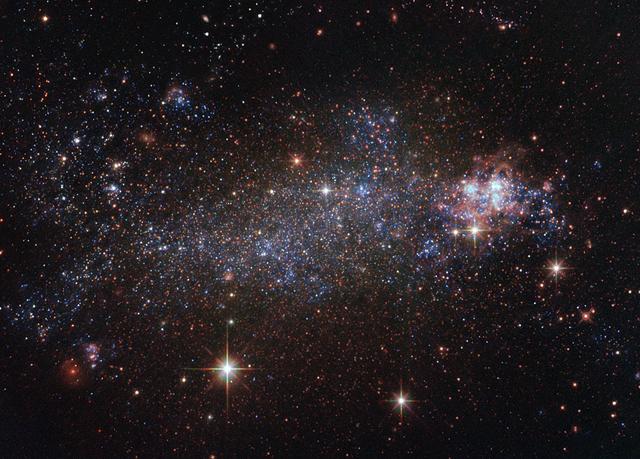
Ver en NASA ↗This NASA/ESA Hubble Space Telescope picture shows a galaxy named SBS 1415+437 or SDSS CGB 12067.1, located about 45 million light-years from Earth. SBS 1415+437 is a Wolf–Rayet galaxy, a type of starbursting galaxy with an unusually high number of extremely …
Ver en NASA ↗On Friday, May 18, 2018, at the Astrotech processing facility in Titusville, Florida, near NASA's Kennedy Space Center, scientists and engineers from the Applied Physics Laboratory at Johns Hopkins University install a computer chip on NASA's Parker Solar Pro…
Ver en NASA ↗Eclipse 2010 Composite A solar eclipse photo (gray and white) from the Williams College Expedition to Easter Island in the South Pacific (July 11, 2010) was embedded with an image of the Sun’s outer corona taken by the Large Angle Spectrometric Coronagraph (…
Ver en NASA ↗Less than once per decade, Mercury passes between the Earth and the sun in a rare astronomical event known as a planetary transit. The 2016 Mercury transit occurred on May 9th, between roughly 7:12 a.m. and 2:42 p.m. EDT. The images in this video are from NA…
Ver en NASA ↗Contenido y metadatos proporcionados por la NASA Image and Video Library.