





/NASA’s%20Artemis%20III%20Announcement%20(Official%20NASA%20Trailer)~thumb.jpg)

This full-frame view of asteroid Vesta was obtained by NASA Dawn spacecraft with its framing camera on July, 24 2011. This image was taken through the camera clear filter. The image has a resolution of about 485 meters per pixel.
Ver en NASA ↗🚀 Biblioteca espacial oficial
Imágenes y vídeos de NASA
Explora el catálogo multimedia público de NASA sin salir de TuPortalNews.
Explora temas destacados
Selecciona un tema o realiza una búsqueda personalizada.
3.592 resultados en NASA
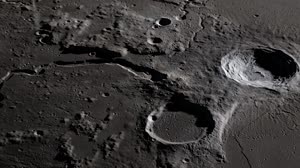
This image from NASA Dawn spacecraft shows many large subdued craters that have smaller, younger craters on top of them on asteroid Vesta. There are two large subdued craters in the center of the image, which have very degraded and rounded rims.
Ver en NASA ↗This artist image depicts a faraway solar system like our own except for one big difference. Planets and asteroids circle around not one, but two suns. NASA Spitzer Space Telescope found evidence that such solar systems may be common in the universe.
Ver en NASA ↗This image from NASA Dawn spacecraft of asteroid Vesta shows Antonia crater. Antonia rim has two different states of freshness: the bottom left one-third of the rim is very degraded but the other two-thirds of the rim is reasonably fresh.
Ver en NASA ↗This 3D image shows the topography of craters and grooves of asteroid Vesta south polar region obtained by the framing camera instrument aboard NASA Dawn spacecraft on Aug. 23 and 28, 2011. You need 3D glasses to view this image.
Ver en NASA ↗This image from NASA Dawn spacecraft of asteroid Vesta shows Aelia crater with a larger, more degraded crater to the left. Dark and bright material crops out from Aelia rim and slumps towards its center extending in rays outside the crater rim.
Ver en NASA ↗This image from NASA Dawn spacecraft shows a part of asteroid Vesta surface reasonably far north into the northern hemisphere which appears washed out because it has been stretched to make features visible that would otherwise be too dark to see.
Ver en NASA ↗Observations from NASA Spitzer Space Telescope have revealed that mature planetary systems -- dusty disks of asteroids, comets and possibly planets -- are more frequent around close-knit twin, or binary, stars than single stars like our sun.
Ver en NASA ↗These two images compare topographic maps of the giant asteroid Vesta as discerned by NASA Hubble Space Telescope top and as seen by NASA Dawn spacecraft bottom. Hubble has been in an orbit around Earth, while Dawn orbited Vesta from 2011 to 2012.
Ver en NASA ↗In this diagram, the Vega system, which was already known to have a cooler outer belt of comets orange, is compared to our solar system with its asteroid and Kuiper belts. The ring of warm, rocky debris was detected using NASA Spitzer Space Telescope,
Ver en NASA ↗NASA Dawn spacecraft obtained this image of asteroid Vesta south polar scarp with its framing camera on August 12, 2011. The image was taken through the framing camera clear filter. The image has a resolution of about 260 meters per pixel.
Ver en NASA ↗This image, processed to show the true size of the giant asteroid Vesta, shows Vesta in front of a spectacular background of stars. It was obtained by the framing camera aboard NASA Dawn spacecraft on May 3, 2011, from a distance of about 750,000 miles.
Ver en NASA ↗This image is from the last sequence of images NASA Dawn spacecraft obtained of the giant asteroid Vesta, looking down at Vesta north pole as it was departing. Dawn escaped from Vesta orbit on Sept. 4, 2012 PDT Sept. 5, 2012 CET.
Ver en NASA ↗This image from NASA Dawn spacecraft shows heavily cratered terrain in asteroid Vesta equatorial region. The craters have a wide range of sizes and many different forms, which include fresh, degraded and barely visible because they are so degraded.
Ver en NASA ↗NASA Dawn spacecraft obtained this image of asteroid Vesta with its framing camera on Sept. 09, 2011. This image of the south polar region was taken at a distance of 864 miles 1,390 kilometers. The image has a resolution of about 130 meters per pixel.
Ver en NASA ↗This image from NASA Dawn spacecraft shows small rilles scars on asteroid Vesta surface, mostly concentrated in the right half image, presumably due to impacts throwing out boulders, which crash across the surface scouring the rilles as they go.
Ver en NASA ↗This image from NASA Dawn spacecraft of asteroid Vesta shows Sossia crater, which is the crater partially surrounded by dark material. Sossia crater has a reasonably fresh rim and patches of dark material cropping out around part of this rim.
Ver en NASA ↗NASA Dawn spacecraft obtained these images of asteroid Vesta on Aug. 28 left and Sept. 9, 2011. These images of the south polar region were taken at a distance of 1,700 miles 2,740 kilometers with a resolution of about 260 and 130 meters per pixel.
Ver en NASA ↗Comet C/2013 UQ4 Catalina first looked like an asteroid when NASA NEOWISE team first observed it on December 31, 2013. These exposures were taken that day, when the comet was at a distance of about 2.9 AU from the sun.
Ver en NASA ↗NASA Dawn spacecraft obtained this image of the surface of asteroid Vesta with its framing camera on August 12, 2011. This image was taken through the framing camera clear filter. The image has a resolution of about 260 meters per pixel.
Ver en NASA ↗NASA’s Psyche spacecraft undergoes processing and servicing ahead of launch atop a work stand inside the Payload Hazardous Servicing Facility at NASA’s Kennedy Space Center in Florida on May 3, 2022. Psyche is targeting to lift off aboard a SpaceX Falcon Heav…
Ver en NASA ↗A team working on NASA’s Psyche spacecraft transitioning it from a vertical to horizontal test configuration during prelaunch processing inside the Payload Hazardous Servicing Facility at NASA’s Kennedy Space Center in Florida on May 9, 2022. The mission is t…
Ver en NASA ↗NASA Office of Communications Deputy Chief Patrick Lynch, left, introduces, from left to right, NASA Program Executive Melissa Morris, NASA Project Manager Rich Burns, Lockheed Martin Program Manager Sandy Freund, OSIRIS-REx Deputy Curation Lead Kevin Righter…
Ver en NASA ↗NASA’s Psyche spacecraft undergoes processing and servicing ahead of launch atop a work stand inside the Payload Hazardous Servicing Facility at NASA’s Kennedy Space Center in Florida on May 3, 2022. Psyche is targeting to lift off aboard a SpaceX Falcon Heav…
Ver en NASA ↗Contenido y metadatos proporcionados por la NASA Image and Video Library.