





/NASA’s%20Artemis%20III%20Announcement%20(Official%20NASA%20Trailer)~thumb.jpg)

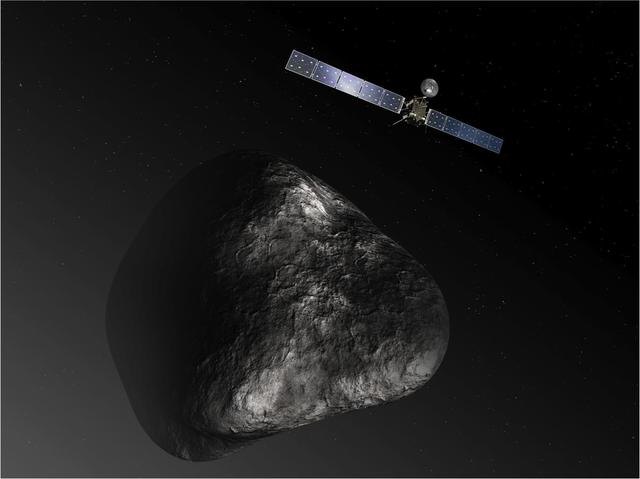
Oliver Price, a planetary science PhD student at University College London’s Mullard Space Science Laboratory in the United Kingdom, has developed a new image-processing technique to mine through the wealth of data about comet tails.
Ver en NASA ↗🚀 Biblioteca espacial oficial
Imágenes y vídeos de NASA
Explora el catálogo multimedia público de NASA sin salir de TuPortalNews.
Explora temas destacados
Selecciona un tema o realiza una búsqueda personalizada.
400 resultados en NASA
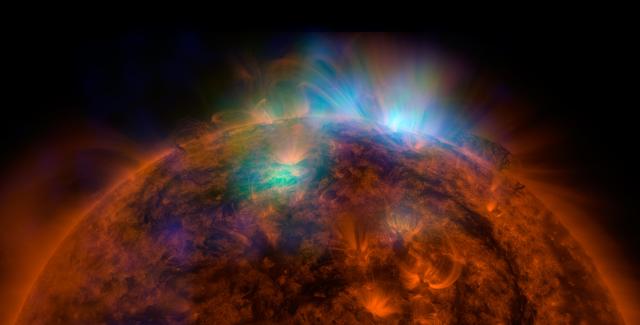
Along with the visible light and warmth constantly emitted by our sun comes a whole spectrum of X-ray and ultraviolet radiation that streams toward Earth. A new CubeSat – a miniature satellite that provides a low-cost platform for missions – is now in space o…
Ver en NASA ↗NASA ASTRONAUTS DISCUSS MISSION WITH KCRG-TV AND KITSAP SUN NEWSPAPER Aboard the International Space Station, NASA astronauts Raja Chari and Kayla Barron discussed living and working in space during an in-flight event December 13 with KCRG-TV in Cedar Rapids…
Ver en NASA ↗A movie trailer about the MMS mission.
Ver en NASA ↗A coronal mass ejection burst off the side of the sun on May 9, 2014. The giant sheet of solar material erupting was the first CME seen by NASA's Interface Region Imaging Spectrograph, or IRIS. The field of view seen here is about five Earth's wide and about …
Ver en NASA ↗On April 17, 2016, an active region on the sun’s right side released a mid-level solar flare, captured here by NASA’s Solar Dynamics Observatory. This solar flare caused moderate radio blackouts, according to NOAA’s Space Weather Prediction Center. Scientists…
Ver en NASA ↗On April 17, 2016, an active region on the sun’s right side released a mid-level solar flare, captured here by NASA’s Solar Dynamics Observatory. This solar flare caused moderate radio blackouts, according to NOAA’s Space Weather Prediction Center. Scientists…
Ver en NASA ↗Edited video of a solar prominence seen by NASA's Solar Dynamics Observatory on April 21, 2015.
Ver en NASA ↗Hear data visualizer Ernie Wright discuss the map in the video above.
Ver en NASA ↗Bright swaths of red and green, known as airglow, are visible in this time-lapse view of Earth's limb captured from the International Space Station. Airglow occurs when gases in the upper atmosphere become charged by the Sun's radiation, emitting light. By me…
Ver en NASA ↗During the June 2011 lunar eclipse, scientists will be able to get a unique view of the moon. While the sun is blocked by the Earth, LRO's Diviner instrument will take the temperature on the lunar surface. Since different rock sizes cool at different rates, s…
Ver en NASA ↗Scientists have recently gathered some of the strongest evidence to date to explain what makes the sun's outer atmosphere so much hotter than its surface.
Ver en NASA ↗This short video features commentary by David Sibeck, project scientist for the THEMIS mission, discussing a visualization of reconnection fronts.
Ver en NASA ↗On Jan. 28, 2014, NASA's newly-launched Interface Region Imaging Spectrograph, or IRIS, observed its strongest solar flare to date.
Ver en NASA ↗On March 17, 2015, an interplanetary shock – a shockwave created by the driving force of a coronal mass ejection, or CME, from the sun – struck the outermost radiation belt, triggering the greatest geomagnetic storm of the preceding decade. And NASA's Van All…
Ver en NASA ↗This video explains how our moon creates a solar eclipse, why it's such a rare event to see, and how data from NASA's Lunar Reconnaissance Orbiter has enhanced our ability to map an eclipse's path of totality.
Ver en NASA ↗The Magnetospheric Multiscale, or MMS, mission stacked all four of its spacecraft in preparation for vibration testing. This time lapse shows one image every thirty seconds over three days of work. First, the spacecraft are assembled into mini-stacks, or plac…
Ver en NASA ↗The Solar Dynamics Observatory (SDO) celebrates its 5th anniversary since it launched on February 11, 2010. This time-lapse video captures one frame every 8 hours starting when data became available in June 2010 and finishing February 8, 2015. The different c…
Ver en NASA ↗Using data from three different satellites, scientists have developed new models that recreate, in 3-D, CMEs and shocks, separately. This movie illustrates the recreation of a CME and shock that erupted from the Sun on March 7, 2011. The pink lines show the C…
Ver en NASA ↗Short, narrated video about IBEX's interstellar matter observations.
Ver en NASA ↗A mid-level flare, an M6.5, erupted from the sun on April 2, 2014, peaking at 10:05 a.m. EDT. This image from NASA's Solar Dynamics Observatory shows the flare in a blend of two wavelengths of extreme ultraviolet light: 304 angstroms and 171 angstroms, colori…
Ver en NASA ↗Contenido y metadatos proporcionados por la NASA Image and Video Library.