















/NASA’s%20Artemis%20III%20Announcement%20(Official%20NASA%20Trailer)~thumb.jpg)
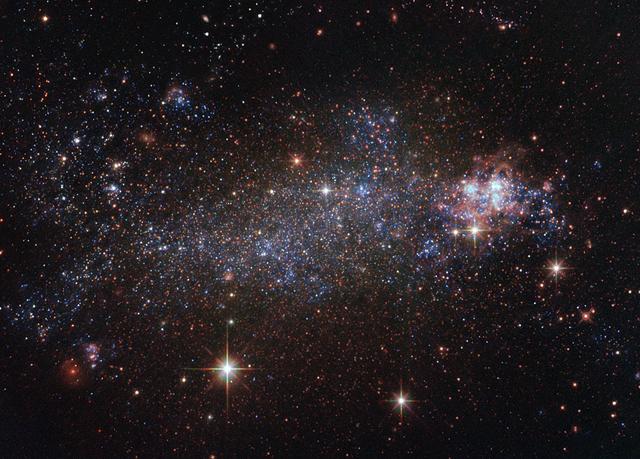


Scientists on NASA's New Horizons mission have discovered what looks like a giant bite-mark on the planet surface. The southern portion of the left inset above shows the cratered plateau uplands informally named Vega Terra.
Ver en NASA ↗🚀 Biblioteca espacial oficial
Imágenes y vídeos de NASA
Explora el catálogo multimedia público de NASA sin salir de TuPortalNews.
Explora temas destacados
Selecciona un tema o realiza una búsqueda personalizada.
548 resultados en NASA
This computer animation illustrates how Pluto's moon Nix changes its spin unpredictably as it orbits the "double planet" Pluto-Charon. The view is from the surface of Pluto as the moon circles the Pluto-Charon system. This is a time-lapse view of th…
Ver en NASA ↗This artist concept shows NASA fleet of observatories busily gathering data before and after July 14, 2015 to help piece together what we know about Pluto, and what features New Horizons data might help explain.
Ver en NASA ↗NASA New Horizons spacecraft detected water ice on Pluto surface, picking up on the ice near-infrared spectral characteristics in regions informally called Viking Terra, along Virgil Fossa west of Elliot crater, and in Bare Montes.
Ver en NASA ↗On July 14, 2015, the telescopic camera on NASA New Horizons spacecraft took the highest resolution images ever obtained of the intricate pattern of pits across a section of Pluto prominent heart-shaped region, informally named Tombaugh Regio.
Ver en NASA ↗This image was taken by the Long Range Reconnaissance Imager (LORRI) on NASA's New Horizons spacecraft shortly before closest approach to Pluto on July 14, 2015; it resolves details as small as 270 yards (250 meters). The scene shown is about 130 miles (210 k…
Ver en NASA ↗This image shows the results of the New Horizons team first search for potentially hazardous material around Pluto, conducted May 11-12, 2015, from a range of 47 million miles 76 million kilometers.
Ver en NASA ↗**This image was taken at 3:38 a.m. EDT on July 13, one day before New Horizons’ closest approach to Pluto.** New Horizons has obtained impressive new images of Pluto and its large moon Charon that highlight their compositional diversity. These are not actua…
Ver en NASA ↗This annotated view from NASA New Horizons of a portion of Pluto Sputnik Planum Sputnik Plain, named for Earth first artificial satellite, shows an array of enigmatic features.
Ver en NASA ↗This area seen by NASA's New Horizons is south of Pluto dark equatorial band informally named Cthulhu Regio, and southwest of the vast nitrogen ice plains informally named Sputnik Planitia.
Ver en NASA ↗This area seen by NASA's New Horizons is south of Pluto dark equatorial band informally named Cthulhu Regio, and southwest of the vast nitrogen ice plains informally named Sputnik Planitia.
Ver en NASA ↗This image of Pluto is part of series of New Horizons Long Range Reconnaissance Imager LORRI photos taken May 8-12, 2015; the image at left shows LORRI view of Pluto just one month earlier.
Ver en NASA ↗Pluto and Charon, the largest of Pluto five known moons, seen Jan. 25 and 27, 2015, through the telescopic Long-Range Reconnaissance Imager LORRI on NASA New Horizons spacecraft.
Ver en NASA ↗This image of Pluto is part of series of New Horizons Long Range Reconnaissance Imager LORRI photos taken May 8-12, 2015; the image at left shows LORRI view of Pluto just one month earlier.
Ver en NASA ↗This image of Pluto is part of series of New Horizons Long Range Reconnaissance Imager LORRI photos taken May 8-12, 2015; the image at left shows LORRI view of Pluto just one month earlier.
Ver en NASA ↗This geological map from NASA's New Horizons covers a portion of Pluto's surface and includes the vast nitrogen-ice plain informally named Sputnik Planum and surrounding terrain.
Ver en NASA ↗A composite of enhanced color images of Pluto lower right and Charon upper left, taken by NASA New Horizons spacecraft as it passed through the Pluto system on July 14, 2015. This image highlights the striking differences between Pluto and Charon.
Ver en NASA ↗Pluto nearly fills the frame in this image from the Long Range Reconnaissance Imager (LORRI) aboard NASA’s New Horizons spacecraft, taken on July 13, 2015, when the spacecraft was 476,000 miles (768,000 kilometers) from the surface. This is the last and most …
Ver en NASA ↗This image obtained by NASA's New Horizons spacecraft shows the night side of Pluto large, Texas-sized moon Charon, against a star field, lit by faint, reflected light from Pluto itself.
Ver en NASA ↗This image of Pluto and its big moon Charon was taken by NASA New Horizons spacecraft at 04:15 UTC on July 1, 2015, and shows the clearest view yet of the sides of Pluto and Charon.
Ver en NASA ↗New close-up images of a region near Pluto’s equator reveal a giant surprise: a range of youthful mountains rising as high as 11,000 feet (3,500 meters) above the surface of the icy body. The mountains likely formed no more than 100 million years ago -- mere…
Ver en NASA ↗Locations of more than 1,000 craters mapped on Pluto by NASA New Horizons mission indicate a wide range of surface ages, which likely means that Pluto has been geologically active throughout its history.
Ver en NASA ↗Audience members view images of Neptune taken by Voyager while scientists discuss how the first images of Pluto and its moons will be captured during the "New Horizons: The First Mission to the Pluto System and the Kuiper Belt" Event at NASA Headquarters in W…
Ver en NASA ↗These images from NASA New Horizons spacecraft show numerous large-scale features on Pluto surface. When various large, dark and bright regions appear near limbs, they give Pluto a distinct, but false, non-spherical appearance.
Ver en NASA ↗Contenido y metadatos proporcionados por la NASA Image and Video Library.