





/NASA’s%20Artemis%20III%20Announcement%20(Official%20NASA%20Trailer)~thumb.jpg)

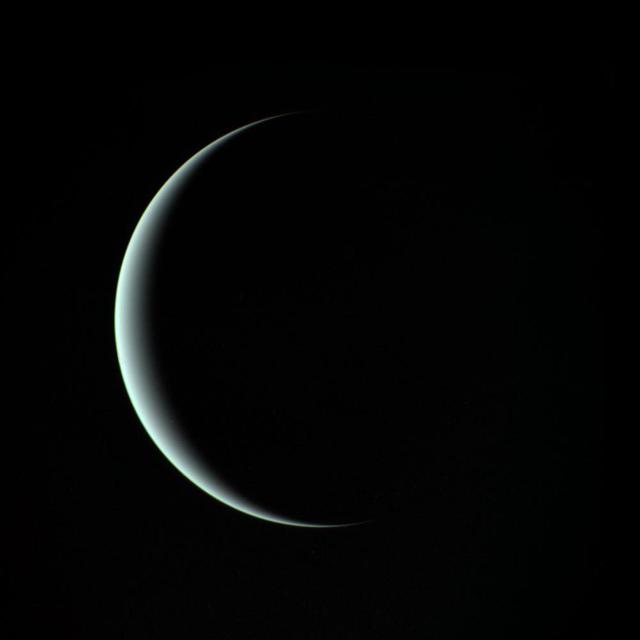
Photo by Voyager 2 (JPL) During August 16 and 17, 1989, the Voyager 2 narrow-angle camera was used to photograph Neptune almost continuously, recording approximately two and one-half rotations of the planet. These images represent the most complete set of ful…
Ver en NASA ↗🚀 Biblioteca espacial oficial
Imágenes y vídeos de NASA
Explora el catálogo multimedia público de NASA sin salir de TuPortalNews.
Explora temas destacados
Selecciona un tema o realiza una búsqueda personalizada.
265 resultados en NASA
This mosaic from NASA Galileo Probe is of an equatorial hotspot on Jupiter and shows the features of a hazy cloud layer tens of kilometers above Jupiter main visible cloud deck.
Ver en NASA ↗Ames and Moffett Field (MFA) historical sites and memorials Navy Lockheed SP-2E Neptune Long Range Antisubmarine Partol Aircraft on display in front of MFA Bldg 158 Flgiht Ops (tower) with monuments
Ver en NASA ↗This diagram image shows the estimated radii of the six planets in the planetary system K2-128, as well as their distance from the parent star.
Ver en NASA ↗Ames and Moffett Field (MFA) historical sites and memorials Navy Lockheed SP-2E Neptune Long Range Antisubmarine Partol Aircraft on display in front of MFA Bldg 158 Flgiht Ops (tower) with monuments
Ver en NASA ↗P-34712 Range: 1.1 million kilometers (683,000 miles) This wide-angle Voyager 2 image, taken through the camera's clear filter, is the first to show Neptune's rings in detail. The two main rings, about 53,000 km (33,000 miles) and 63,000 km (39,000 miles) fro…
Ver en NASA ↗P-34578 BW One of two new ring arcs, or partial rings, discovered by Voyager 2, is faintly visible just outside the orbit of the Neptunian moon 1989N4.The 155-second exposure taken by the spacecraft's narrow-angle camera shows the glare of an overexposed Nept…
Ver en NASA ↗Range : 16 million km (9.9 million miles) P-34616 This series of six Voyager 2 images of Neptune through different filters reveals altitude in Neptune's clouds. The top three images, taken though orange, violet, and ultraviolet filters by the narrow-angle c…
Ver en NASA ↗Planets having atmospheres rich in helium may be common in our galaxy, according to a new theory based on data from NASA Spitzer Space Telescope. This artist concept depicts a proposed helium-atmosphere planet called GJ 436b.
Ver en NASA ↗This annotated map projection from NASA's New Horizons spacecraft shows Charon, the largest of Pluto's five moons, annotated with its first set of official feature names.
Ver en NASA ↗P-34666 This false color photograph of Neptune was reconstructed from two images taken by Voyager 2's wide angle camera, through the orange and two different methane filters. Objects that deep in the atmosphere are blue, while those at higher altitudes are wh…
Ver en NASA ↗Range : 4 million km (2.5 million miles) Already-intriquing patterns of unknown origin appear on the surgace of Neptune's largest satellite, Trition, in this image from Voyager 2. Voyager images show that Trition's diameter is about 2,720 km (1,690 miles), …
Ver en NASA ↗This picture of Neptune was produced from images taken through the ultraviolet, violet and green filters of the Voyager 2 wide-angle camera. This 'false' color image has been made to show clearly details of the cloud structure and to paint clouds located at …
Ver en NASA ↗Range : 14.8 million km. ( 9.2 million miles) P-34595C This contrast enhanced color photograph of Neptune was produced from images taken through the orange, green, and violet filters of the narrow angle camera. As Voyager 2 approaches Neptune, rapidly increa…
Ver en NASA ↗P-34668 Range : 25 million km. ( 16 million miles ) Smallest Resolvable Feature : 45 km or 28 miles This Voyager 2 image of Neptune, shot with a narrow angle camera, shows the discovery of shadows in Neptune's atmosphere. The shadows cast onto deep cloud …
Ver en NASA ↗Voyager II Imagery - Neptune: This image of clouds in Neptune's atmosphere is the first that tests the accuracy of the weather forecast that was made eight days earlier to select targets for the Voyager narrow-angle camera. Three of the four targeted feature…
Ver en NASA ↗Voyager II Imagery; Neptune. This bulls-eye view of Neptune's small dark spot (D2) was obtained by Voyager 2's narrow-angle camera , when Neptune was within 1.1 million km (680,000 miles) of the planet. The smallest structures that can be seen are 20 km (12 m…
Ver en NASA ↗Dr. Fran Bagenal, senior scientist at the University of Colorado, far right, speaks during a panel discussion at the "NASA's New Horizons Pluto Mission: Continuing Voyager's Legacy of Exploration" event on Monday, August, 25, 2014, in the James E. Webb Audito…
Ver en NASA ↗By using NASA's Spitzer Space Telescope, astronomers have found that the varying glow of brown dwarfs over time can be explained by bands of patchy clouds rotating at different speeds, as shown in this artist's concept.
Ver en NASA ↗P-34665 This false color Voyager 2 image of Neptune's satellite Triton, is a composite of three images taken through ultraviolet, green, and viloet filters. The smallest resolvable features are about 47 km., or 29 miles accross. Mottling in the bright souther…
Ver en NASA ↗P-34689 Range : 130,000 km. ( 80,000 miles ) Smallest Resolvable Feature : 2.5 km or 1.5 miles This image of Neptune's moon Triton, shot by Voyager 2, is seen here. The long linear feature exteding vertically across the image is probably a graben -- a norro…
Ver en NASA ↗P-34690 Field of View : 1,000 km. or 600 miles This photograph of Neptune's moon Triton was acquired by Voyager 2. Triton's limb cuts obliquely accross the middle of the image. Three irregular dark areas, surrounded by brighter material, dominate the image. …
Ver en NASA ↗P-34681 Range: 870,000 kilometers (540,000 miles) This image of Neptune's irregularly-shaped satellite 1989N1 taken by Voyager 2 shows a resolution of 8 kilometers (5 miles) per pixel. The satellite has an average radius of about 200 kilometers (120 miles) an…
Ver en NASA ↗Dr. John Spencer, senior scientist at the Southwest Research Institute, answers a question from the audience during a panel discussion at the "NASA's New Horizons Pluto Mission: Continuing Voyager's Legacy of Exploration" event on Monday, August, 25, 2014, in…
Ver en NASA ↗Contenido y metadatos proporcionados por la NASA Image and Video Library.