





/NASA’s%20Artemis%20III%20Announcement%20(Official%20NASA%20Trailer)~thumb.jpg)

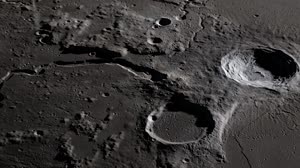
Banded Moon
Ver en NASA ↗🚀 Biblioteca espacial oficial
Imágenes y vídeos de NASA
Explora el catálogo multimedia público de NASA sin salir de TuPortalNews.
Explora temas destacados
Selecciona un tema o realiza una búsqueda personalizada.
19.932 resultados en NASA
Disturbing Moons
Ver en NASA ↗Switcharoo Moons
Ver en NASA ↗Fingerprints of the Moons
Ver en NASA ↗Most mountains on the Earth are formed as plates collide and the crust buckles. Not so for the Moon, where mountains are formed as a result of impacts as seen by NASA Lunar Reconnaissance Orbiter.
Ver en NASA ↗NASA Galileo spacecraft took this image of Earth moon on December 7, 1992 on its way to explore the Jupiter system in 1995-97. The distinct bright ray crater at the bottom of the image is the Tycho impact basin.
Ver en NASA ↗This map shows the gravity field of the moon as measured by NASA GRAIL mission. The viewing perspective, known as a Mercator projection, shows the far side of the moon in the center and the nearside as viewed from Earth at either side.
Ver en NASA ↗The waxing gibbous Moon above the southern Atlantic Ocean
Ver en NASA ↗New Moon. By the modern definition, New Moon occurs when the Moon and Sun are at the same geocentric ecliptic longitude. The part of the Moon facing us is completely in shadow then. Pictured here is the traditional New Moon, the earliest visible waxing cresce…
Ver en NASA ↗These graben - a kind of trench that is formed as a surface expands - were imaged near a region of the Moon called Mare Frigoris by NASA's Lunar Reconnaissance Orbiter (LRO).
Ver en NASA ↗This image of the crescent moon was obtained by the Galileo Solid State imaging system on December 8 at 5 a.m. PST as NASA Galileo spacecraft neared the Earth.
Ver en NASA ↗New Moon. By the modern definition, New Moon occurs when the Moon and Sun are at the same geocentric ecliptic longitude. The part of the Moon facing us is completely in shadow then. Pictured here is the traditional New Moon, the earliest visible waxing cresce…
Ver en NASA ↗NASA Lunar Reconnaissance Orbiter looks at the Moon in 3D. 3D glasses are necessary to view this image.
Ver en NASA ↗Mars is kept company by two cratered moons -- an inner moon named Phobos and an outer moon named Deimos.
Ver en NASA ↗Panoramas of Apollo sites were created to familiarize various Constellation projects with the actual nature of the lunar surface. View of the Lunar Surface towards the western Horizon. Image was created using Apollo 14 images - mag 66 frames 9271 thru 9293.
Ver en NASA ↗This image of the western hemisphere of the Moon was taken through a green filter by NASA Galileo spacecraft at 9:35 a.m. PST Dec. 9 at a range of about 350,000 miles. In the center is the Orientale Basin.
Ver en NASA ↗This view of the Moon north pole is a mosaic assembled from 18 images taken by NASA Galileo imaging system through a green filter as the spacecraft flew by on December 7, 1992.
Ver en NASA ↗A special maneuver of NASA Terra spacecraft was performed as it traversed the nightside enabling a backward somersault of the spacecraft, allowing the normally Earth-viewing instruments to look at deep space and the waxing gibbous Moon.
Ver en NASA ↗These color visualizations of the Moon were obtained by NASA Galileo spacecraft as it left the Earth after completing its first Earth Gravity Assist. The images were acquired Dec. 8-9, 1990.
Ver en NASA ↗ISS040-E-010643 (12 June 2014) --- A full moon is featured in this image photographed by an Expedition 40 crew member on the International Space Station.
Ver en NASA ↗Full Moon. Rises at sunset, high in the sky around midnight. Visible all night. This marks the first time that accurate shadows at this level of detail are possible in such a computer simulation. The shadows are based on the global elevation map being develo…
Ver en NASA ↗This composite image depicts the moon rugged south polar region in two lights. The color image is the highest resolution topography map to date of the moon south pole.
Ver en NASA ↗The full moon is seen as it rises near the National Mall, Saturday, March 19, 2011, in Washington. The full moon tonight is called a "Super Moon" since it is at its closest to Earth. Photo Credit: (NASA/Paul E. Alers)
Ver en NASA ↗The full moon is seen with holiday lights, Tuesday, Dec. 29, 2020, in Arlington, Va. Photo Credit: (NASA/Bill Ingalls)
Ver en NASA ↗Contenido y metadatos proporcionados por la NASA Image and Video Library.