





/NASA’s%20Artemis%20III%20Announcement%20(Official%20NASA%20Trailer)~thumb.jpg)


001D8612.NEF
Ver en NASA ↗🚀 Biblioteca espacial oficial
Imágenes y vídeos de NASA
Explora el catálogo multimedia público de NASA sin salir de TuPortalNews.
Explora temas destacados
Selecciona un tema o realiza una búsqueda personalizada.
629 resultados en NASA
728U1767.NEF
Ver en NASA ↗NASA Galaxy Evolution Explorer Mission celebrates its sixth anniversary studying galaxies beyond our Milky Way through its sensitive ultraviolet telescope, the only such far-ultraviolet detector in space. Pictured here, the galaxy NGC598 known as M33.
Ver en NASA ↗This image shows the central region of the spiral galaxy NGC 4631 as seen edge-on from the Chandra X-Ray Observatory (CXO) and the Hubble Space Telescope (HST). The Chandra data, shown in blue and purple, provide the first unambiguous evidence for a halo of h…
Ver en NASA ↗S66-45328 (19 July 1966) --- Ultraviolet spectra of stars in the Carina-Vela region of the southern Milky Way. These objective-grating spectra were obtained by astronauts John W. Young and Michael Collins during Gemini-10 stand-up EVA on July 19, 1966, with a…
Ver en NASA ↗007Q0232.NEF
Ver en NASA ↗The tip of the wing of the Small Magellanic Cloud galaxy is dazzling in this new view from NASA Great Observatories. The SMC, is a small galaxy about 200,000 light-years way that orbits our own Milky Way spiral galaxy.
Ver en NASA ↗The large bubble is an embryonic star that looks set to turn into one of the brightest stars in our Milky Way galaxy in this infrared image from the Herschel Space Telescope.
Ver en NASA ↗NASA Spitzer Space Telescope sees RCW 79 in the southern Milky Way, 17,200 light-years from Earth in the constellation Centaurus.
Ver en NASA ↗In a global experiment in exoplanet observation, the K2 mission and Earth-based observatories on six continents will survey millions of stars toward the center of our Milky Way galaxy.
Ver en NASA ↗NASA NuSTAR has captured these first, focused views of the supermassive black hole at the heart of our Milky Way galaxy in high-energy X-ray light.
Ver en NASA ↗This image shows a composite view of the Crab nebula, an iconic supernova remnant in our Milky Way galaxy, as viewed by the Herschel Space Observatory and the Hubble Space Telescope.
Ver en NASA ↗This composite of the giant barred spiral galaxy NGC 6872 is 522,000 light-years across, making it about five times the size of the Milky Way.
Ver en NASA ↗This panoramic view encompasses the entire sky and reveals the distribution of galaxies beyond the Milky Way galaxy, which astronomers call extended sources, as observed by Two Micron All-Sky Survey.
Ver en NASA ↗There something special going on in the nearby Circinus galaxy, as revealed by this image from NASA WISE telescope. The Circinus galaxy is located in the constellation of Circinus and is obscured by the plane of our Milky Way galaxy.
Ver en NASA ↗This image is a map of the portion of the sky covered by the preliminary release of WISE data. WISE surveyed the entire sky in four infrared wavelengths in 2010. This map is centered on the Milky Way galaxy.
Ver en NASA ↗This image from NASA Herschel, in the constellation of Vulpecula, shows an entire assembly line of newborn stars. The diffuse glow reveals the widespread cold reservoir of raw material that our Milky Way galaxy has in stock for building stars.
Ver en NASA ↗W3 is an enormous stellar nursery about 6,200 light-years away in the Perseus Arm, one of the Milky Way galaxy main spiral arms as seen by ESA Herschel space observatory.
Ver en NASA ↗NASA Spitzer Space Telescope shows the supernova remnant 1E0102.2-7219 sits next to the nebula N76 in a bright, star-forming region of the Small Magellanic Cloud, a satellite galaxy to our Milky Way galaxy.
Ver en NASA ↗A rich collection of colorful astronomical objects is revealed in this picturesque image of the Rho Ophiuchi cloud complex from NASA Wide-field Infrared Explorer; the cloud is found rising above the plane of the Milky Way in the night sky.
Ver en NASA ↗This composite of 30 Doradus, the Tarantula Nebula, contains data from Chandra blue, Hubble green, and Spitzer red. Located in the Large Magellanic Cloud, the Tarantula Nebula is one of the largest star-forming regions close to the Milky Way.
Ver en NASA ↗By spying on a neighboring galaxy, NASA Hubble Space Telescope has captured an image of a young, globular-like star cluster—a type of object unknown in our Milky Way Galaxy.
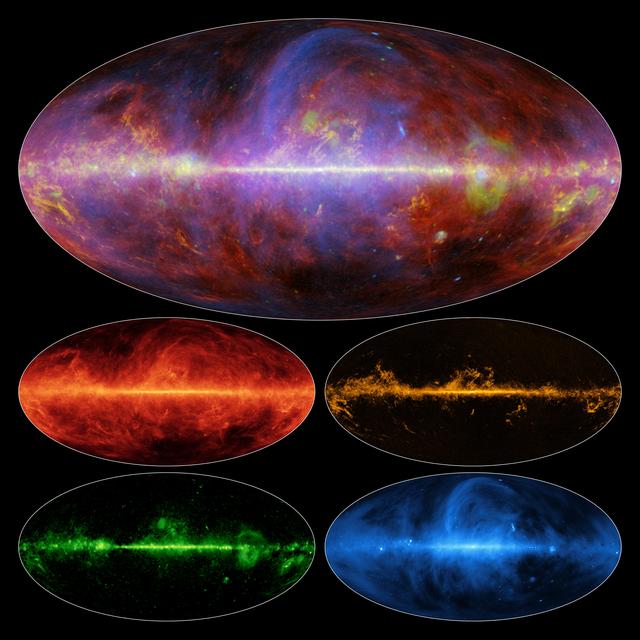
Ver en NASA ↗This image of the microwave sky was synthesized using data spanning the range of light frequencies detected by ESA Planck. A vast portion of the sky is dominated by the diffuse emission from gas and dust in our Milky Way galaxy.
Ver en NASA ↗This artist concept shows NASA Voyager spacecraft against a field of stars in the darkness of space as they travel farther away from Earth, on a journey to interstellar space, and will eventually circle around the center of the Milky Way galaxy.
Ver en NASA ↗Contenido y metadatos proporcionados por la NASA Image and Video Library.