





/NASA’s%20Artemis%20III%20Announcement%20(Official%20NASA%20Trailer)~thumb.jpg)

At least four distinct plumes of water ice spew out from the south polar region of Saturn moon Enceladus in this dramatically illuminated image. Light reflected off Saturn is illuminating the surface of the moon while the sun backlights the plumes.
Ver en NASA ↗🚀 Biblioteca espacial oficial
Imágenes y vídeos de NASA
Explora el catálogo multimedia público de NASA sin salir de TuPortalNews.
Explora temas destacados
Selecciona un tema o realiza una búsqueda personalizada.
6.539 resultados en NASA
Comet C/2013 UQ4 Catalina first looked like an asteroid when NASA NEOWISE team first observed it on December 31, 2013. These exposures were taken that day, when the comet was at a distance of about 2.9 AU from the sun.
Ver en NASA ↗This chart compares the first Earth-size planets found around a sun-like star to planets in our own solar system, Earth and Venus. NASA Kepler mission discovered the newfound planets, called Kepler-20e and Kepler-20f.
Ver en NASA ↗NASA NEOWISE spacecraft viewed comet C/2014 Q2 Lovejoy for a second time on January 30, 2015, as the comet passed through the closest point to our sun along its 14,000-year orbit, at a solar distance of 120 million miles 193 million kilometers.
Ver en NASA ↗These two images show HD 157728, a nearby star 1.5 times larger than the sun. Project 1640 uses new technology on the Palomar Observatory 200-inch Hale telescope near San Diego, Calif., to spot planets.
Ver en NASA ↗The Sun blew out a powerful coronal mass ejection (CME) from just around the edge of the Sun (Oct. 14, 2014). The particle cloud expanded around all the Sun in a rough circle, hence the name 'halo' CME. This event was also associated with a fairly strong flar…
Ver en NASA ↗iss070e024002 (Nov. 13, 2023) --- The sun's glint beams in between a cloudy stretch of the south Atlantic Ocean off the coast of Argentina.
Ver en NASA ↗The southward-facing side of Building 4220 on Marshall Space Flight Center’s campus is illuminated by the afternoon sun.
Ver en NASA ↗The sun rises behind Cape Canaveral Lighthouse at Cape Canaveral Air Force Station in Florida on Oct. 13, 2020.
Ver en NASA ↗The sun rises behind Cape Canaveral Lighthouse at Cape Canaveral Air Force Station in Florida on Oct. 13, 2020.
Ver en NASA ↗Earth observation taken by the Expedition 39 crew aboard the ISS. Image was released by astronaut on Twitter and downlinked in folder: sun glint.
Ver en NASA ↗As the sun sets on July 8, 2010, workers prepare to pour new epoxy grout for the hydrostatic bearing assembly of the giant Mars
Ver en NASA ↗Images acquired December 21, 2010 - September 20, 2011. To download the high res and learn more go to: earthobservatory.nasa.gov/IOTD/view.php?id=52248 One of the most frequently misunderstood concepts in science is the reason for Earth’s seasons. As we exp…
Ver en NASA ↗This artist concept depicts a distant hypothetical solar system, similar in age to our own. Looking inward from the system outer fringes, a ring of dusty debris can be seen, and within it, planets circling a star the size of our Sun.
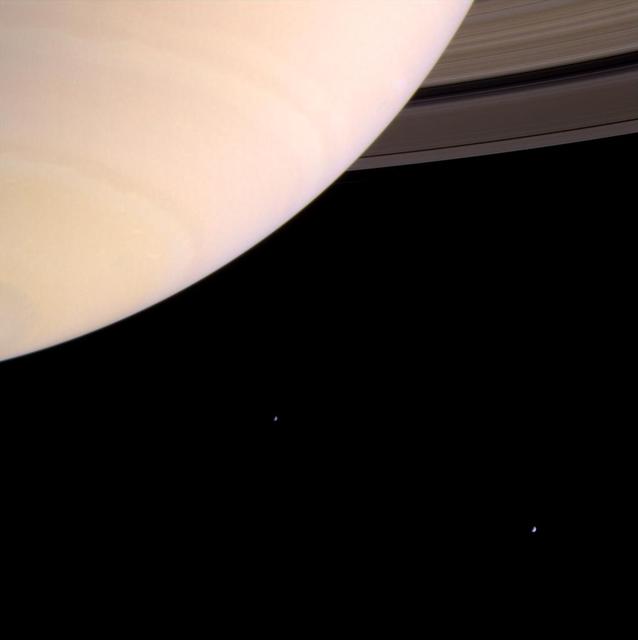
Ver en NASA ↗Although we are used to seeing Saturn moons lit directly by the Sun, sometimes we can catch them illuminated by Saturnshine. Here, NASA Cassini spacecraft see Mimas upper right lit by light reflected off of Saturn.
Ver en NASA ↗As of mid-November, ISON is officially upon us. Using Hubble, we've taken our closest look yet at the innermost region of the comet, where geysers of sublimating ice are fueling a spectacular tail. Made from observations on November 2nd, the image combines …
Ver en NASA ↗This NASA Cassini image of Saturn moon Enceladus backlit by the sun shows the fountain-like sources of the fine spray of material that towers over the south polar region.
Ver en NASA ↗This series of images shows the Martian moon Deimos as it crossed in front of the Sun, as seen by NASA's Curiosity Mars rover on Sunday, March 17, 2019 (the 2,350th Martian day, or sol, of the mission).
Ver en NASA ↗Strands and arches of plasma streamed above the edge of the Sun for over a day, pulled by powerful magnetic forces Aug. 11-12, 2016., observed by NASA's Solar Dynamics Observatory.
Ver en NASA ↗The giant sand dunes in Kaiser Crater, seen by NASA's Mars Reconnaissance Orbiter, experience gully erosion of the steep slip faces every year in late winter as the sun warms these slopes and seasonal carbon dioxide frost sublimates.
Ver en NASA ↗This image captured by NASA's Mars Reconnaissance Orbiter spacecraft has low-sun lighting that accentuates the many transverse ridges on this slope, extending from Euripus Mons mountains.
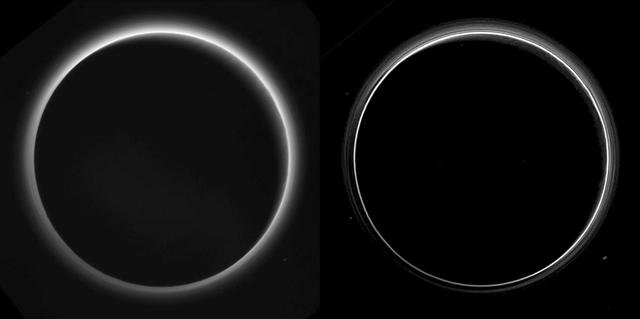
Ver en NASA ↗In this small section of the larger crescent image of Pluto, taken by NASA New Horizons just 15 minutes after the spacecraft closest approach on July 14, 2015, the setting sun illuminates a fog or near-surface haze.
Ver en NASA ↗ISS015-E-10471 (3 June 2007) --- The profile of the atmosphere and a setting sun are featured in this image photographed by an Expedition 15 crewmember on the International Space Station.
Ver en NASA ↗iss063e046732 (July 14, 2020) --- The sun's glint beams on the South Pacific Ocean as the International Space Station orbited just off the coast of Auckland, New Zealand.
Ver en NASA ↗Contenido y metadatos proporcionados por la NASA Image and Video Library.