





/NASA’s%20Artemis%20III%20Announcement%20(Official%20NASA%20Trailer)~thumb.jpg)

A SpaceX Falcon 9 first stage booster lands on Landing Zone 4 following liftoff of NASA’s TRACERS (Tandem Reconnection and Cusp Electrodynamics Reconnaissance Satellites) mission at Space Launch Complex 4 East at Vandenberg Space Force Base in California on …
Ver en NASA ↗🚀 Biblioteca espacial oficial
Imágenes y vídeos de NASA
Explora el catálogo multimedia público de NASA sin salir de TuPortalNews.
Explora temas destacados
Selecciona un tema o realiza una búsqueda personalizada.
6.539 resultados en NASA
The immense Andromeda galaxy, also known as Messier 31, is captured in full in this image from NASA Wide-field Infrared Survey Explorer. Andromeda is the closest large galaxy to our Milky Way galaxy, and is located 2.5 million light-years from our sun.
Ver en NASA ↗On May 19th, 2005, NASA Mars Exploration Rover Spirit captured this stunning view as the Sun sank below the rim of Gusev crater on Mars. This Panoramic Camera Pancam mosaic was taken around 6:07 in the evening of the rover 489th martian day.
Ver en NASA ↗Seasonal flows called recurring slope lineae RSL grow down warm slopes in the summer, fade when they become inactive, then re-form the following year when the slopes warm up again from the Sun. This observation is from NASA Mars Reconnaissance Orbiter
Ver en NASA ↗In April 2016, NASA New Horizons spacecraft observed 1994 JR1, a 90-mile 145-kilometer wide Kuiper Belt object KBO orbiting more than 3 billion miles 5 billion kilometers from the sun.
Ver en NASA ↗This artist concept illustrates a hot, Neptune-sized planet called GJ 436b. NASA Spitzer Space Telescope has found evidence that GJ 436b, orbiting a star beyond our sun lacks methane -- an ingredient common to many planets in our own solar system.
Ver en NASA ↗This is the first image of Earth ever taken from another planet that actually shows our home as a planetary disk. Because Earth and the Moon are closer to the Sun than Mars, they exhibit phases, just as the Moon, Venus, & Mercury do when viewed from Earth
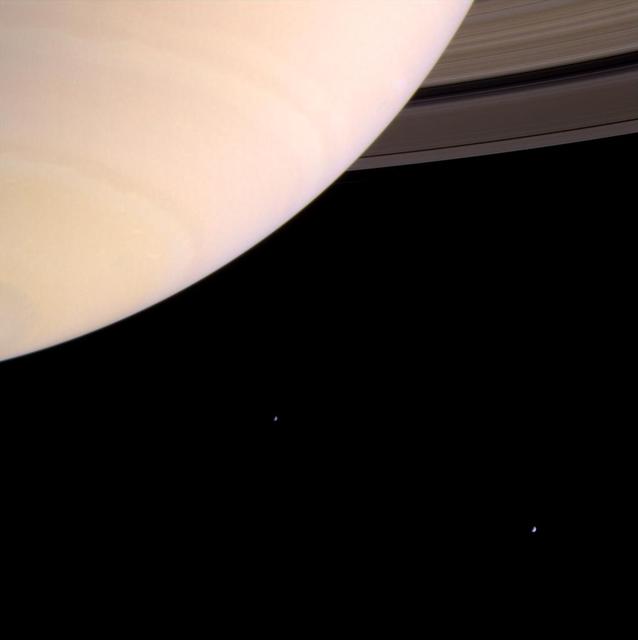
Ver en NASA ↗A new day dawns on Saturn as the part of the planet is seen emerging once more into the Sun light by NASA Cassini orbiter. With an estimated rotation period of 10 hours and 40 minutes, Saturn days and nights are much shorter than those on Earth.
Ver en NASA ↗With its all-sky infrared survey, NASA Wide-field Infrared Survey Explorer, or WISE, has identified millions of quasar candidates. Quasars are supermassive black holes with masses millions to billions times greater than our sun.
Ver en NASA ↗NGC 7293, better known as the Helix nebula, displays its ultraviolet glow courtesy of NASA GALEX. The Helix is the nearest example of a planetary nebula, which is the eventual fate of a star, like our own Sun, as it approaches the end of its life.
Ver en NASA ↗NASA Voyager 2 took this picture of Neptune largest satellite,Triton, from less than 80,000 km 50,000 miles. The image shows an area in Triton northern hemisphere. The Sun is just above the horizon, so features cast shadows that accentuate height
Ver en NASA ↗This view of the ringed planet shows its tilt relative to the plane of its orbit around the Sun. The planet tilts nearly 27 degrees relative to the ecliptic plane giving rise to seasons in which the rings shadow each hemisphere in its respective winter
Ver en NASA ↗NASA Mars Reconnaissance Orbiter shows Mars northern-most sand dunes beginning to emerge from their winter cover of seasonal carbon dioxide dry ice. Dark, bare south-facing slopes are soaking up the warmth of the sun.
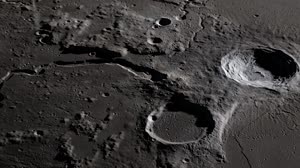
Ver en NASA ↗The lunar highlands exhibit rhythmic patterns thought to result from slow, downslope creep of the loose regolith soil. These subtle patterns are most easily seen when the Sun is low to the horizon in this image taken by NASA Lunar Reconnaissance Orbit
Ver en NASA ↗Observations from NASA Spitzer Space Telescope have revealed that mature planetary systems -- dusty disks of asteroids, comets and possibly planets -- are more frequent around close-knit twin, or binary, stars than single stars like our sun.
Ver en NASA ↗Within that narrow window during a solar eclipse where one on Earth can watch the Moon shadow obscure more than 90% of the Sun, NASA Terra spacecraft captured these views of the Antarctic surface during the total solar eclipse of November 23, 2003.
Ver en NASA ↗After passing Mercury the first time and making a trip around the Sun, NASA Mariner 10 again flew by Mercury on Sept. 21, 1974. The south pole is located on the right hand edge of Chao Meng Fu crater that has only its rim sticking up into the light.
Ver en NASA ↗Artist impression of Herschel is set against an image captured by the observatory, showing baby stars forming in the Rosette nebula. The bright spots are dusty cocoons containing massive forming stars, each one up to ten times the mass of our own sun.
Ver en NASA ↗This image from NASA Herschel, was taken looking towards a region of our Milky Way galaxy in the Eagle constellation, closer to the galactic center than our sun. Here, we see the outstanding end products of the stellar assembly line.
Ver en NASA ↗This image from NASA Spitzer Space Telescope shows the nasty effects of living near a group of massive stars: radiation and winds from the massive stars white spot in center are blasting planet-making material away from stars like our sun.
Ver en NASA ↗This chart illustrates relative masses of super-dense cosmic objects, ranging from white dwarfs to supermassive black holes encased in the cores of most galaxies. The first three dead stars left all form when stars more massive than our sun explode.
Ver en NASA ↗This graph of data from NASA Spitzer Space Telescope shows how astronomers located a hot spot on a distant gas planet named upsilon Andromedae b. Termed an exoplanet, it orbits a star beyond our sun, and whips around very closely to its star.
Ver en NASA ↗This image shows our own back yard, astronomically speaking, from a vantage point about 30 light-years away from the sun. It highlights the population of tiny brown dwarfs recently discovered by NASA WISE. The image simulates actual positions of stars.
Ver en NASA ↗This artist concept is of the one-million-year-old star system called UX Tau A, approximately 450 light-years away. NASA Spitzer Space Telescope showed a gap in the dusty planet-forming disk swirling around the system central sun-like star.
Ver en NASA ↗Contenido y metadatos proporcionados por la NASA Image and Video Library.