





/NASA’s%20Artemis%20III%20Announcement%20(Official%20NASA%20Trailer)~thumb.jpg)
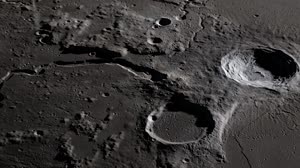
These images from NASA Dawn spacecraft are located in asteroid Vesta Marcia quadrangle, a few degrees below Vesta equator. Octavia Crater looks remarkably like a terrestrial landslide.
Ver en NASA ↗🚀 Biblioteca espacial oficial
Imágenes y vídeos de NASA
Explora el catálogo multimedia público de NASA sin salir de TuPortalNews.
Explora temas destacados
Selecciona un tema o realiza una búsqueda personalizada.
3.592 resultados en NASA
This colorized map from NASA Dawn mission shows the distribution of minerals across the surface of the giant asteroid Vesta. It was made from spectra -- or data collected in different wavelengths of radiation.
Ver en NASA ↗NASA Dawn spacecraft obtained these side-by-side views of a dark hill of the surface of asteroid Vesta with its framing camera on August 19, 2011. The images have a resolution of about 260 meters per pixel.
Ver en NASA ↗This image mosaic from NASA Dawn mission shows a slice of the surface of the giant asteroid Vesta. This mosaic, which covers one quarter of Vesta surface, shows the pronounced difference between the northern and southern hemispheres.
Ver en NASA ↗These two color views of the asteroid Gaspra were produced by combining three images taken through violet, green, and infrared filters by NASA Galileo spacecraft on October 29, 1991.
Ver en NASA ↗This image shows the first, unprocessed image obtained by NASA Dawn spacecraft of the giant asteroid Vesta in front of a background of stars. It was obtained by Dawn framing camera on May 3, 2011.
Ver en NASA ↗This image from NASA Dawn spacecraft shows Caparronia crater on asteroid Vesta, an unusually shaped, irregular rim that is sharp and fresh in some areas and more rounded and degraded in others.
Ver en NASA ↗Galaxy Messier 74, with its spiral arms seen face-on, is in the center of this image captured by NASA Wide-field Infrared Survey Explorer, or WISE, while an asteroid tracks its way across the sky.
Ver en NASA ↗This image from NASA Dawn spacecraft are located in asteroid Vesta Floronia quadrangle, in Vesta northern hemisphere. There are also many hummocky slumps of material around the crater walls and base.
Ver en NASA ↗Results from NASA NEOWISE survey find that more potentially hazardous asteroids, or PHAs, are closely aligned with the plane of our solar system than previous models suggested.
Ver en NASA ↗A distinctive pitted terrain observed by NASA Dawn mission on asteroid Vesta has also been seen on Mars. The morphologies of pits are similar on both bodies, with irregular shapes and sharp angles where pits share walls.
Ver en NASA ↗In this image, obtained by NASA Dawn spacecraft from above the surface of the giant asteroid Vesta, topography in the area surrounding the south pole area shows impact craters, ridges and grooves. You need 3D glasses to view this image.
Ver en NASA ↗NASA Dawn spacecraft obtained this image of craters and grooves in the south polar region on asteroid Vesta with its framing camera on Sept. 3, 2011. The image has a resolution of about 220 meters per pixel.
Ver en NASA ↗Inside SpaceX’s Payload Processing Facility at Vandenberg Space Force Base in California, both halves of the Falcon 9 rocket’s protective payload fairing move toward NASA’s Double Asteroid Redirection Test (DART) spacecraft on Nov. 16, 2021. The payload fairi…
Ver en NASA ↗Inside SpaceX’s Payload Processing Facility at Vandenberg Space Force Base in California, both halves of the Falcon 9 rocket’s protective payload fairing are secured around NASA’s Double Asteroid Redirection Test (DART) spacecraft on Nov. 16, 2021. The payloa…
Ver en NASA ↗Inside SpaceX’s Payload Processing Facility at Vandenberg Space Force Base in California, both halves of the Falcon 9 rocket’s protective payload fairing move toward NASA’s Double Asteroid Redirection Test (DART) spacecraft on Nov. 16, 2021. The payload fairi…
Ver en NASA ↗Inside SpaceX’s Payload Processing Facility at Vandenberg Space Force Base in California, both halves of the Falcon 9 rocket’s protective payload fairing move toward NASA’s Double Asteroid Redirection Test (DART) spacecraft on Nov. 16, 2021. The payload fairi…
Ver en NASA ↗The Near Earth Asteroid Rendezvous (NEAR) spacecraft embarks on a journey that will culminate in a close encounter with an asteroid. The launch of NEAR inaugurates NASA's irnovative Discovery program of small-scale planetary missions with rapid, lower-cost de…
Ver en NASA ↗Shown is a view of the Vehicle Assembly at NASA’s Kennedy Space Center in Florida, on Oct. 16, 2021 – in the early-morning hours on the day of the Lucy mission. A United Launch Alliance V 401 rocket roared off the pad at Cape Canaveral Space Force Station’s S…
Ver en NASA ↗Tom Statler, Double Asteroid Redirection Test (DART) program scientist for NASA’s Science Mission Directorate’s Planetary Science Division, participates in an engineering briefing for the agency’s DART mission at Vandenberg Space Force Base in California on N…
Ver en NASA ↗Derrol Nail, NASA Communications, moderates a prelaunch news conference for the agency’s Double Asteroid Redirection Test (DART) mission at Vandenberg Space Force Base in California on Nov. 22, 2021. DART is the first mission to test technologies for preventi…
Ver en NASA ↗Lori Glaze, director of NASA’s Science Mission Directorate’s Planetary Science Division, participates in an engineering briefing for the agency’s Double Asteroid Redirection Test (DART) mission at Vandenberg Space Force Base in California on Nov. 21, 2021. DA…
Ver en NASA ↗Thomas Zurbuchen, associate administrator for NASA’s Science Mission Directorate, participates in a prelaunch news conference for the agency’s Double Asteroid Redirection Test (DART) mission at Vandenberg Space Force Base in California on Nov. 22, 2021. DART …
Ver en NASA ↗Omar Baez, senior launch director for NASA’s Launch Services Program, participates in a prelaunch news conference for the agency’s Double Asteroid Redirection Test (DART) mission at Vandenberg Space Force Base in California on Nov. 22, 2021. DART is the first…
Ver en NASA ↗Contenido y metadatos proporcionados por la NASA Image and Video Library.