






/NASA’s%20Artemis%20III%20Announcement%20(Official%20NASA%20Trailer)~thumb.jpg)

Reddish spots and shallow pits pepper the enigmatic ridged surface of Europa in this view combining information from images taken by NASA Galileo spacecraft during two different orbits around Jupiter.
Ver en NASA ↗🚀 Biblioteca espacial oficial
Imágenes y vídeos de NASA
Explora el catálogo multimedia público de NASA sin salir de TuPortalNews.
Explora temas destacados
Selecciona un tema o realiza una búsqueda personalizada.
2.639 resultados en NASA
This image shows Loki, the most powerful volcano in the solar system, which has been constantly active on Jupiter moon Io. NASA Galileo spacecraft took these images during its approach to Io on October 10, 1999.
Ver en NASA ↗This ultraviolet image from NASA Galaxy Evolution Explorer shows NGC 3242, a planetary nebula frequently referred to as Jupiter Ghost. The small circular white and blue area at the center of the image is the well-known portion of the nebula.
Ver en NASA ↗Wonderful colors in a volcanic crater named Tupan Patera on Jupiter moon Io, as seen in this image from NASA Galileo spacecraft, show varied results of lava interacting with sulfur-rich materials.
Ver en NASA ↗This frame from an artist animation shows the clockwork-like orbits of a triple-star system called HD 188753, which was discovered to harbor a gas giant, or hot Jupiter, planet.
Ver en NASA ↗These images compare surface features observed by NASA Cassini spacecraft at the Xanadu region on Saturn moon Titan left, and features observed by NASA Galileo spacecraft on Jupiter cratered moon Callisto right.
Ver en NASA ↗On Oct. 9, NASA Juno spacecraft flew past Earth, using our home planet gravity to get the final boost it needed to reach Jupiter. The JunoCam instrument captured this monochrome view of Earth.
Ver en NASA ↗This view of a part of the Galileo Regio region on Jupiter moon Ganymede shows fine details of the dark terrain that makes up about half of the surface of the planet-sized moon.
Ver en NASA ↗Tupan Caldera, a volcanic crater on Jupiter moon Io, has a relatively cool area, possibly an island, in its center, as indicated by infrared imagery from NASA Galileo spacecraft during an Oct. 16, 2001 flyby.
Ver en NASA ↗This artist concept of Jupiter moon Ganymede, the largest moon in the solar system, illustrates the club sandwich model of its interior oceans. Scientists suspect Ganymede has a massive ocean under an icy crust.
Ver en NASA ↗This frame from a movie was captured by a star tracker camera on NASA Jupiter-bound Juno spacecraft. It was taken over several days as Juno approached Earth for a close flyby that would send the spacecraft onward to the giant planet.
Ver en NASA ↗NASA Cassini spacecraft imaged the surface of Saturn moon Helene as the it flew by the moon on Jan. 31, 2011. Helene is a Trojan moon of Dione, named for the Trojan asteroids that orbit 60 degrees ahead of and behind Jupiter as it circles the Sun.
Ver en NASA ↗This image of northeast Africa and the Arabian Peninsula was taken from an altitude of about 500,000 kilometers 300,000 miles by NASA’s Galileo spacecraft on December 9, 1992, as it left Earth en route to Jupiter.
Ver en NASA ↗To present the best information in a single view of Jupiter moon Ganymede, a global image mosaic was assembled, incorporating the best available imagery from NASA Voyager 1 and 2 spacecraft and NASA Galileo spacecraft.
Ver en NASA ↗This artist concept shows a simulated view from the surface of Jupiter moon Europa. Europa potentially rough, icy surface, tinged with reddish areas that scientists hope to learn more about.
Ver en NASA ↗This five-frame sequence of New Horizons images captures the giant plume from Io Tvashtar volcano. These were snapped by the probe Long Range Reconnaissance Imager LORRI as the spacecraft flew past Jupiter earlier this year.
Ver en NASA ↗Topographic detail is seen in this stereoscopic view of the Galileo Regio region of Jupiter moon Ganymede. The picture is a computer reconstruction from two images taken by NASA Galileo during 1996.
Ver en NASA ↗This image taken by NASA Spitzer Space Telescope shows the comet Encke riding along its pebbly trail of debris long diagonal line between the orbits of Mars and Jupiter.
Ver en NASA ↗This color image of the Earth was taken by NASA’s Galileo spacecraft on December 11 as it departed on its 3-year flight to Jupiter, about 2 1/2 days after the second Earth flyby.
Ver en NASA ↗This artist illustration shows a planetary disk left that weighs the equivalent of 50 Jupiter-mass planets. It demonstrates a first-of-its-kind feat from astronomers using the Herschel space observatory.
Ver en NASA ↗This map shows predicted heat flow at the surface of Jupiter moon Io from two tidal-heating models. Red indicates areas where more heat is expected; blue where less heat is expected.
Ver en NASA ↗In August 2001, NASA Galileo spacecraft has returned imagery of a hot spot on Jupiter moon Io that was the source of a towering plume indicating a sulfur-dioxide concentration that may have been fallout from the plume.
Ver en NASA ↗Observations from NASA WISE all-sky survey reveal new clues about Jovian Trojans, mysterious asteroids that orbit in front of and behind Jupiter in its path around the sun seen here in an artist’s concept.
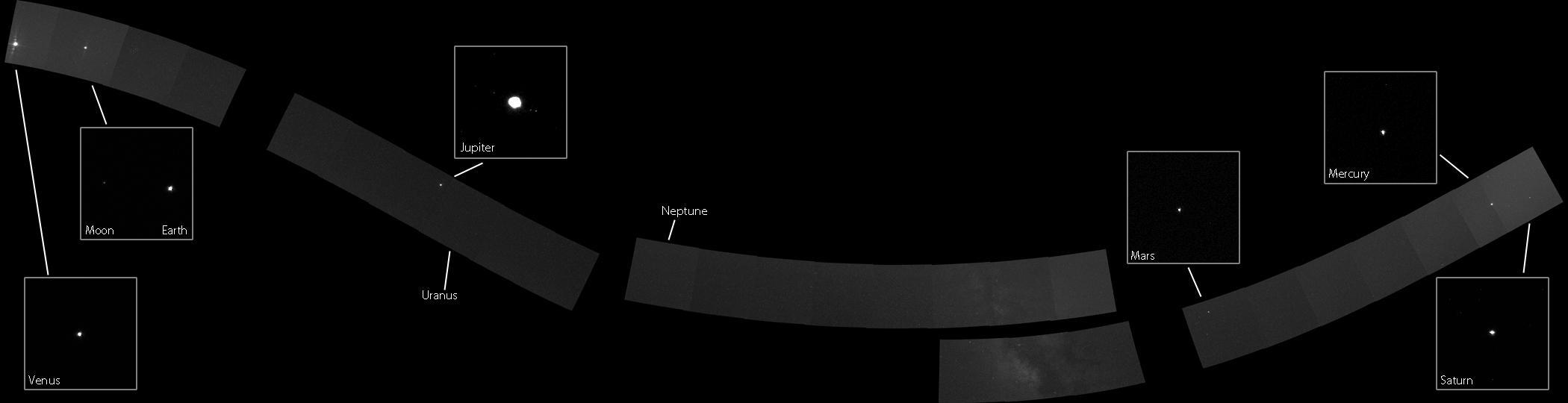
Ver en NASA ↗This is an updated montage of planetary images taken by spacecraft managed by NASA’s Jet Propulsion Laboratory in Pasadena, CA. Included are from top to bottom images of Mercury, Venus, Earth and Moon, Mars, Jupiter, Saturn, Uranus and Neptune.
Ver en NASA ↗Contenido y metadatos proporcionados por la NASA Image and Video Library.