





/NASA’s%20Artemis%20III%20Announcement%20(Official%20NASA%20Trailer)~thumb.jpg)

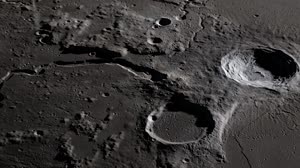
This image from NASA Dawn spacecraft shows a part of the heavily cratered terrain in asteroid Vesta northern hemisphere. Some of the craters have fresh, sharp rims, which suggests that they are reasonably young.
Ver en NASA ↗🚀 Biblioteca espacial oficial
Imágenes y vídeos de NASA
Explora el catálogo multimedia público de NASA sin salir de TuPortalNews.
Explora temas destacados
Selecciona un tema o realiza una búsqueda personalizada.
3.592 resultados en NASA
he visible and infrared mapping spectrometer aboard NASA Dawn spacecraft acquired this set of images during the high-altitude mapping orbit phase at about 420 miles 680 kilometers above the surface of asteroid Vesta.
Ver en NASA ↗These mosaic images from NASA Dawn mission show how dark, carbon-rich materials tend to speckle the rims of smaller craters or their immediate surroundings on the giant asteroid Vesta; Numisia Crater is shown at left.
Ver en NASA ↗These images from NASA Dawn spacecraft show part of the grooved terrain in asteroid Vesta Pinaria quadrangle, which is in the southern hemisphere. Large-scale grooves and depressions can be seen running diagonally across the image.
Ver en NASA ↗These images from NASA Dawn spacecraft, located in asteroid Vesta Floronia quadrangle, in Vesta northern hemisphere, demonstrate a special analytical technique, which results in shadowed areas of Vesta surface becoming illuminated.
Ver en NASA ↗These images from NASA Dawn spacecraft are located in asteroid Vesta Gegania quadrangle, in Vesta southern hemisphere; tiny craters and streaks developed from material can be seen slumping towards the center of the crater.
Ver en NASA ↗This image, one of the first obtained by NASA Dawn spacecraft in its low altitude mapping orbit, shows many buried craters located within the equatorial trough region of the giant asteroid Vesta.
Ver en NASA ↗This map from NASA Dawn mission indicates the presence of hydrated minerals on the giant asteroid Vesta about 30 degrees north latitude, in August 2011. At the time, it was winter in Vesta northern hemisphere.
Ver en NASA ↗This anaglyph from NASA Dawn spacecraft shows three fresh craters on asteroid Vesta, which have been nicknamed the Snowman craters. You need 3D glasses to view this image.
Ver en NASA ↗NASA Dawn spacecraft obtained this image of the surface of asteroid Vesta with its framing camera on August 11, 2011. It was taken through the camera clear filter. The image has a resolution of about 260 meters per pixel.
Ver en NASA ↗NASA Dawn spacecraft obtained this image of the giant asteroid Vesta with its framing camera on Aug. 14 2011. This image was taken through the camera clear filter. The image has a resolution of about 260 meters per pixel.
Ver en NASA ↗This image from NASA Dawn spacecraft shows part of the sharp, fresh rim of a large crater on asteroid Vesta. There is some bright material slumping towards the center of this crater but this is mostly overshadowed by the dark material.
Ver en NASA ↗NASA Dawn spacecraft obtained this image of asteroid Vesta with its framing camera on Aug. 26, 2011 at a distance of 1,700 miles 2,740 kilometers. The image has a resolution of about 260 meters per pixel.
Ver en NASA ↗These images from NASA Dawn spacecraft show part of the rim of asteroid Vesta south polar basin, which is dominated by a large scarp cliff that runs vertically across the center of the images.
Ver en NASA ↗This view of the topography of asteroid Vesta surface is composed of several images obtained with the framing camera on NASA Dawn spacecraft on August 6, 2011. The image mosaic is shown superimposed on a digital terrain model.
Ver en NASA ↗NASA Dawn spacecraft obtained this image of an unusual hill on asteroid Vesta with its framing camera on August 18, 2011. The image has a resolution of about 260 meters per pixel.
Ver en NASA ↗This image from NASA Dawn spacecraft of asteroid Vesta shows many secondary crater chains on Vesta surface. This image is located in Vesta Domitia quadrangle, in Vesta northern hemisphere.
Ver en NASA ↗This image from NASA Dawn spacecraft of asteroid Vesta shows Teia crater, which is the crater with bright and dark material. There is mostly bright material in Teia crater but there is also a patch of dark material on one side.
Ver en NASA ↗This image from NASA Dawn spacecraft shows a close up of part of the rim around the crater Canuleia on the giant asteroid Vesta. Canuleia, about 6 miles 10 kilometers in diameter, is the large crater at the bottom-left of this image.
Ver en NASA ↗Observations from NASA WISE all-sky survey reveal new clues about Jovian Trojans, mysterious asteroids that orbit in front of and behind Jupiter in its path around the sun seen here in an artist’s concept.
Ver en NASA ↗This image combines two separate views of the giant asteroid Vesta obtained by NASA Dawn spacecraft. The data reveal a world of many varied, well-separated layers and ingredients.
Ver en NASA ↗This color picture is made from images taken by the imaging system on NASA Galileo spacecraft about 14 minutes before its closest approach to asteroid 243 Ida on August 28, 1993.
Ver en NASA ↗This image from NASA Dawn spacecraft shows Tarpeia crater, located in Vesta Rheasilvia quadrangle, near asteroid Vesta south pole. Tarpeia has a sharp, fresh rim surrounding it.
Ver en NASA ↗This image from NASA Dawn spacecraft of asteroid Vesta shows Canuleia crater, a large, irregularly shaped crater. Other interesting features of Canuleia include the diffuse bright material that is both inside and outside of its rim.
Ver en NASA ↗Contenido y metadatos proporcionados por la NASA Image and Video Library.