






/NASA’s%20Artemis%20III%20Announcement%20(Official%20NASA%20Trailer)~thumb.jpg)

Technicians prepare to install the nearly 10 feet (3 meters) wide dish-shaped high-gain antenna to NASA’s Europa Clipper, a spacecraft to study Jupiter’s icy moon, at the agency’s Payload Hazardous Servicing Facility at Kennedy Space Center in Florida on Mond…
Ver en NASA ↗🚀 Biblioteca espacial oficial
Imágenes y vídeos de NASA
Explora el catálogo multimedia público de NASA sin salir de TuPortalNews.
Explora temas destacados
Selecciona un tema o realiza una búsqueda personalizada.
2.639 resultados en NASA
Technicians prepare to install the nearly 10 feet (3 meters) wide dish-shaped high-gain antenna to NASA’s Europa Clipper, a spacecraft to study Jupiter’s icy moon, at the agency’s Payload Hazardous Servicing Facility at Kennedy Space Center in Florida on Tues…
Ver en NASA ↗Technicians prepare to install the nearly 10 feet (3 meters) wide dish-shaped high-gain antenna to NASA’s Europa Clipper, a spacecraft to study Jupiter’s icy moon, at the agency’s Payload Hazardous Servicing Facility at Kennedy Space Center in Florida on Mond…
Ver en NASA ↗Technicians prepare to install the nearly 10 feet (3 meters) wide dish-shaped high-gain antenna to NASA’s Europa Clipper, a spacecraft to study Jupiter’s icy moon, at the agency’s Payload Hazardous Servicing Facility at Kennedy Space Center in Florida on Mond…
Ver en NASA ↗Technicians prepare to install the nearly 10 feet (3 meters) wide dish-shaped high-gain antenna to NASA’s Europa Clipper, a spacecraft to study Jupiter’s icy moon, at the agency’s Payload Hazardous Servicing Facility at Kennedy Space Center in Florida on Tues…
Ver en NASA ↗Technicians prepare to install the nearly 10 feet (3 meters) wide dish-shaped high-gain antenna to NASA’s Europa Clipper, a spacecraft to study Jupiter’s icy moon, at the agency’s Payload Hazardous Servicing Facility at Kennedy Space Center in Florida on Mond…
Ver en NASA ↗Technicians prepare to install the nearly 10 feet (3 meters) wide dish-shaped high-gain antenna to NASA’s Europa Clipper, a spacecraft to study Jupiter’s icy moon, at the agency’s Payload Hazardous Servicing Facility at Kennedy Space Center in Florida on Mond…
Ver en NASA ↗Technicians prepare to install the nearly 10 feet (3 meters) wide dish-shaped high-gain antenna to NASA’s Europa Clipper, a spacecraft to study Jupiter’s icy moon, at the agency’s Payload Hazardous Servicing Facility at Kennedy Space Center in Florida on Mond…
Ver en NASA ↗Three full-disk color views of Jupiter volcanic moon Io as seen by NASA Galileo spacecraft are shown in enhanced color to highlight details of the surface.
Ver en NASA ↗Science instruments and other hardware for NASA's Europa Clipper spacecraft will come together in the mission's final phase before launching to Jupiter's icy moon Europa in 2024.
Ver en NASA ↗Composite Pioneer 10 imagery Excitement rose as the PICS displayed images of Jupiter of ever-increasing size as Pioneer 10 plunged at high speed toward its closest approach to the planet. The most dramatic moment was perhaps after closest approach and after t…
Ver en NASA ↗On February 5, 1979, Voyager 1 made its closest approach to Jupiter since early 1974 and 1975 when Pioneers 10 and 11 made their voyages to Jupiter and beyond. Voyager 1 completed its Jupiter encounter in early April, after taking almost 19,000 pictures and r…
Ver en NASA ↗This four-frame mosaic shows the ancient impact structure Asgard on Jupiter's moon Callisto. This image was taken on November 4, 1996, by NASA's Galileo spacecraft during its third orbit around Jupiter.
Ver en NASA ↗An artist's concept shows the internal structure of Jupiter's moon Io.
Ver en NASA ↗This artist's concept depicts NASA's Europa Clipper spacecraft as it orbits Jupiter and passes over the gas giant's ice-covered moon Europa.
Ver en NASA ↗Artist: Rick Guidice Pioneer Jupiter encounters Artwork: The gravity of Jupiter (or of Saturn), coupled with its orbital motion, can be used in a slingshot technique to speed spacecraft to the outer planets. (S.P. fig. no. 1-21).
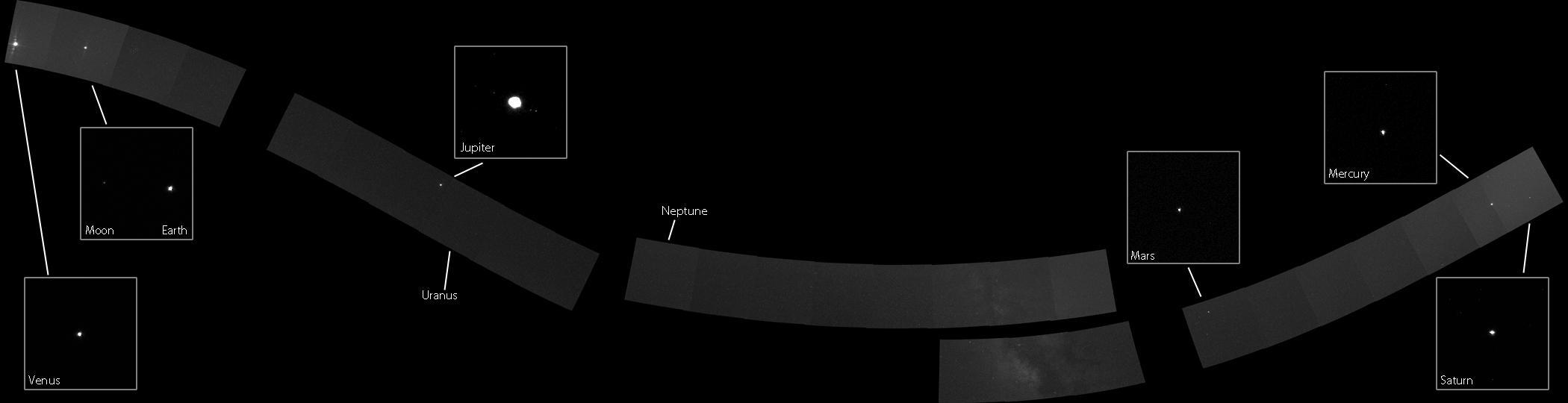
Ver en NASA ↗NASA's Psyche spacecraft captured multiple star and planet images in late January 2025 that include notable appearances by Mars, Jupiter, and the Jovian moons Io, Ganymede, Callisto, and Europa.
Ver en NASA ↗Jovian Lightning
Ver en NASA ↗Jovian Dark Spot
Ver en NASA ↗This view of the Great Red Spot is seen in greatly exaggerated color. The colors do not represent the true hues seen in the Jovian atmosphere but have been produced by special computer processing to enhance subtle variations in both color and shading.
Ver en NASA ↗This computer-generated image depicts the Jovian Infrared Auroral Mapper (JIRAM) instrument aboard NASA's Juno spacecraft.
Ver en NASA ↗This photo from NASA Voyager 2 was taken on Jun. 9, 1979 and is centered over the long-lived disturbed region west of the Great Red Spot GRS.
Ver en NASA ↗Night Side Jovian Aurora
Ver en NASA ↗This view of the region just to the Southeast of the Great Red Spot was taken by NASA Voyager 1 on March 4, 1979 at a distance of 1,100,000 miles 1,800,000 km.
Ver en NASA ↗Contenido y metadatos proporcionados por la NASA Image and Video Library.