






/NASA’s%20Artemis%20III%20Announcement%20(Official%20NASA%20Trailer)~thumb.jpg)


A magnetic filament of solar material erupted on the sun in late September, breaking the quiet conditions in a spectacular fashion. The 200,000 mile long filament ripped through the sun's atmosphere, the corona, leaving behind what looks like a canyon of fire…
Ver en NASA ↗🚀 Biblioteca espacial oficial
Imágenes y vídeos de NASA
Explora el catálogo multimedia público de NASA sin salir de TuPortalNews.
Explora temas destacados
Selecciona un tema o realiza una búsqueda personalizada.
6.531 resultados en NASA
NASA release July 27, 2011 These jets, known as spicules, were captured in an SDO image on April 25, 2010. Combined with the energy from ripples in the magnetic field, they may contain enough energy to power the solar wind that streams from the sun toward Ea…
Ver en NASA ↗Comet ISON swoops around the sun and through Scorpius. This composite merges an SDO AIA 171 sun image (Nov. 28, 2214 UT), SOHO C2 (2036 UT) and C3 (2030 UT) images, and a DSS view of the sky in northern Scorpius. Credit: NASA/ESA/SOHO, NASA/SDO, DSS, and Fr…
Ver en NASA ↗Scientists have developed a way to produce models of where the magnetic field lines are several times each day. Here we have created a time-lapse version of these models over four days (2-3 each day) to give you a peek at how these change over time. The spira…
Ver en NASA ↗The sun emitted a significant solar flare, peaking at 12:22 p.m. EDT on March 11, 2015. NASA’s Solar Dynamics Observatory, which watches the sun constantly, captured an image of the event. Solar flares are powerful bursts of radiation. Harmful radiation from …
Ver en NASA ↗Caption: NASA’s Solar Dynamics Observatory (SDO) captured this image of an M5.7 class flare on May 3, 2013 at 1:30 p.m. EDT. This image shows light in the 131 Angstrom wavelength, a wavelength of light that can show material at the very hot temperatures of a …
Ver en NASA ↗Caption: NASA’s Solar Dynamics Observatory (SDO) captured this image of an M5.7 class flare on May 3, 2013 at 1:30 p.m. EDT. This image shows light in the 131 Angstrom wavelength, a wavelength of light that can show material at the very hot temperatures of a …
Ver en NASA ↗The sun has been virtually spotless, as in no sunspots, over the past 11 days, a spotless stretch that we have not seen since the last solar minimum many years ago. From NASA's SDO Mar. 14-17, 2017.
Ver en NASA ↗NASA Administrator Jared Isaacman arrives at the SUN ’n FUN Aerospace Expo in a formation flight with his F-5 aircraft, Wednesday, Apr. 15, 2026, in Lakeland, Fla. Photo Credit: (NASA/John Kraus)
Ver en NASA ↗Apollo 16, Footsteps Under High Sun
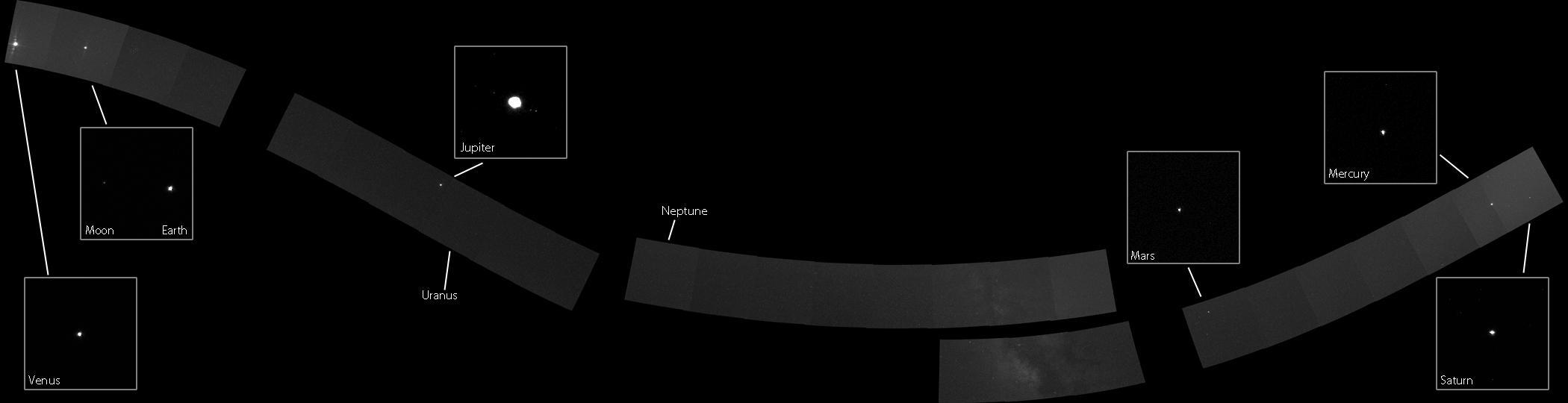
Ver en NASA ↗The cameras of Voyager 1 on Feb. 14, 1990, pointed back toward the sun and took a series of pictures of the sun and the planets, making the first ever portrait of our solar system as seen from the outside.
Ver en NASA ↗NASA image release January 6, 2010 Caption: Spicules on the sun, as observed by the Solar Dynamics Observatory. These bursts of gas jet off the surface of the sun at 150,000 miles per hour and contain gas that reaches temperatures over a million degrees. GR…
Ver en NASA ↗NASA Administrator Jared Isaacman, center; Sean Gustafson, senior advisor to the administrator, left; and Jerry Kerby, pilot, right, pose for a photograph following their air show performance at the SUN ’n FUN Aerospace Expo, Wednesday, Apr. 15, 2026, in Lake…
Ver en NASA ↗NASA Administrator Jared Isaacman is seen with one of his personal F-5 aircraft ahead of an air show performance at the SUN ’n FUN Aerospace Expo, Wednesday, Apr. 15, 2026, in Lakeland, Fla. Photo Credit: (NASA/John Kraus)
Ver en NASA ↗NASA Administrator Jared Isaacman is seen in the cockpit of his personal F-5 aircraft after arriving at the SUN ’n FUN Aerospace Expo, Wednesday, Apr. 15, 2026, in Lakeland, Fla. Photo Credit: (NASA/John Kraus)
Ver en NASA ↗The sun emitted a significant solar flare, peaking at 1:48 p.m. EDT on Sept. 10, 2014. NASA's Solar Dynamics Observatory captured images of the event. Solar flares are powerful bursts of radiation. Harmful radiation from a flare cannot pass through Earth's at…
Ver en NASA ↗Solar Flare Extremely energetic objects permeate the universe. But close to home, the sun produces its own dazzling lightshow, producing the largest explosions in our solar system and driving powerful solar storms.. When solar activity contorts and realigns t…
Ver en NASA ↗A dark line snaked across the lower half of the sun on Feb.10, 2015, as seen in this image from NASA's Solar Dynamics Observatory, or SDO. SDO shows colder material as dark and hotter material as light, so the line is, in fact, an enormous swatch of colder ma…
Ver en NASA ↗NASA’s Solar Dynamics Observatory, or SDO, captured this solar image on March 16, 2015, which clearly shows two dark patches, known as coronal holes. The larger coronal hole of the two, near the southern pole, covers an estimated 6- to 8-percent of the total …
Ver en NASA ↗A corona mass ejection (CME) erupted from just around the edge of the sun on May 1, 2013, in a gigantic rolling wave. CMEs can shoot over a billion tons of particles into space at over a million miles per hour. This CME occurred on the sun’s limb and is not h…
Ver en NASA ↗NASA's Solar Dynamics Observatory scientists use their computer models to generate a view of the sun's magnetic field. An extreme ultraviolet view of the sun is compared with the same image showing the superimposed field lines on August 10, 2018.
Ver en NASA ↗Michael Sandras, a member of the Pontchartrain Astronomical Society, explains his solar telescope to students of Second Street in Bay St. Louis, Hancock County and Nicholson elementary schools in StenniSphere's Millennium Hall on April 10. The students partic…
Ver en NASA ↗This image shows the Sun as it appears on Mars throughout the day. Scientists monitor the dimming of the setting Sun to assess how much dust is in the martian atmosphere. The pictures were taken by the Mars Exploration Rover Spirit panoramic camera.
Ver en NASA ↗Caption: This is an image of magnetic loops on the sun, captured by NASA's Solar Dynamics Observatory (SDO). It has been processed to highlight the edges of each loop to make the structure more clear. A series of loops such as this is known as a flux rope, …
Ver en NASA ↗Contenido y metadatos proporcionados por la NASA Image and Video Library.