










/NASA’s%20Artemis%20III%20Announcement%20(Official%20NASA%20Trailer)~thumb.jpg)


The latest spectra from NASA New Horizons Ralph instrument reveal an abundance of methane ice, but with striking differences from place to place across the frozen surface of Pluto.
Ver en NASA ↗🚀 Biblioteca espacial oficial
Imágenes y vídeos de NASA
Explora el catálogo multimedia público de NASA sin salir de TuPortalNews.
Explora temas destacados
Selecciona un tema o realiza una búsqueda personalizada.
548 resultados en NASA
This frame from a movie, composed of images taken by NASA New Horizons, shows Pluto as it rotates about its axis. The images were taken May 28-June 3, 2015, from distances ranging from approximately 56 million kilometers to 48.5 million kilometers.
Ver en NASA ↗This image contains the initial, informal names being used by the New Horizons team for the features on Pluto Sputnik Planum plain. These names have not yet been approved by the International Astronomical Union IAU.
Ver en NASA ↗This image contains the initial, informal names being used by NASA New Horizons team for the features and regions on the surface of Pluto largest moon, Charon. These names have not yet been approved by the International Astronomical Union IAU.
Ver en NASA ↗This approximate true-color image from NASA New Horizons shows hydrocarbons accumulating into small particles, a fraction of a micrometer in size, and scatter sunlight to make the bright blue haze seen in this image.
Ver en NASA ↗This is the most detailed view to date of the entire surface of the dwarf planet Pluto, as constructed from multiple NASA Hubble Space Telescope photographs taken from 2002 to 2003.
Ver en NASA ↗This mosaic strip, extending across the hemisphere that faced the New Horizons spacecraft as it flew past Pluto on July 14, 2015, now includes all of the highest-resolution images taken by the NASA probe.
Ver en NASA ↗Ice probably frozen nitrogen that appears to have accumulated on the uplands on the right side of this image from NASA New Horizons, is draining from Pluto mountains onto the informally named Sputnik Planum.
Ver en NASA ↗Peering closely at the heart of Pluto, in the western half of what mission scientists have informally named Tombaugh Regio Tombaugh Region, NASA New Horizons Ralph instrument revealed evidence of carbon monoxide ice.
Ver en NASA ↗A newly discovered mountain range lies near the southwestern margin of Pluto heart-shaped Tombaugh Regio Tombaugh Region, situated between bright, icy plains and dark, heavily-cratered terrain as seen by NASA New Horizons spacecraft.
Ver en NASA ↗At center left of Pluto vast heart-shaped feature Tombaugh Regio lies a vast, craterless plain that appears to be no more than 100 million years old, and is possibly still being shaped by geologic processes as seen by NASA New Horizons spacecraft.
Ver en NASA ↗These maps are from NASA's New Horizons' data on the topography (top) and composition (bottom) of Pluto's surface. In the high-resolution topographical map, the highlighted red region is high in elevation.
Ver en NASA ↗This color version of NASA New Horizons Long Range Reconnaissance Imager LORRI picture of Pluto taken July 3, 2015, was created by adding color data from the Ralph instrument gathered earlier in the mission.
Ver en NASA ↗The science team of NASA New Horizons mission has produced an updated global map of the dwarf planet Pluto. The map includes all resolved images of the surface acquired between July 7-14, 2015.
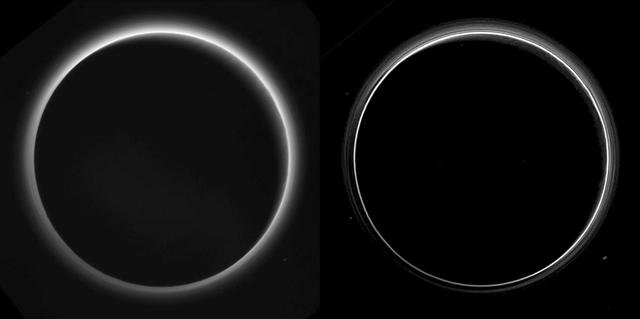
Ver en NASA ↗Pluto haze layer shows its blue color in this picture taken by NASA New Horizons. The high-altitude haze is thought to be similar in nature to that seen at Saturn moon Titan.
Ver en NASA ↗In this small section of the larger crescent image of Pluto, taken by NASA New Horizons just 15 minutes after the spacecraft closest approach on July 14, 2015, the setting sun illuminates a fog or near-surface haze.
Ver en NASA ↗NASA's New Horizons spacecraft flew within 8,000 miles of dwarf planet Pluto on 14 July 2015. Our view of this cold, previously unexplored world, 4.67 billion miles from Earth, has evolved since its discovery by Clyde W. Tombaugh in 1930. This short clip sh…
Ver en NASA ↗NASA New Horizons spacecraft continues to transmit the sharpest views of Pluto that it obtained and recorded during its flyby of the distant planet on July 14, 2015.
Ver en NASA ↗This image was created by NASA New Horizons to reveal color surface features of Pluto and its largest moon, Charon. It was taken between June 23 and June 29, 2015.
Ver en NASA ↗Like a cosmic lava lamp, a large section of Pluto icy surface is being constantly renewed by a process called convection that replaces older surface ices with fresher material as evidenced by NASA's New Horizons.
Ver en NASA ↗This image from NASA's New Horizons spacecraft shows an overlay of the first official Pluto feature names.
Ver en NASA ↗This frame from a movie, which extends across the hemisphere that faced New Horizons spacecraft as it flew past Pluto on July 14, 2015, includes all of the highest-resolution images taken by the NASA probe.
Ver en NASA ↗This image of Pluto and its largest moon, Charon, was taken by the Ralph color imager aboard NASA New Horizons spacecraft on April 9 and downlinked to Earth the following day.
Ver en NASA ↗Images of Pluto taken by NASA New Horizons spacecraft before closest approach on July 14, 2015, reveal small features, from craters to faulted mountain blocks, to the textured surface of the vast basin informally called Sputnik Planum.
Ver en NASA ↗Contenido y metadatos proporcionados por la NASA Image and Video Library.