





/NASA’s%20Artemis%20III%20Announcement%20(Official%20NASA%20Trailer)~thumb.jpg)

Evidence for this possible belt was discovered by NASA Spitzer Space Telescope when it spotted warm dust around the star, presumably from asteroids smashing together. This is an artist concept.
Ver en NASA ↗🚀 Biblioteca espacial oficial
Imágenes y vídeos de NASA
Explora el catálogo multimedia público de NASA sin salir de TuPortalNews.
Explora temas destacados
Selecciona un tema o realiza una búsqueda personalizada.
3.592 resultados en NASA
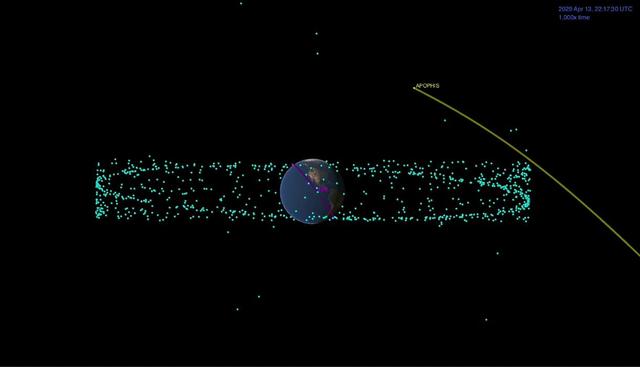
This frame from a movie shows the progression of NASA NEOWISE survey in the mission first year following its restart in December 2013. Each dot represents an asteroid or comet that the mission observed.
Ver en NASA ↗NASA Dawn spacecraft obtained this image of various craters on asteroid Vesta with its framing camera on August 19, 2011. The image has a resolution of about 260 meters per pixel.
Ver en NASA ↗This image from NASA Dawn spacecraft shows a very shadowed region in Vesta northern hemisphere. Roughly the upper one third of asteroid Vesta northern hemisphere is currently in shadow.
Ver en NASA ↗This set of images from NASA Dawn spacecraft shows topography of the southern hemisphere of the giant asteroid Vesta and a map of Vesta gravity variations that have been adjusted to account for Vesta shape.
Ver en NASA ↗This image from NASA Dawn spacecraft is dominated by a wide, young, fresh crater on asteroid Vesta. Surrounding this crater is its ejecta blanket, a covering of small particles that were thrown out during the impact that formed the crater.
Ver en NASA ↗These images from NASA Dawn spacecraft are located in asteroid Vesta Urbinia quadrangle, in Vesta southern hemisphere. Rays of bright material surround Canuleia crater and rays of dark material extend from the top part of Sossia crater.
Ver en NASA ↗This image from NASA Dawn spacecraft shows a part of the surface of asteroid Vesta, which is mantled covered by an ejecta blanket, evident as smoothly textured surface visible across the image.
Ver en NASA ↗This artist lithograph features general information, significant dates, and interesting facts on the back about asteroid Vesta and dwarf planet Ceres and is part of the Mission Art series from NASA Dawn mission.
Ver en NASA ↗This image from NASA Dawn spacecraft shows areas of dark material which are both associated with impact craters and between these craters on asteroid Vesta. Dark material is seen cropping out of the rims and sides of the larger craters.
Ver en NASA ↗These images from NASA Dawn spacecraft show part of Rheasilvia quadrangle in asteroid Vesta southern hemisphere. The hummocky, undulating terrain surrounding the central complex feature consists of ridges and grooves.
Ver en NASA ↗This image shows examples of straighter, shorter, wider gullies that scientists on NASA Dawn mission have found on the giant asteroid Vesta. The crater shown here is called Fonteia.
Ver en NASA ↗NASA Dawn spacecraft obtained this image of dark material on hilltops on asteroid Vesta with its framing camera on August 18, 2011. The image has a resolution of about 260 meters per pixel.
Ver en NASA ↗This image from NASA Dawn spacecraft of asteroid Vesta shows chains of craters on an undulating surface probably formed of fine-grained debris, called regolith, which was ejected from large impact craters as they formed nearby.
Ver en NASA ↗In this image from NASA Dawn spacecraft, a number of small dark areas, mostly clustered in the center and left of the image, are visible in asteroid Vesta cratered landscape. A lot of these dark patches are small impact craters.
Ver en NASA ↗The left side of Helena crater on asteroid Vesta has a fresh and distinctive rim. Dark and bright material crops out of this part of the rim and slumps towards the center of the crater in this image from NASA Dawn spacecraft.
Ver en NASA ↗This frame from an animation illustrates asteroid-hunting results from NASA Wide-field Infrared Survey Explorer, or WISE, taken during its one-year survey of the sky in infrared light.
Ver en NASA ↗This mosaic of the surface of asteroid Vesta was made from images obtained by NASA Dawn spacecraft while the area was entirely in the sun shadow. Light reflecting off of other areas of Vesta provides the only illumination.
Ver en NASA ↗This image from NASA Dawn spacecraft of asteroid Vesta shows Octavia crater, located in Vesta Marcia quadrangle, just south of Vesta equator. Octavia rim is fresher on the right side and more degraded on the left side.
Ver en NASA ↗NASA Dawn spacecraft obtained this image of dark patches and stripes on crater walls on asteroid Vesta with its framing camera on August 18, 2011. The image has a resolution of about 260 meters per pixel.
Ver en NASA ↗This image of asteroid Vesta from NASA Dawn spacecraft shows a region of the surface that is rather smooth in appearance which is located in Vesta Marcia quadrangle, near the Vestan equator.
Ver en NASA ↗These images from NASA Dawn spacecraft show Oppia crater on asteroid Vesta, after which Oppia quadrangle is named. Oppia crater is a distinctive crater because it has an unusually shaped rim, which is almost rectangular in form.
Ver en NASA ↗This image from NASA Dawn spacecraft shows numerous linear chains and clusters of small craters on asteroid Vesta. These chains and clusters of craters were created by material that was ejected during the formation of a large crater.
Ver en NASA ↗These images from NASA Dawn spacecraft, located in asteroid VestaFloronia quadrangle, in Vesta northern hemisphere, demonstrate a special analytical technique, which results in shadowed areas of Vesta surface becoming illuminated.
Ver en NASA ↗Contenido y metadatos proporcionados por la NASA Image and Video Library.