





/NASA’s%20Artemis%20III%20Announcement%20(Official%20NASA%20Trailer)~thumb.jpg)

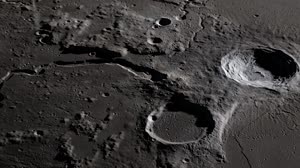
The crater on asteroid Vesta shown in this image from NASA Dawn spacecraft was emplaced onto the ejecta blanket of two large twin craters. Commonly, rays from impact craters are brighter than the surrounding surface.
Ver en NASA ↗🚀 Biblioteca espacial oficial
Imágenes y vídeos de NASA
Explora el catálogo multimedia público de NASA sin salir de TuPortalNews.
Explora temas destacados
Selecciona un tema o realiza una búsqueda personalizada.
3.592 resultados en NASA
This graphic shows the global distribution of craters that hit the giant asteroid Vesta, based on data from NASA Dawn mission. The yellow circles indicate craters of 2 miles or wider, with the size of the circles indicating the size of the crater.
Ver en NASA ↗This image from NASA Dawn spacecraft shows many fresh craters, several with bright ejecta rays, which were formed by impacts into the floor of asteroid Vesta south polar basin.
Ver en NASA ↗These images from NASA Dawn spacecraft show Claudia crater marked by an arrow and its surroundings. Claudia crater is the crater which is used to define 0° longitude on asteroid Vesta.
Ver en NASA ↗This image from NASA Dawn spacecraft shows a relatively smooth part of asteroid Vesta surface. This smooth texture is probably due to the surface being covered in a layer of tiny dust particles.
Ver en NASA ↗This image from NASA Dawn spacecraft shows a large crater with several smaller craters at the edge on the giant asteroid Vesta. Rough texture in the crater wall at far right may be the underlying bedrock.
Ver en NASA ↗This image from NASA Dawn spacecraft of asteroid Vesta shows Aquilia crater located in Pinaria quadrangle, in Vesta southern hemisphere. The especially degraded bottom rim was probably formed by debris slumping into the crater.
Ver en NASA ↗This image from NASA Mars Mars Reconnaissance Orbiter shows a triple impact crater in Elysium Planitia near Tartarus Montes, which probably formed when a binary-or even triple-asteroid struck the surface.
Ver en NASA ↗These images from NASA Dawn spacecraft, located in asteroid Vesta Marcia quadrangle, in Vesta northern hemisphere, demonstrate a special analytical technique, which results in shadowed areas of Vesta surface becoming illuminated.
Ver en NASA ↗This image from NASA Dawn spacecraft shows a part of Vesta northern hemisphere, which is mostly in darkness. Since Dawn arrival at asteroid Vesta the sun has not illuminated Vesta most northerly latitudes.
Ver en NASA ↗This image from NASA Dawn spacecraft shows the brightest area seen on asteroid Vesta so far. It shows a crater located inside the rim of the Rheasilvia basin at the south pole of Vesta.
Ver en NASA ↗This composite-color view from NASA Dawn mission shows Cornelia Crater, streaked with dark materials, on the giant asteroid Vesta. You need 3D glasses to view this image.
Ver en NASA ↗NASA Dawn spacecraft obtained this image of the giant asteroid Vesta with its framing camera on July 9, 2011. Vesta is also considered a protoplanet because it is a large body that almost became a planet.
Ver en NASA ↗These images from NASA Dawn spacecraft are located in asteroid Vesta Numisia quadrangle, in Vesta northern hemisphere. The bottom part of the rim of Fabia crater is much fresher than the top part of the rim.
Ver en NASA ↗These images from NASA Dawn spacecraft are located in asteroid Vesta Numisia quadrangle, southern hemisphere; layers can be seen slumping towards the crater center and there is slightly brighter material overlying slightly less bright material.
Ver en NASA ↗This image from NASA Dawn spacecraft shows a young, fresh crater, which is about 7 km in diameter, on asteroid Vesta. This crater has both dark and bright rays fanning out from it.
Ver en NASA ↗This image from NASA Dawn spacecraft of asteroid Vesta shows Helena crater, which is the crater that resembles the shape of a butterfly wings center, and Laelia crater bottom right.
Ver en NASA ↗These images from NASA Dawn spacecraft show Gegania crater on asteroid Vesta, after which Gegania quadrangle is named. The image at left shows the albedo brightness/darkness of the surface.
Ver en NASA ↗NASA Dawn spacecraft has spiraled closer and closer to the surface of the giant asteroid Vesta. These images were obtained by Dawn framing camera in the three phases of its campaign since arriving at Vesta in mid-2011.
Ver en NASA ↗This image from NASA Dawn spacecraft shows a sharp, fresh crater rim of a large crater that is only partly in the bottom right corner of this image and is located in Vesta Numisia quadrangle, near asteroid Vesta equator.
Ver en NASA ↗This is the first global map of the giant asteroid Vesta composed from images recorded by the framing camera aboard NASA Dawn spacecraft. The equator is running parallel to the upper image border, approximately above the bright, smooth band of troughs.
Ver en NASA ↗This image shows a close-up of long, narrow, sinuous gullies that scientists on NASA Dawn mission have found on the giant asteroid Vesta. The crater shown here is called Cornelia.
Ver en NASA ↗Many types of craters exist on Mars. Most are generated by impacts of asteroids and comets. However, in this image captured by NASA Mars Reconnaissance Orbiter, the craters may be due to steam explosions.
Ver en NASA ↗The image shows Claudia arrow, a tiny crater through which by definition Vesta prime meridian runs from the asteroid north pole to its south pole. This image is from NASA Dawn spacecraft.
Ver en NASA ↗Contenido y metadatos proporcionados por la NASA Image and Video Library.