





/NASA’s%20Artemis%20III%20Announcement%20(Official%20NASA%20Trailer)~thumb.jpg)

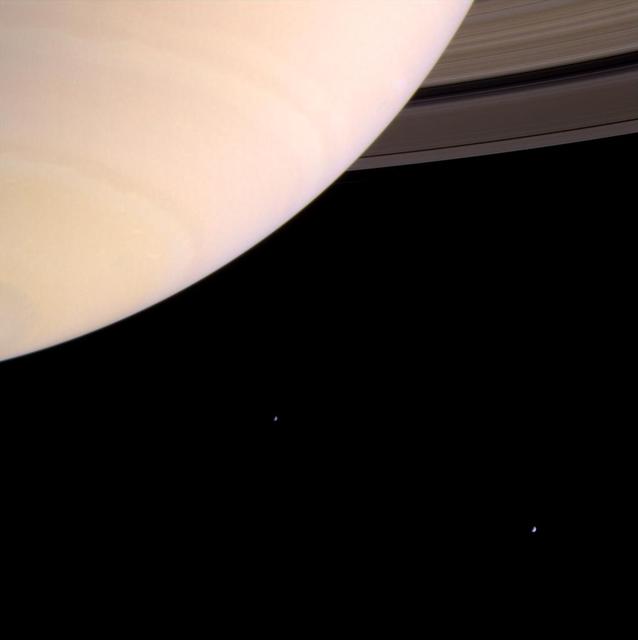
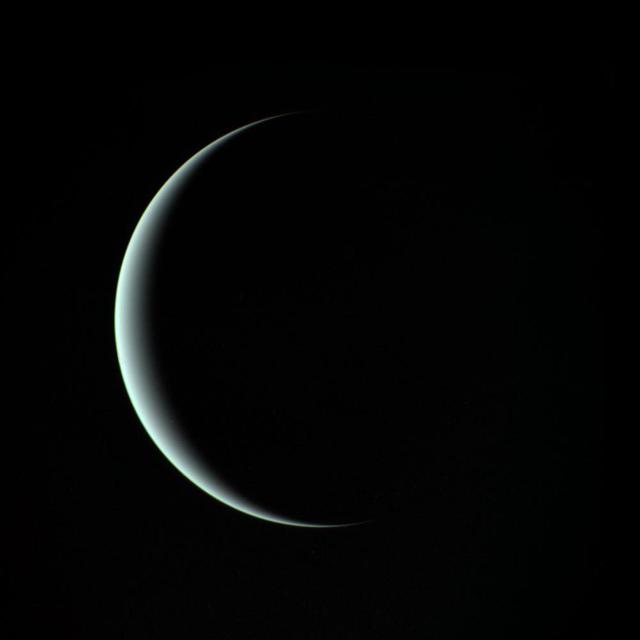
Enceladus unusual plume is only easily visible when NASA Cassini spacecraft and the Sun are on opposite sides of Enceladus. So what lighting up the moon then? It light reflected off Saturn.
Ver en NASA ↗🚀 Biblioteca espacial oficial
Imágenes y vídeos de NASA
Explora el catálogo multimedia público de NASA sin salir de TuPortalNews.
Explora temas destacados
Selecciona un tema o realiza una búsqueda personalizada.
6.539 resultados en NASA
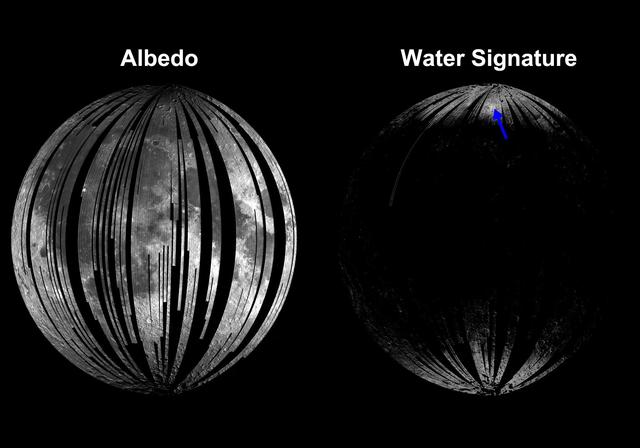
This image of the moon is from NASA Moon Mineralogy Mapper on the Indian Space Research Organization Chandrayaan-1 mission. It is a three-color composite of reflected near-infrared radiation from the sun.
Ver en NASA ↗NASA's InSight lander snapped a series of images of the Sun rising and setting on Mars using the camera on its robotic arm on April 10, 2022, the 1,198th Martian day, or sol, of the mission.
Ver en NASA ↗Like a human working in a radiation environment, NASA Curiosity rover carries its own version of a dosimeter to measure radiation from outer space and the sun. This graphic shows the flux of radiation detected the rover Radiation Assessment Detector.
Ver en NASA ↗Canyons and mountain peaks snake along the terminator on the crater-covered, icy moon Dione. With the Sun at a low angle on their local horizon, the line of mountain ridges above center casts shadows toward the east
Ver en NASA ↗This artist concept shows NASA two Voyager spacecraft exploring a turbulent region of space known as the heliosheath, the outer shell of the bubble of charged particles around our sun. The Voyagers have been in space 33 years.
Ver en NASA ↗The Dumbbell nebula, also known as Messier 27, pumps out infrared light in this image from NASA Spitzer Space Telescope. Planetary nebulae are now known to be the remains of stars that once looked a lot like our sun.
Ver en NASA ↗NASA Cassini spacecraft imaged the surface of Saturn moon Helene as the it flew by the moon on Jan. 31, 2011. Helene is a Trojan moon of Dione, named for the Trojan asteroids that orbit 60 degrees ahead of and behind Jupiter as it circles the Sun.
Ver en NASA ↗This chart shows what types of objects WISE can and cannot see at certain distances from our sun. Bodies with larger masses are brighter, and therefore can be seen at greater distances.
Ver en NASA ↗NASA Cassini spacecraft has delivered a glorious view of Saturn, taken while the spacecraft was in Saturn shadow. The cameras were turned toward Saturn and the sun so that the planet and rings are backlit.
Ver en NASA ↗The artist concept depicts Kepler-62f, a super-Earth-size planet in the habitable zone of a star smaller and cooler than the sun, located about 1,200 light-years from Earth in the constellation Lyra.
Ver en NASA ↗Observations from NASA WISE all-sky survey reveal new clues about Jovian Trojans, mysterious asteroids that orbit in front of and behind Jupiter in its path around the sun seen here in an artist’s concept.
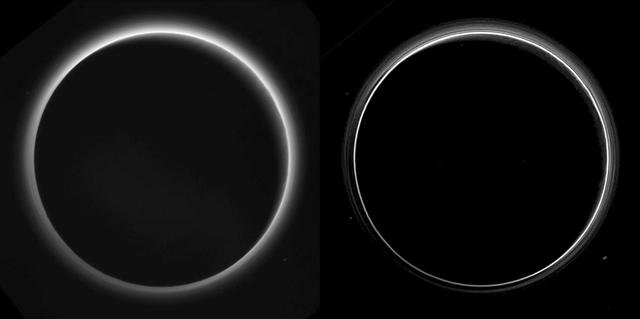
Ver en NASA ↗Artist concept of the interaction of the solar wind the supersonic outflow of electrically charged particles from the Sun with Pluto predominantly nitrogen atmosphere based on NASA New Horizons SWAP instrument.
Ver en NASA ↗This image shows Phobos, the larger of Mars two moons, as it transits in front of the sun. This image was taken by NASA Mars Exploration Rover Opportunity during the afternoon of the rover 3,078th Martian day, or sol.
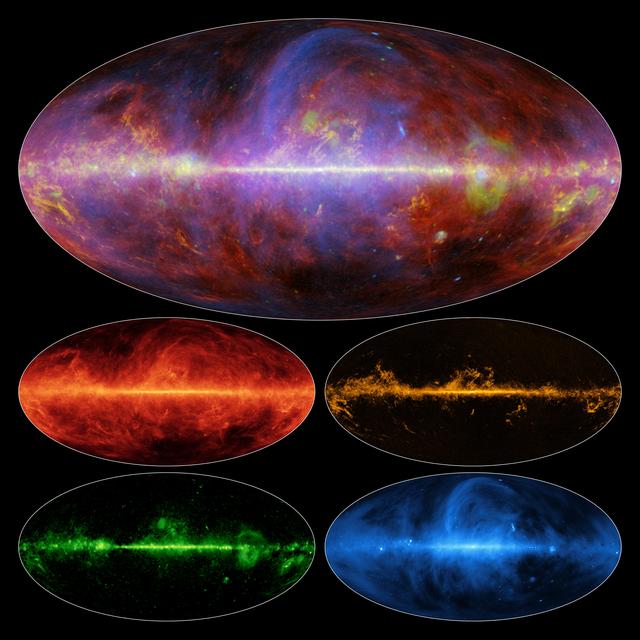
Ver en NASA ↗This three-color combination constructed from ESA Planck two highest frequency channels and an image obtained with the NASA Infrared Astronomical Satellite shows local dust structures within 500 light-years of the sun.
Ver en NASA ↗As winter turns to spring at the south polar ice cap of Mars, the rising sun reveals dark spots and fans emerging from the cold polar night. Using visual images left and temperature data right
Ver en NASA ↗This artist concept illustrates the frenzied activity at the core of our Milky Way galaxy. The galactic center hosts a supermassive black hole in the region known as Sagittarius A*, or Sgr A*, with a mass of about four million times that of our sun.
Ver en NASA ↗The red smudge at the center of this image is the first comet discovered by NASA Wide-Field Infrared Survey Explorer, or WISE. The comet is a dusty mass of ice and parades around the sun every 4.7 years.
Ver en NASA ↗This graphic shows the different streams of charged particles inside the bubble around our sun and outside, in the unexplored territory of interstellar space. The heliosheath, where NASA two Voyager spacecraft are now traveling, is shown in red.
Ver en NASA ↗This frame from a sequence of nine images taken by the Surface Stereo Imager on NASA Phoenix Mars Lander shows the sun rising on the morning of the lander 101st Martian day after landing.
Ver en NASA ↗This graphic shows the position of the Voyager 1 and Voyager 2 probes, relative to the heliosphere, a protective bubble created by the Sun that extends well past the orbit of Pluto.
Ver en NASA ↗019A0836.NEF
Ver en NASA ↗The United Launch Alliance Atlas V payload fairing, containing the Solar Orbiter spacecraft, is being secured on top of the company’s Atlas V rocket inside the Vertical Integration Facility at Space Launch Complex 41 on Cape Canaveral Air Force Station in Flo…
Ver en NASA ↗The United Launch Alliance Atlas V payload fairing, containing the Solar Orbiter spacecraft, is moved into the Vertical Integration Facility at Space Launch Complex 41 on Cape Canaveral Air Force Station in Florida on Jan. 31, 2020. The payload fairing will b…
Ver en NASA ↗Contenido y metadatos proporcionados por la NASA Image and Video Library.