





/NASA’s%20Artemis%20III%20Announcement%20(Official%20NASA%20Trailer)~thumb.jpg)

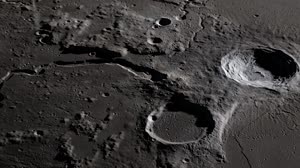
These images from NASA Dawn spacecraft are located in asteroid Vesta Gegania quadrangle, a little south of Vesta equator; boulders can be seen on the bottom side of the crater.
Ver en NASA ↗🚀 Biblioteca espacial oficial
Imágenes y vídeos de NASA
Explora el catálogo multimedia público de NASA sin salir de TuPortalNews.
Explora temas destacados
Selecciona un tema o realiza una búsqueda personalizada.
3.592 resultados en NASA
This image from NASA Dawn spacecraft shows the texture of the surface in a part of asteroid Vesta southern hemisphere. This region is just north of the main Rheasilvia structure.
Ver en NASA ↗This image from NASA Dawn spacecraft shows many linear and curvilinear grooves running roughly diagonally across asteroid Vesta Gegania quadrangle.
Ver en NASA ↗NASA Dawn spacecraft obtained this false-color image of asteroid Vesta equatorial region with its framing camera on July 25, 2011.
Ver en NASA ↗These images from NASA Dawn spacecraft are dominated by the 35km diameter Bellicia crater on asteroid Vesta, after which Bellicia quadrangle is named.
Ver en NASA ↗This image from NASA Dawn spacecraft shows a surface with craters buried under thick ejected material that displays a grooved texture on the giant asteroid Vesta.
Ver en NASA ↗This anaglyph from NASA Dawn spacecraft shows degraded craters in asteroid Vesta northern hemisphere. You need 3D glasses to view this image.
Ver en NASA ↗This 3D image of asteroid Vesta from NASA Dawn spacecraft shows hills, troughs, ridges and steep craters. You need 3D glasses to view this image.
Ver en NASA ↗These images from NASA Dawn spacecraft are located in asteroid Vesta Floronia quadrangle, in Vesta northern hemisphere; distinct sinuous grooves are visible around the rim of the crater.
Ver en NASA ↗This image from NASA Dawn spacecraft, located in asteroid Vesta Urbinia quadrangle in the Vestan southern hemisphere, shows a small crater with ejecta made of dark material.
Ver en NASA ↗The south pole of the giant asteroid Vesta reveals cliffs that are several miles or kilometers high, deep grooves, and craters. This oblique view is from NASA Dawn spacecraft.
Ver en NASA ↗This image from NASA Dawn spacecraft shows craters with both sharp and smooth rims, a ghost crater and dark and bright material in asteroid Vesta southern hemisphere.
Ver en NASA ↗Hydrogen is most abundant in areas with low reflectivity, or albedo, on the giant asteroid Vesta, as shown in this contour map from NASA Dawn mission.
Ver en NASA ↗This anaglyph image shows the topography of the mountain-central complex in asteroid Vesta south polar region. You need 3D glasses to view this image.
Ver en NASA ↗This false-color image from NASA Dawn spacecraft is of the of the giant asteroid Vesta. Scientists are studying image like these to better understand the different materials on the surface.
Ver en NASA ↗These images from NASA Dawn spacecraft are dominated by the 45km diameter Domitia crater on asteroid Vesta, after which Domitia quadrangle is named.
Ver en NASA ↗This image from NASA Dawn spacecraft shows numerous grooves linear depressions and crater chains, especially in the right hand side of the image of asteroid Vesta.
Ver en NASA ↗This colorized composite image from NASA Dawn mission shows the crater Antonia, which lies in the enormous Rheasilvia basin in the southern hemisphere of the giant asteroid Vesta.
Ver en NASA ↗This closeup of asteroid Vesta from NASA Dawn spacecraft shows small scale features such as grabens linear depressions which run parallel to and inside the troughs.
Ver en NASA ↗This image from NASA Dawn spacecraft shows an escarpment located in asteroid Vesta near Rheasilvia quadrangle, near Vesta south pole.
Ver en NASA ↗This image from NASA Dawn spacecraft of asteroid Vesta Fabia shows Justina crater, located in Vesta Urbinia quadrangle, in Vesta southern hemisphere.
Ver en NASA ↗From left to right, NASA Astromatierals Curator Francis McCubbin, NASA Sample Return Capsule Science Lead Scott Sandford, and University of Arizona OSIRIS-REx Principal Investigator Dante Lauretta, collect science data, Sunday, Sept. 24, 2023, shortly after t…
Ver en NASA ↗University of Arizona OSIRIS-REx Principal Investigator Dante Lauretta, right, answers questions from reporters during an OSIRIS-REx sample return press conference, Wednesday, Aug. 30, 2023, at the Department of Defense's Utah Test and Training Range. The sam…
Ver en NASA ↗Lockheed Martin System Safety Engineer Victoria Thiem, left, and On Scene Commander of Recovery Stuart Wylie, right, perform preliminary checks on the sample return capsule from NASA’s OSIRIS-REx mission, Sunday, Sept. 24, 2023, shortly after the capsule land…
Ver en NASA ↗Contenido y metadatos proporcionados por la NASA Image and Video Library.