





/NASA’s%20Artemis%20III%20Announcement%20(Official%20NASA%20Trailer)~thumb.jpg)

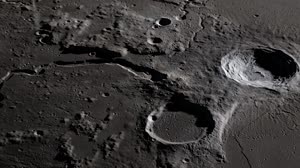
This mosaic of the surface of asteroid Vesta was made from images obtained by NASA Dawn spacecraft while the area was entirely in the sun shadow. Light reflecting off of other areas of Vesta provides the only illumination.
Ver en NASA ↗🚀 Biblioteca espacial oficial
Imágenes y vídeos de NASA
Explora el catálogo multimedia público de NASA sin salir de TuPortalNews.
Explora temas destacados
Selecciona un tema o realiza una búsqueda personalizada.
6.539 resultados en NASA
Surveyor 6 casting 18-meter long shadow with Sun just 8° above the horizon. Surveyor 6 Landed 10 November 1967 in Sinus Medii. This image was taken by NASA Lunar Reconnaissance Orbiter.
Ver en NASA ↗NASA Galileo spacecraft captured this dramatic image of mountains on Io. The Sun was low in the sky. A low scarp runs from the upper left toward the center of the image. The jagged ridge is Mongibello Mons.
Ver en NASA ↗The low sun elevation in this image of NASA Dawn spacecraft of asteroid Vesta enhances small topographic details near the rim of the large crater, part of which is visible in the bottom left of the image.
Ver en NASA ↗This image shows the dust density and the growth of structure in a simulated disk, which extends about 100 times farther from its star than Earth orbit around the sun.
Ver en NASA ↗Researchers using NASA Stratospheric Observatory for Infrared Astronomy SOFIA have captured infrared images of the last exhalations of a dying sun-like star. This image is of the planetary Nebula M2-9.
Ver en NASA ↗This is a Tempel 1 temperature map of the nucleus with different spatial resolutions from NASA Deep Impact mission. The color bar in the middle gives temperature in Kelvins. The sun is to the right in all images.
Ver en NASA ↗NASA Spitzer Space Telescope detected a prebiotic, or potentially life-forming, molecule called hydrogen cyanide HCN in the planet-forming disks around yellow stars like our sun, but not in the disks around cooler, reddish stars.
Ver en NASA ↗As spring turns to summer, the frost cover has been removed from the south polar cap. The surface textures seen in this VIS image are created by action of the sun on the icy cap.
Ver en NASA ↗The South Pole is receiving sun every day now as spring progresses. The surface texture visible in this image captured by NASA Mars Odyssey was created by the effect of solar warming on the ice.
Ver en NASA ↗Under the unflinching summer sun, workers at NASA Deep Space Network complex in Goldstone, Calif., use a crane to lift a runner segment that is part of major surgery on a giant, 70-meter-wide antenna.
Ver en NASA ↗Mars has two small, asteroid-sized moons named Phobos and Deimos. This frame from an animation shows the point of view of the rover, located near the equator of Mars, as these moons occasionally pass in front of, or transit, the disk of the sun.
Ver en NASA ↗This frame from an animation shows the coldest brown dwarf yet seen, and the fourth closest system to our sun. Called WISE J085510.83-071442.5, this dim object was discovered through its rapid motion across the sky.
Ver en NASA ↗This artist conception compares the KOI-961 planetary system to Jupiter and the largest four of its many moons. The KOI-961 planetary system hosts the three smallest planets known to orbit a star beyond our sun.
Ver en NASA ↗This is an artist concept of a hypothetical 10-million-year-old star system. The bright blur at the center is a star much like our sun. The other orb in the image is a gas-giant planet like Jupiter.
Ver en NASA ↗This artist conception illustrates Kepler-22b, a planet known to comfortably circle in the habitable zone of a sun-like star. It is the first planet that NASA Kepler mission has confirmed to orbit in a star habitable zone.
Ver en NASA ↗The dunes in Richardson crater, located at 72 degrees south latitude, are still covered in frost as seen by NASA Mars Odyssey. The small dark spots are where the sun is beginning to remove the ice and reveal the darker dune materials below.
Ver en NASA ↗This spectacular image of Saturn clouds looks obliquely across the high northern latitudes. The Sun is low on the horizon here, making the vertical extent of the clouds easier to see. Cloud bands surrounding the vortex
Ver en NASA ↗As the sun warms the surface and more frost is removed, the dunes and other features near the north pole of Mars are revealed. This image from NASA Mars Odyssey shows that the inter-dune areas are complex.
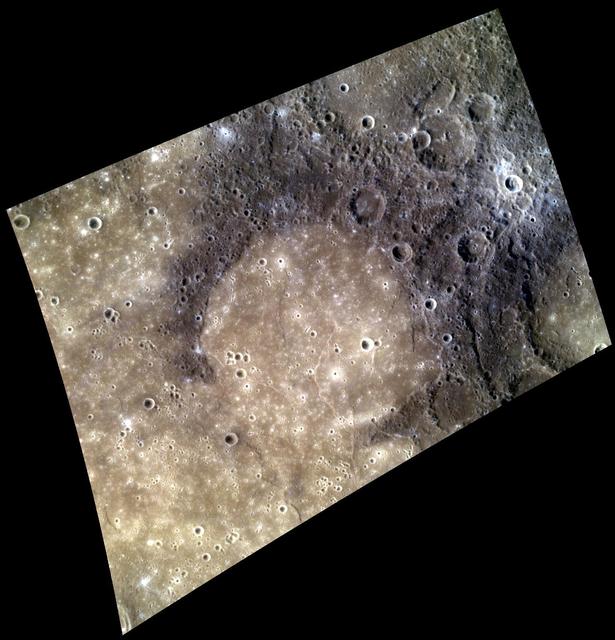
Ver en NASA ↗As NASA MESSENGER approached Mercury on January 14, 2008, the spacecraft Narrow-Angle Camera on the Mercury Dual Imaging System MDIS instrument captured this view of the planet rugged, cratered landscape illuminated obliquely by the Sun.
Ver en NASA ↗This image from NASA Dawn spacecraft shows an area in Vesta northern hemisphere that has been illuminated by the sun. As asteroid Vesta progresses from its winter to its spring the sunlight is creeping further and further northwards.
Ver en NASA ↗This diagram compares the planets of the inner solar system to Kepler-62, a five-planet system about 1,200 light-years from Earth in the constellation Lyra. At seven billion years old, the star is somewhat older than the sun.
Ver en NASA ↗This first image of asteroid 951 Gaspra was taken by NASA Galileo spacecraft on October 29, 1991, from a distance of 16,200 kilometers 10,000 miles. The Sun is shining from the right.
Ver en NASA ↗These images from NASA Spitzer Space Telescope of C/2012 S1 Comet ISON were taken on June 13, when ISON was 310 million miles about 500 million kilometers from the sun.
Ver en NASA ↗Contenido y metadatos proporcionados por la NASA Image and Video Library.