





/NASA’s%20Artemis%20III%20Announcement%20(Official%20NASA%20Trailer)~thumb.jpg)

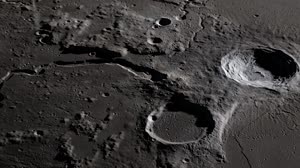
This image from NASA Dawn spacecraft shows a small, young, fresh crater on asteroid Vesta with bright and dark rays extending from it.
Ver en NASA ↗🚀 Biblioteca espacial oficial
Imágenes y vídeos de NASA
Explora el catálogo multimedia público de NASA sin salir de TuPortalNews.
Explora temas destacados
Selecciona un tema o realiza una búsqueda personalizada.
3.592 resultados en NASA
This image from NASA Dawn spacecraft shows Dawn visible and infrared spectrometer image, overlain on top of a framing camera image of the same region on asteroid Vesta.
Ver en NASA ↗This image NASA Dawn spacecraft shows a fresh scarp rimmed crater on asteroid Vesta with a remarkable distribution of bright and dark material in its interior.
Ver en NASA ↗This image from NASA Dawn spacecraft of asteroid Vesta shows Aelia crater, located in Vesta Lucaria Tholus quadrangle, in Vesta southern hemisphere.
Ver en NASA ↗This perspective view of Cornelia crater on the giant asteroid Vesta shows an example of pitted terrain, an unexpected discovery in data returned by NASA Dawn mission.
Ver en NASA ↗This image from NASA Dawn spacecraft of asteroid Vesta shows two craters, one that has been named Canuleia and one that has been named Sossia.
Ver en NASA ↗This image from NASA Dawn spacecraft shows undulating terrain, located only in asteroid Vesta southern hemisphere, in and around the Rheasilvia impact basin.
Ver en NASA ↗This anaglyph from NASA Dawn spacecraft image shows the topography of asteroid Vesta southeastern region. You need 3D glasses to view this image.
Ver en NASA ↗These images of Tarpeia crater, near the south pole of the giant asteroid Vesta, were obtained by the visible and infrared mapping spectrometer on NASA Dawn spacecraft.
Ver en NASA ↗This image, made from data obtained by NASA Dawn spacecraft, shows a perspective view of a layered young crater in the Rheasilvia basin at asteroid Vesta.
Ver en NASA ↗This map, made from data obtained by NASA Dawn spacecraft, shows the distribution of pyroxene, an iron- and magnesium-rich mineral, in the southern hemisphere of the giant asteroid Vesta.
Ver en NASA ↗This image from NASA Dawn spacecraft shows a close up image of two of the craters that make up the three Snowman craters on asteroid Vesta.
Ver en NASA ↗These images are of HED howardite, eucrite and diogenite meteorites are a large group of meteorites believed to originate from asteroid Vesta, a hypothesis that is consistent with current Dawn observations.
Ver en NASA ↗These images are of HED howardite, eucrite and diogenite meteorites are a large group of meteorites believed to originate from asteroid Vesta, a hypothesis that is consistent with current Dawn observations.
Ver en NASA ↗These images from NASA Dawn spacecraft are located in asteroid Vesta Floronia quadrangle, in Vesta northern hemisphere; small boulders visible inside of Scantia crater.
Ver en NASA ↗This image from NASA Dawn spacecraft is dominated by the approximately 8 km diameter bright ray crater named Tuccia on asteroid Vesta.
Ver en NASA ↗This image, one of the first obtained by NASA Dawn spacecraft in its low altitude mapping orbit, shows a part of one of the troughs at the equator of the giant asteroid Vesta.
Ver en NASA ↗This image from NASA Dawn mission shows a shadowy view of the northern hemisphere of the giant asteroid Vesta during Dawn last look back.
Ver en NASA ↗This image from NASA Dawn spacecraft shows old cratered terrain located on asteroid Vesta equator. Many of these craters have very degraded, rounded rims.
Ver en NASA ↗This image of asteroid Vesta is one of many images taken by NASA Dawn spacecraft to create an animation showing the diversity of minerals through color representation.
Ver en NASA ↗This image from NASA Dawn spacecraft shows a surface with many craters and linear chains of small craters that merge into ridges on the giant asteroid Vesta.
Ver en NASA ↗This global map from NASA Dawn mission shows the topography of the giant asteroid Vesta, with the seven most prominent impact basins highlighted.
Ver en NASA ↗This is a NASA Hubble Space Telescope color image of dwarf planet Ceres, the largest object in the asteroid belt. The contrast has been enhanced to reveal surface details.
Ver en NASA ↗This image from NASA Dawn spacecraft shows dark colored mountains top of the image in the northern region of asteroid Vesta. The origin of such mountains is currently being investigated.
Ver en NASA ↗Contenido y metadatos proporcionados por la NASA Image and Video Library.