





/NASA’s%20Artemis%20III%20Announcement%20(Official%20NASA%20Trailer)~thumb.jpg)

This artist concept shows hundreds of brown dwarfs deep red, expected to be added to the population of known stars in our solar neighborhood. Our sun and other known stars appear white, yellow or red.
Ver en NASA ↗🚀 Biblioteca espacial oficial
Imágenes y vídeos de NASA
Explora el catálogo multimedia público de NASA sin salir de TuPortalNews.
Explora temas destacados
Selecciona un tema o realiza una búsqueda personalizada.
6.539 resultados en NASA
The third closest star system to the sun, called WISE J104915.57-531906, center of large image, which was taken by NASA WISE. It appeared to be a single object, but a sharper image from Gemini Observatory, revealed that it was binary star system.
Ver en NASA ↗This artist concept shows the immediate aftermath of a large asteroid impact around NGC 2547-ID8, a 35-million-year-old sun-like star thought to be forming rocky planets.
Ver en NASA ↗This image from NASA Spitzer Space Telescope shows what lies near the sword of the constellation Orion -- an active stellar nursery containing thousands of young stars and developing protostars. Many will turn out like our sun.
Ver en NASA ↗A brilliant spot of sunlight, the opposition effect, travels outward across the rings as the Cassini spacecraft orbits Saturn. This surge in ring brightness is created around the point directly opposite the Sun from the spacecraft
Ver en NASA ↗This image from NASA 2001 Mars Odyssey spacecraft shows sand dunes located near the north polar cap. It is springtime and the dunes will darken with time as the winter frost sublimates in the sun.
Ver en NASA ↗Jupiter, Saturn, Uranus, and Neptune are known as the jovian Jupiter-like planets because they are all gigantic compared with Earth, and they have a gaseous nature. This diagram shows the approximate distance of the jovian planets from the Sun.
Ver en NASA ↗This self-portrait of NASA Mars Exploration Rover Opportunity comes courtesy of the Sun and the rover front hazard-avoidance camera. The dramatic snapshot of Opportunity shadow was taken as the rover continues to move farther into Endurance Crater
Ver en NASA ↗After passing Mercury the first time and making a trip around the Sun, NASA Mariner 10 again flew by Mercury on Sept. 21, 1974. This encounter brought the spacecraft in front of Mercury in the southern hemisphere.
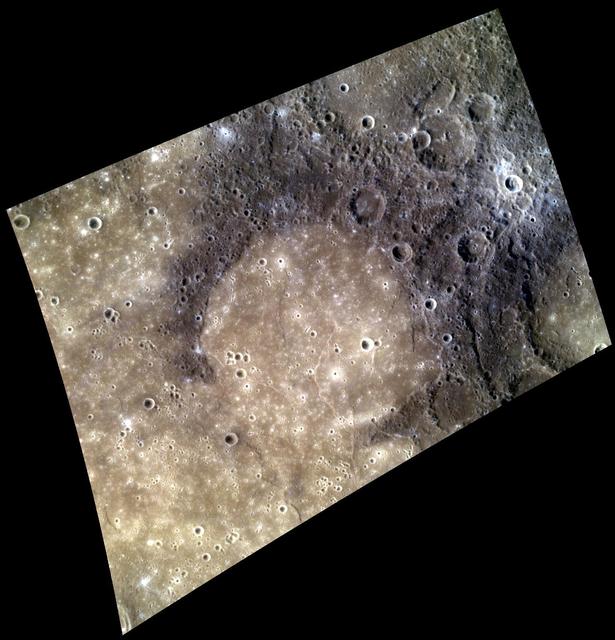
Ver en NASA ↗NASA MESSENGER spacecraft Narrow Angle Camera NAC on the Mercury Dual Imaging System MDIS acquired this view of Mercury surface illuminated obliquely from the right by the Sun.
Ver en NASA ↗Tiny, dust-sized particles in Saturn rings become much easier to see at high phase angle -- the angle formed by the Sun, the rings and the spacecraft. The brightest ring is the F ring; the next feature to the left is the outer edge of the A ring
Ver en NASA ↗NASA Wide-field Infrared Survey Explorer will uncover many failed stars, or brown dwarfs, in infrared light. This diagram shows a brown dwarf in relation to Earth, Jupiter, a low-mass star and the sun.
Ver en NASA ↗WISE J104915.57-531906, center of the larger image, was taken by the NASA WISE. This is the closest star system discovered since 1916, and the third closest to our sun. It is 6.5 light-years away.
Ver en NASA ↗This artist concept illustrates a supermassive black hole with millions to billions times the mass of our sun. Supermassive black holes are enormously dense objects buried at the hearts of galaxies.
Ver en NASA ↗This graph, or spectrum, from NASA Spitzer Space Telescope tells astronomers that some of the most basic ingredients of DNA and protein are concentrated in a dusty planet-forming disk circling a young sun-like star called IRS 46.
Ver en NASA ↗NASA Voyager 2 obtained this color image of Neptune largest satellite,Triton, on Aug. 22, 1989. The south pole of Triton is tipped toward the sun and it is summer in the southern hemisphere.
Ver en NASA ↗Saturn north polar hexagon basks in the Sun light now that spring has come to the northern hemisphere. Many smaller storms dot the north polar region and Saturn signature rings put in an appearance in the background.
Ver en NASA ↗This Hubble telescope snapshot of MyCn18, a young planetary nebula, reveals that the object has an hourglass shape with an intricate pattern of etchings in its walls. A planetary nebula is the glowing relic of a dying, Sun-like star.
Ver en NASA ↗Epimetheus 116 kilometers, or 72 miles across, at right and Janus 181 kilometers, or 113 miles across, at left are lit here by reflected greylight from Saturn. The Sun brightens only thin slivers of the moonssurfaces.
Ver en NASA ↗This graphic shows the relative positions of NASA most distant spacecraft in early 2011, looking at the solar system from the side. Voyager 1 is the most distant spacecraft, 10.9 billion miles away from the sun at a northward angle.
Ver en NASA ↗After passing Mercury the first time and making a trip around the Sun, NASA Mariner 10 again flew by Mercury on Sept. 21, 1974. This encounter brought the spacecraft in front of Mercury in the southern hemisphere.
Ver en NASA ↗This image of the polar region illustrates the effect of the sun on polar frost. The highstanding ridges have lost all their frost cover, while the lows shaded by the ridges still have a bright frost cover
Ver en NASA ↗This image from the High-Resolution Instrument on NASA EPOXI mission spacecraft shows part of the nucleus of comet Hartley 2. The sun is illuminating the nucleus from the right. A distinct cloud of individual particles is visible.
Ver en NASA ↗As comets C/2012 S1 ISON and the well-known short-period comet 2P/Encke both approached their closest distances to the Sun in November, 2013, they also passed close to the MESSENGER spacecraft orbiting the innermost planet Mercury.
Ver en NASA ↗Contenido y metadatos proporcionados por la NASA Image and Video Library.