





/NASA’s%20Artemis%20III%20Announcement%20(Official%20NASA%20Trailer)~thumb.jpg)

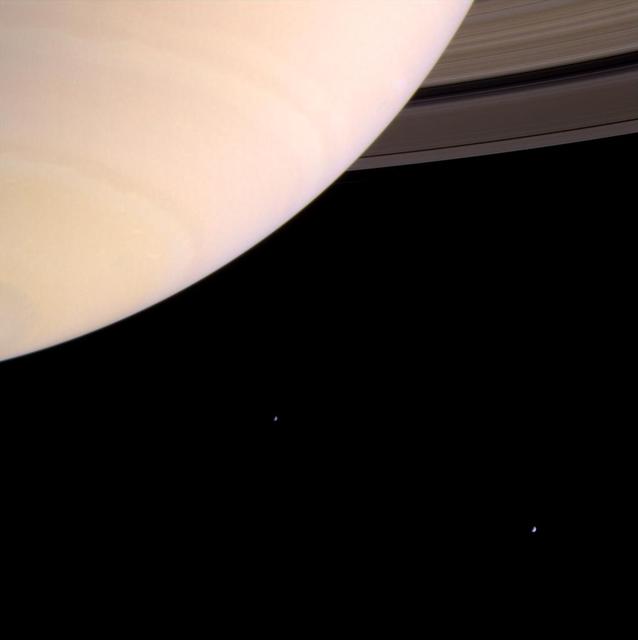
Epimetheus 116 kilometers, or 72 miles across, at right and Janus 181 kilometers, or 113 miles across, at left are lit here by reflected greylight from Saturn. The Sun brightens only thin slivers of the moonssurfaces.
Ver en NASA ↗🚀 Biblioteca espacial oficial
Imágenes y vídeos de NASA
Explora el catálogo multimedia público de NASA sin salir de TuPortalNews.
Explora temas destacados
Selecciona un tema o realiza una búsqueda personalizada.
4.237 resultados en NASA
This infrared view looks toward middle to high northern latitudes on Saturn, revealing entrancing meanders in the clouds. The cloud patterns transition from puffier looking in the south -- possibly a region of shear -- to smoother oval shapes in the north
Ver en NASA ↗A serene orb of ice is set against the gentle pastel clouds of giant Saturn. Rhea transits the face of the gas giant, whose darkened rings and their planet-hugging shadows appear near upper right
Ver en NASA ↗Rippling with detail, the southern hemisphere of Saturn comes to life in this view from the Cassini spacecraft. Long, flowing streamers and bands of great contrast soften toward the pole, where a great hurricane-like storm resides
Ver en NASA ↗These two false-color views from NASA Cassini spacecraft show detailed patterns that change during one Saturn day within the huge storm in the planet northern hemisphere.
Ver en NASA ↗Titan, Saturn largest moon and Mimas in the foreground are seen together in this view from Cassini. Titan gravity is weaker than Earth, so the moon atmosphere is quite extended -- a quality hinted at in this view
Ver en NASA ↗Saturn atmosphere produces beautiful and sometimes perplexing features. Is the bright feature below center a rare crossing of a feature from a zone to a belt, or is it an illusion created by different cloud layers at different levels?
Ver en NASA ↗This view of high southern latitudes on Saturn shows very linear clouds at top, usually indicative of stable prevailing winds, and two turbulent, swirling features farther south
Ver en NASA ↗This infrared view from high above Saturn ringplane highlights the contrast in the cloud bands, the dimly glowing rings and their shadows on the gas giant planet. The overall effect is stirring
Ver en NASA ↗The Cassini spacecraft continues to profile the haze structure and opacity in Saturn upper atmosphere with images like this, which captures Rigel, a star in Orion whose brightness is well-known, as it passes behind the planet
Ver en NASA ↗This dramatic close-up of Saturn south pole shows the hurricane-like vortex that resides there. The entire polar region is dotted with bright clouds, including one that appears to be inside the central ring of the polar storm
Ver en NASA ↗This spectacular image of Saturn clouds looks obliquely across the high northern latitudes. The Sun is low on the horizon here, making the vertical extent of the clouds easier to see. Cloud bands surrounding the vortex
Ver en NASA ↗The moon Mimas casts a shadow and creates a single blemish on the kingly crescent of Saturn. Mimas is not shown in this view, but its shadow can be seen on the planet just north of the rings and their shadow.
Ver en NASA ↗This frame from a movie from NASA Cassini mission shows a polar projection of the curious six-sided jet stream at Saturn north pole known as the hexagon in the infrared.
Ver en NASA ↗These two natural color views taken 11 hours -- one Saturn day -- apart by NASA Cassini spacecraft help scientists measure wind speeds in the huge storm seen here in the planet northern hemisphere.
Ver en NASA ↗This image from NASA Cassini spacecraft reveals the wind patterns within a large vortex that was spawned by a giant northern storm on Saturn. The arrows indicate the local direction of the winds.
Ver en NASA ↗Saturn most prominent feature, its dazzling ring system, takes center stage in this stunning natural color mosaic which reveals the color and diversity present in this wonder of the solar system.
Ver en NASA ↗These false-color images from NASA Cassini spacecraft chronicle a day in the life of a huge storm that developed from a small spot that appeared 12 weeks earlier in Saturn northern mid-latitudes.
Ver en NASA ↗During its final close flyby of Saturn moon Enceladus, NASA Cassini orbiter shows this view featuring the nearly parallel furrows and ridges of the feature named Samarkand Sulci.
Ver en NASA ↗These images compare surface features observed by NASA Cassini spacecraft at the Xanadu region on Saturn moon Titan left, and features observed by NASA Galileo spacecraft on Jupiter cratered moon Callisto right.
Ver en NASA ↗The shadow of the moon Mimas creates a smudge on the southern hemisphere of Saturn in this view from NASA Cassini spacecraft. Mimas does not appear here, but it does cast its shadow on the planet in the lower left of the image.
Ver en NASA ↗The soft, sweeping shadows of Saturn C ring cover bright patches of clouds in the planet atmosphere. The shadow-throwing rings stretch across the view at bottom. The dark inner edge of the B ring is visible at top
Ver en NASA ↗This image obtained by NASA Cassini spacecraft shows some of the more bizarre trails that were dragged out from Saturn F ring by objects about a half mile 1 kilometer in diameter.
Ver en NASA ↗An enhanced close-up view shows at least two distinct jets spraying a mist of fine particles from the south polar region of Enceladus. This image shows the night side of Saturn and the active moon against dark sky
Ver en NASA ↗Contenido y metadatos proporcionados por la NASA Image and Video Library.