





/NASA’s%20Artemis%20III%20Announcement%20(Official%20NASA%20Trailer)~thumb.jpg)

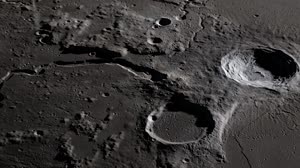
This image from NASA Dawn spacecraft is centered on asteroid Vesta Vibidia crater. There is a distinctive distribution of bright and dark material around Vibidia crater.
Ver en NASA ↗🚀 Biblioteca espacial oficial
Imágenes y vídeos de NASA
Explora el catálogo multimedia público de NASA sin salir de TuPortalNews.
Explora temas destacados
Selecciona un tema o realiza una búsqueda personalizada.
3.592 resultados en NASA
This image from NASA Dawn spacecraft of asteroid Vesta shows Drusilla crater, which is the irregularly shaped crater offset from the center of the image.
Ver en NASA ↗This mosaic from NASA Dawn spacecraft shows dark material near a series of craters known as the nowman on asteroid Vesta. That ejected material is a complex mixture of components.
Ver en NASA ↗This image from NASA Dawn spacecraft shows linear grooves and ridges in Vesta regolith, located in Vesta Tuccia quadrangle, in asteroid Vesta southern hemisphere.
Ver en NASA ↗This image shows three slices of a class of meteorites that fell to Earth that NASA Dawn mission has confirmed as originating from the giant asteroid Vesta.
Ver en NASA ↗This enhanced image, taken by the framing camera instrument aboard NASA Dawn spacecraft on July 9, 2011, views the south polar region of this giant asteroid.
Ver en NASA ↗Vesta is the largest asteroid visited by a spacecraft. It is currently being observed by NASA Dawn spacecraft, which has entered orbit around Vesta.
Ver en NASA ↗This image from NASA Dawn mission shows huge grooves on the giant asteroid Vesta that were the result of mega impacts at the south pole.
Ver en NASA ↗With the help of NASA Spitzer Space Telescope, astronomers have discovered that what was thought to be a large asteroid called Don Quixote is in fact a comet.
Ver en NASA ↗These composite images from NASA Dawn spacecraft show three views of a terrain with ridges and grooves near Aquilia crater in the southern hemisphere of the giant asteroid Vesta.
Ver en NASA ↗These images from NASA Dawn spacecraft show the ~20km diameter Numisia crater on asteroid Aster, after which Numisia quadrangle is named.
Ver en NASA ↗Equatorial troughs of asteroid Vesta are shown running obliquely across this image from NASA Dawn spacecraft. The troughs both overlie and are overlain by impact craters.
Ver en NASA ↗These images are of HED howardite, eucrite and diogenite meteorites, a large group of meteorites believed to originate from asteroid Vesta, a hypothesis that is consistent with current Dawn observations.
Ver en NASA ↗This colorized composite image from NASA Dawn mission shows the crater Antonia, which lies in the enormous Rheasilvia basin in the southern hemisphere of the giant asteroid Vesta.
Ver en NASA ↗This image from NASA Dawn spacecraft shows a relatively fresh crater with bright deposits exposed in the crater wall that streak downslope on the giant asteroid Vesta.
Ver en NASA ↗This artist concept shows NASA Dawn spacecraft orbiting the giant asteroid Vesta. The depiction of Vesta is based on images obtained by Dawn framing cameras.
Ver en NASA ↗These images from NASA Dawn spacecraft show part of asteroid Vesta equatorial region, which contains impact craters and troughs linear depressions.
Ver en NASA ↗These images from NASA Dawn spacecraft show part of asteroid Vesta equatorial region, which contains many different sizes of impact craters.
Ver en NASA ↗This image from NASA Dawn spacecraft of asteroid Vesta shows Laelia crater and Sextilia crater, located in Vesta Sextilia quadrangle, in Vesta southern hemisphere.
Ver en NASA ↗This mosaic from NASA Dawn spacecraft shows asteroid Vesta southern hemisphere lower part of the image and equatorial regions upper part of the image.
Ver en NASA ↗This image from NASA Dawn spacecraft of asteroid Vesta shows Lepida crater, located in Vesta Floronia quadrangle, in Vesta northern hemisphere.
Ver en NASA ↗Numerous small, bright spots appear on asteroid Vesta, as seen in this image from NASA Dawn spacecraft. This region is just north of the equator, to the west of Marcia crater.
Ver en NASA ↗These composite images from NASA Dawn spacecraft show three views of a terrain with ridges and grooves near Aquilia crater in the southern hemisphere of the giant asteroid Vesta.
Ver en NASA ↗Scientists with NASA Dawn mission have created perspective views of the Rheasilvia impact basin on the giant asteroid Vesta. Rheasilvia is located in Vesta southern hemisphere.
Ver en NASA ↗Contenido y metadatos proporcionados por la NASA Image and Video Library.