





/NASA’s%20Artemis%20III%20Announcement%20(Official%20NASA%20Trailer)~thumb.jpg)

NASA’s TRACERS (Tandem Reconnection and Cusp Electrodynamics Reconnaissance Satellites) mission launches at 11:13 a.m. PDT (2:13 p.m. EDT) on Wednesday, July 23, 2025, atop a SpaceX Falcon 9 rocket at Space Launch Complex 4 East at Vandenberg Space Force Base…
Ver en NASA ↗🚀 Biblioteca espacial oficial
Imágenes y vídeos de NASA
Explora el catálogo multimedia público de NASA sin salir de TuPortalNews.
Explora temas destacados
Selecciona un tema o realiza una búsqueda personalizada.
6.539 resultados en NASA
This view taken through overhead window W7 on Columbia's, Orbiter Vehicle (OV) 102's, aft flight deck shows the Long Duration Exposure Facility (LDEF) in the grasp of the remote manipulator system (RMS) during STS-32 retrieval activities. Other cameras at eye…
Ver en NASA ↗NASA’s TRACERS (Tandem Reconnection and Cusp Electrodynamics Reconnaissance Satellites) mission launches at 11:13 a.m. PDT (2:13 p.m. EDT) on Wednesday, July 23, 2025, atop a SpaceX Falcon 9 rocket at Space Launch Complex 4 East at Vandenberg Space Force Base…
Ver en NASA ↗NASA’s TRACERS (Tandem Reconnection and Cusp Electrodynamics Reconnaissance Satellites) mission launches at 11:13 a.m. PDT (2:13 p.m. EDT) on Wednesday, July 23, 2025, atop a SpaceX Falcon 9 rocket at Space Launch Complex 4 East at Vandenberg Space Force Base…
Ver en NASA ↗A SpaceX Falcon 9 rocket carrying NASA’s TRACERS (Tandem Reconnection and Cusp Electrodynamics Reconnaissance Satellites) mission stands vertical Tuesday, July 22, 2025, at Space Launch Complex 4 East at Vandenberg Space Force Base in California. The TRACERS …
Ver en NASA ↗NASA’s TRACERS (Tandem Reconnection and Cusp Electrodynamics Reconnaissance Satellites) mission launches at 11:13 a.m. PDT (2:13 p.m. EDT) on Wednesday, July 23, 2025, atop a SpaceX Falcon 9 rocket at Space Launch Complex 4 East at Vandenberg Space Force Base…
Ver en NASA ↗NASA Earth Science Division Director Michael Freilich shows meteorologists an AERONET sun photometer, right, and a model of the Global Precipitation Measurement (GPM) Core Observatory during a media event for the release of the Third U.S. National Climate Ass…
Ver en NASA ↗015B1427.NEF
Ver en NASA ↗STS109-345-032 (1-12 March 2002) --- One of the astronauts aboard the Space Shuttle Columbia photographed this west-looking view featuring the profile of the atmosphere and the setting sun. The shuttle was located over the Java Sea to the south of Kalimantan…
Ver en NASA ↗It is early springtime in the southern hemisphere of Mars in this image from NASA Mars Odyssey. The south polar cap is now illuminated by the sun and the surface can be studied as it changes with the passage of spring.
Ver en NASA ↗This graphic shows the flux of radiation detected by NASA Mars Science Laboratory on the trip from Earth to Mars; the spikes in radiation levels occurred because of large solar energetic particle events caused by giant flares on the sun.
Ver en NASA ↗The sun has now risen over the south pole of Mars. The polar surface is defrosting. This captured by NASA 2001 Mars Odyssey spacecraft image shows layering near the margin of the south polar cap.
Ver en NASA ↗This trio of ghostly images from NASA Spitzer Space Telescope shows the disembodied remains of dying stars called planetary nebulas. Planetary nebulas are a late stage in a sun-like star life.
Ver en NASA ↗This daytime infrared image of Rabe Crater illustrates the warming effect of the sun on sand. The extensive sand sheet and dunes of Rabe crater appear bright in the infrared indicating they are warmer than the surrounding floor and plains materials.
Ver en NASA ↗The sun sets behind Space Launch Complex 2, Vandenberg Air Force Base, California, where NASA Soil Moisture Active Passive SMAP mission satellite is being prepared for liftoff. Launch is scheduled for Jan. 29.
Ver en NASA ↗NASA Kepler mission has discovered a new planetary system that is home to the smallest planet yet found around a star like our sun, approximately 210 light-years away in the constellation Lyra.
Ver en NASA ↗This is an artist concept of a plume of water vapor thought to be ejected off the frigid, icy surface of the Jovian moon Europa, located about 500 million miles 800 million kilometers from the sun.
Ver en NASA ↗The artist concept depicts Kepler-62e, a super-Earth-size planet in the habitable zone of a star smaller and cooler than the sun, located about 1,200 light-years from Earth in the constellation Lyra.
Ver en NASA ↗This image from NASA Dawn spacecraft shows a part of Vesta northern hemisphere, which is mostly in darkness. Since Dawn arrival at asteroid Vesta the sun has not illuminated Vesta most northerly latitudes.
Ver en NASA ↗The artist concept depicts Kepler-69c, a super-Earth-size planet in the habitable zone of a star like our sun, located about 2,700 light-years from Earth in the constellation Cygnus.
Ver en NASA ↗This image, taken by the framing camera aboard NASA Dawn spacecraft, shows several unnamed craters superimposed upon one another. The low sun angle enhances the topography of this densely cratered region.
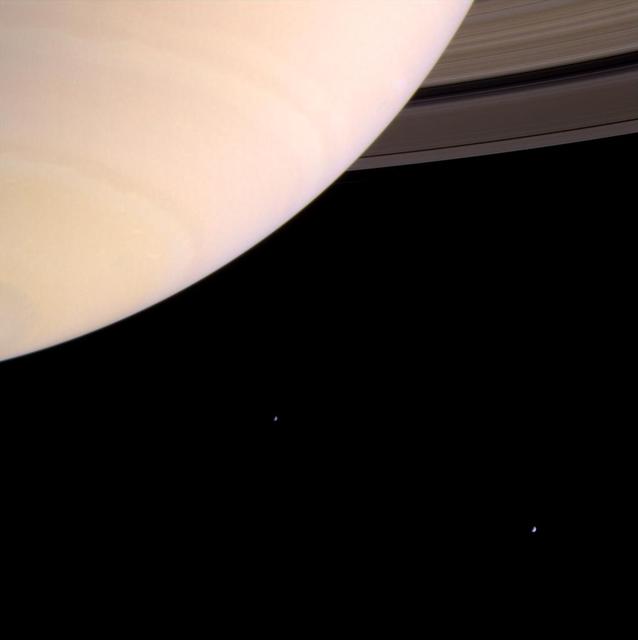
Ver en NASA ↗With giant Saturn hanging in the blackness and sheltering Cassini from the sun blinding glare, the spacecraft viewed the rings as never before, revealing previously unknown faint rings and even glimpsing its home world.
Ver en NASA ↗New data from the Herschel Space Observatory suggest comets are constantly smashing together around the star Fomalhaut, a young star, just a few hundred million years old, and twice as massive as the sun.
Ver en NASA ↗This infrared image from NASA Spitzer Space Telescope shows the broken Comet 73P/Schwassman-Wachmann 3 skimming along a trail of debris left during its multiple trips around the sun.
Ver en NASA ↗Contenido y metadatos proporcionados por la NASA Image and Video Library.