






/NASA’s%20Artemis%20III%20Announcement%20(Official%20NASA%20Trailer)~thumb.jpg)

Many of the features seen in Saturn's rings are shaped by the planet's moons. This view from NASA's Cassini spacecraft shows two different effects of moons that cause waves in the A ring and kinks in a faint ringlet.
Ver en NASA ↗🚀 Biblioteca espacial oficial
Imágenes y vídeos de NASA
Explora el catálogo multimedia público de NASA sin salir de TuPortalNews.
Explora temas destacados
Selecciona un tema o realiza una búsqueda personalizada.
4.237 resultados en NASA
This view from NASA's Cassini spacecraft is the sharpest ever taken of belts of the features called propellers in the middle part of Saturn A ring. The propellers are the small, bright features that look like double dashes.
Ver en NASA ↗Saturn moon Prometheus, seen here looking suspiciously blade-like, is captured by NASA Cassini spacecraft near some of its sculpting in the F ring.
Ver en NASA ↗NASA's Cassini spacecraft shows the sunlit side of Saturn's rings.
Ver en NASA ↗From left, NASA astronauts Jessica Meir, Joseph Acaba, Anne McClain, Matthew Dominick, and Jessica Watkins pose inside the Apollo/Saturn V Center at the Kennedy Space Center Visitor Complex in Florida on Dec. 9, 2020. The five are among the initial team of 18…
Ver en NASA ↗Wavy bands of clouds near Saturn's south pole dominate this ultraviolet image from NASA's Cassini spacecraft.
Ver en NASA ↗Nature is an artist, and this time she seems to have let her paints swirl together a bit. What the viewer might perceive to be Saturn surface captured by NASA Cassini orbiter is really just the tops of its uppermost cloud layers.
Ver en NASA ↗This spectacular, vertigo inducing, false-color image from NASA Cassini mission highlights the storms at Saturn north pole. The angry eye of a hurricane-like storm appears dark red.
Ver en NASA ↗The clouds of Saturn swirl, billow and merge. These bands are layered into stratified cloud decks consisting of droplets of ammonia, ammonium hydrosulfide and water set aloft in a sea of hydrogen and helium
Ver en NASA ↗The bright whorls and small-scale specks of convective clouds drift through a region just north of Saturn bright equatorial band. Observers have seen major storms develop in this region in the past 15-20 years
Ver en NASA ↗This image NASA Cassini spacecraft shows subtle, wavelike patterns, hundreds of narrow features resembling a record grooves in Saturn outer B-ring, and a noticeable abrupt change in overall brightness beyond the dark gap near the right.
Ver en NASA ↗The constant change in Saturn wavy, wiggly F ring is on display in this image obtained by NASA Cassini spacecraft. The image shows a view looking directly down onto the ring with the planet removed from the center.
Ver en NASA ↗Magnificent blue and gold Saturn floats obliquely as one of its gravity-bound companions, Dione, hangs in the distance. The darkened rings seem to nearly touch their shadowy reverse images on the planet below
Ver en NASA ↗This view was taken from above the ringplane and looks toward the unlit side of the rings. Here, the probe gazes upon Titan in the distance beyond Saturn and its dark and graceful rings
Ver en NASA ↗This mosaic of images from NASA Cassini spacecraft shows the trail of a great northern storm on Saturn raging in full force. The contrast in the images has been enhanced to make the turbulent parts of the storm in white stand out.
Ver en NASA ↗The area within Saturn north polar hexagon is shown by NASA Cassini spacecraft to contain myriad storms of various sizes, not the least of which is the remarkable and imposing vortex situated over the planet north pole.
Ver en NASA ↗This Saturn equinox, captured here in a mosaic of light and dark, is the first witnessed up close by an emissary from Earth, none other than our NASA faithful robotic explorer, Cassini.
Ver en NASA ↗The spinning vortex of Saturn north polar storm resembles a deep red rose of giant proportions surrounded by green foliage in this false-color image from NASA Cassini spacecraft.
Ver en NASA ↗NASA Cassini spacecraft peers through the atmosphere of Saturn largest moon, Titan, to examine the dark region Belet. This large region on the moon surface has a low albedo, meaning it reflects little light.
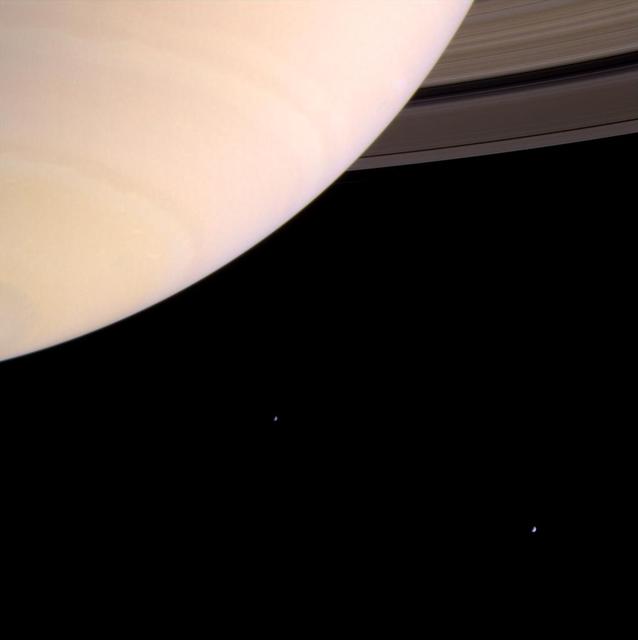
Ver en NASA ↗Whiffs of cloud dance in Saturn atmosphere, while the dim crescent of Rhea 1,528 kilometers, or 949 miles across hangs in the distance.The dark ringplane cuts a diagonal across the top left corner of this view
Ver en NASA ↗This set of images from NASA Cassini spacecraft shows cloud patterns in a band around Saturn before a monstrous thunder-and-lightning storm erupted and again after the head of the storm had disappeared.
Ver en NASA ↗Saturn and Dione appear askew in this view from NASA Cassini spacecraft, with the north poles rotated to the right, as if they were threaded along on the thin diagonal line of the planet rings.
Ver en NASA ↗This set of images from NASA Cassini mission shows the evolution of a massive thunder-and-lightning storm that circled all the way around Saturn and fizzled when it ran into its own tail.
Ver en NASA ↗This figure examines a particularly strong jet stream and the eddies that drive it through the atmosphere of Saturn northern hemisphere. Data from NASA Cassini spacecraft were used to create this figure.
Ver en NASA ↗Contenido y metadatos proporcionados por la NASA Image and Video Library.