





/NASA’s%20Artemis%20III%20Announcement%20(Official%20NASA%20Trailer)~thumb.jpg)
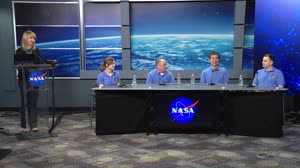

Stephanie Martin, left, NASA Office of Communications, and Nilufar Ramji, NASA Office of STEM Engagement, host a live broadcast of “STEM Forward to the Moon” on July 19, 2019 from Kennedy Space Center’s Apollo/Saturn V Center in Florida. The special program f…
Ver en NASA ↗🚀 Biblioteca espacial oficial
Imágenes y vídeos de NASA
Explora el catálogo multimedia público de NASA sin salir de TuPortalNews.
Explora temas destacados
Selecciona un tema o realiza una búsqueda personalizada.
19.951 resultados en NASA
Stephanie Martin, left, NASA Office of Communications, and Nilufar Ramji, NASA Office of STEM Engagement, host a live broadcast of “STEM Forward to the Moon” on July 19, 2019 from Kennedy Space Center’s Apollo/Saturn V Center in Florida. The special program f…
Ver en NASA ↗AS13-60-8703 (11-17 April 1970) --- This outstanding view of a near full moon was photographed from the Apollo 13 spacecraft during its trans-Earth journey homeward. Though the explosion of the oxygen tank in the Service Module (SM) forced the cancellation of…
Ver en NASA ↗AS11-44-6667 (21 July 1969) --- This outstanding view of the whole full moon was photographed from the Apollo 11 spacecraft during its trans-Earth journey homeward. When this picture was taken, the spacecraft was already 10,000 nautical miles away. Onboard Ap…
Ver en NASA ↗AS11-44-6551 (July 1969) --- This view from the Apollo 11 spacecraft shows the Earth rising above the moon's horizon. The lunar terrain pictured is in the area of Smyth's Sea on the nearside. Coordinates of the center of the terrain are 85 degrees east longit…
Ver en NASA ↗California’s NASA Armstrong Flight Research Center photographer Ken Ulbrich takes photos of Super Blue Blood Moon eclipse making a time-lapse composition of the event on January 31. The total lunar eclipse provided a rare opportunity to capture a supermoon, a…
Ver en NASA ↗New modeling indicates that the grooves on Mars’ moon Phobos could be produced by tidal forces – the mutual gravitational pull of the planet and the moon. Initially, scientists had thought the grooves were created by the massive impact that made Stickney crat…
Ver en NASA ↗California’s NASA Armstrong Flight Research Center’s photographer Carla Thomas takes photos on January 31 of the rare opportunity to capture a supermoon, a blue moon and a lunar eclipse at the same time. A supermoon occurs when the Moon is closer to Earth in …
Ver en NASA ↗ISS019-E-015313 (9 May 2009) --- A full moon is featured in this image, photographed by an Expedition 19 crewmember on the International Space Station.
Ver en NASA ↗Saturn moons Daphnis and Pan demonstrate their effects on the planet rings in this view from NASA Cassini spacecraft. Daphnis, at left, orbits in the Keeler Gap of the A ring; Pan at right, orbits in the Encke Gap of the A ring.
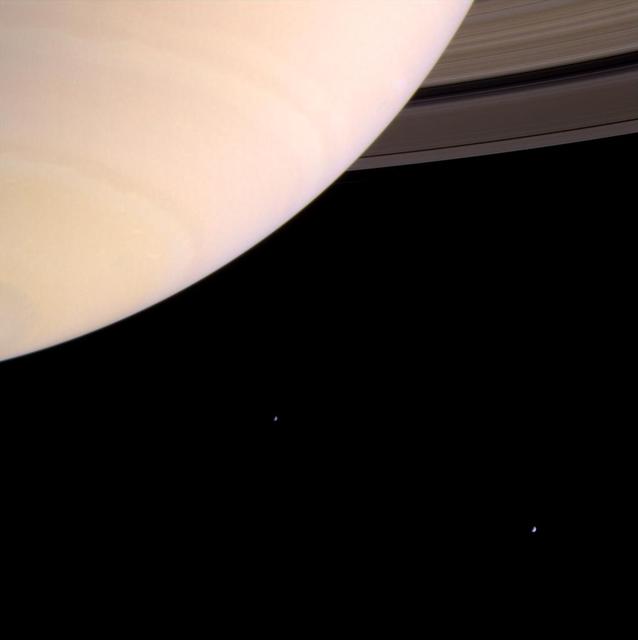
Ver en NASA ↗Two moons hover above the rings from this perspective, Enceladus 313 miles or 504 kilometers across, at left, and Janus 111 miles or 179 kilometers across, at right as seen by NASA Cassini spacecraft.
Ver en NASA ↗This is a polar stereographic map of gravity of the north polar region of the moon from the Gravity Recovery and Interior Laboratory GRAIL mission. The map displays the region from latitude 60 north to the pole.
Ver en NASA ↗These images of Jupiter moon Amalthea were taken with NASA Galileo and Voyager spacecraft. Amalthea is almost pure water ice, hinting that it may not have formed where it now orbits.
Ver en NASA ↗The diminutive moon Mimas can be found hiding in the middle of this view of a crescent of Saturn bisected by rings in this image captured by NASA Cassini spacecraft. Mimas appears as a dark speck just about the ringplane near the center of the image. Th
Ver en NASA ↗Voyager 2 has discovered two hepherd satellites associated with the rings of Uranus. The two moons, designated 1986U7 and 1986U8, are seen here on either side of the bright epsilon ring; all nine of the known Uranian rings are visible.
Ver en NASA ↗Saturn moon Epimetheus casts a shadow across colorful rings in this image taken by NASA Cassini spacecraft before the planet August 2009 equinox. Epimetheus is visible as a small dot at the center of the bottom of the image.
Ver en NASA ↗Saturn moon Prometheus casts a narrow shadow on the rings near the much larger shadow cast by the planet in this image taken by NASA Cassini spacecraft about five months after Saturn August 2009 equinox.
Ver en NASA ↗Two of Saturn moons straddle the planet rings in this color view from NASA Cassini spacecraft. Mimas is closest to NASA Cassini spacecraft here. Epimetheus is on the far side of the rings. Saturn shadow cuts across the middle of the rings.
Ver en NASA ↗Although it is no longer uncharted land, the origin of the dark territory of Cassini Regio on Iapetus remains a mystery. The view looks down onto the northern hemisphere of Iapetus and shows terrain on the moon leading hemisphere
Ver en NASA ↗A darkly defined Rhea passes before the fuzzy orb of Titan in this view from NASA Cassini spacecraft of Saturn two largest moons. Rhea is closer to the spacecraft in this view.
Ver en NASA ↗Saturn small moon Prometheus, slightly overexposed in this image taken by NASA Cassini spacecraft, shows off its potato-like shape as it orbits in the Roche Division between the A ring and thin F ring.
Ver en NASA ↗This picture of a crescent-shaped Earth and Moon -- the first of its kind ever taken by a spacecraft -- was recorded Sept. 18, 1977, by NASA Voyager 1 when it was 7.25 million miles 11.66 million kilometers from Earth.
Ver en NASA ↗Rhea and Dione seem like dark and light fraternal twins in this image from NASA Cassini spacecraft, with each of these two Saturnian moons displaying a large crater oriented similarly in the northern hemisphere.
Ver en NASA ↗Contenido y metadatos proporcionados por la NASA Image and Video Library.