




/NASA’s%20Artemis%20III%20Announcement%20(Official%20NASA%20Trailer)~thumb.jpg)
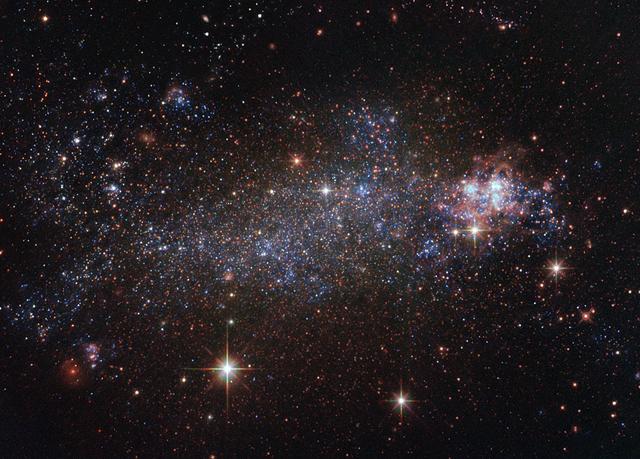

KENNEDY SPACE CENTER, FLA. - At Astrotech in Titusville, Fla., the high-gain communications antenna is ready for installation on the Deep Impact spacecraft (behind it). A NASA Discovery mission, Deep Impact will probe beneath the surface of Comet Tempel 1 on…
Ver en NASA ↗🚀 Biblioteca espacial oficial
Imágenes y vídeos de NASA
Explora el catálogo multimedia público de NASA sin salir de TuPortalNews.
Explora temas destacados
Selecciona un tema o realiza una búsqueda personalizada.
1.036 resultados en NASA
KENNEDY SPACE CENTER, FLA. - Ball Aerospace technicians at Astrotech in Titusville, Fla., attach on overhead crane to the high-gain communications antenna to be installed on the Deep Impact spacecraft. A NASA Discovery mission, Deep Impact will probe beneath…
Ver en NASA ↗At the Shuttle Landing Facility, workers observe the loading of the crated Stardust spacecraft onto a trailer for transporting to the Payload Hazardous Service Facility. Built by Lockheed Martin Astronautics near Denver, Colo., for the Jet Propulsion Laborato…
Ver en NASA ↗KENNEDY SPACE CENTER, FLA. - Ball Aerospace technicians at Astrotech in Titusville, Fla., make sure the crane is securely attached to the high-gain communications antenna to be installed on the Deep Impact spacecraft. A NASA Discovery mission, Deep Impact wi…
Ver en NASA ↗KENNEDY SPACE CENTER, FLA. - Workers in the Spacecraft Assembly and Encapsulation Facility 2 check the position of the CONTOUR spacecraft as it is lowered over the apogee kick motor to which it will be attached. CONTOUR will provide the first detailed look in…
Ver en NASA ↗In the Payload Hazardous Servicing Facility, workers deploy an aerogel grid from the Stardust Sample Return Capsule (SRC) in the Class 100 Glove Box. Stardust will use a unique medium called aerogel to capture comet particles flying off the nucleus of comet W…
Ver en NASA ↗KENNEDY SPACE CENTER, FLA. -- In the Spacecraft Assembly and Encapsulation Facility 2, workers watch closely as the CONTOUR spacecraft is lowered into place over the apogee kick motor to which it will be attached. CONTOUR will provide the first detailed look …
Ver en NASA ↗KENNEDY SPACE CENTER, FLA. -- On Launch Pad 17-A, Cape Canaveral Air Force Station, a view of the first stage of a Boeing Delta II rocket is captured between two of the solid rocket boosters that will be mated to it. The rocket will be the launch vehicle for …
Ver en NASA ↗KENNEDY SPACE CENTER, FLA. - In the Spacecraft Assembly and Encapsulation Facility 2, the CONTOUR spacecraft is carried by an overhead crane to the apogee kick motor sitting on a stand below. The spacecraft will be attached to the motor for launch. CONTOUR…
Ver en NASA ↗In the Payload Hazardous Servicing Facility, workers begin removing the Stardust solar panels for testing. The spacecraft Stardust will use a unique medium called aerogel to capture comet particles flying off the nucleus of comet Wild 2 in January 2004, plus …
Ver en NASA ↗In the Payload Hazardous Service Facility, a worker prepares the Stardust spacecraft for its transfer to . Built by Lockheed Martin Astronautics near Denver, Colo., for the Jet Propulsion Laboratory (JPL) and NASA, the spacecraft Stardust will use a unique me…
Ver en NASA ↗In the Payload Hazardous Servicing Facility, closeout of the Stardust spacecraft is complete. Stardust will use a unique medium called aerogel to capture comet particles flying off the nucleus of comet Wild 2 in January 2004, plus collect interstellar dust fo…
Ver en NASA ↗KENNEDY SPACE CENTER, FLA. -- A thermal technician with Johns Hopkins University Applied Physics Laboratory closes out the blanket around CONTOUR'S Earth-Sun Sensor. The spacecraft will provide the first detailed look into the heart of a comet -- the nucleu…
Ver en NASA ↗In the Payload Hazardous Servicing Facility, Randy Scott (left) and Pat Wedeman (right), with Lockheed Martin Astronautics, check the insulation material on the Stardust spacecraft. Stardust will use a unique medium called aerogel to capture comet particles f…
Ver en NASA ↗In the Payload Hazardous Servicing Facility, Randy Scott (left) and Pat Wedeman (right) , with Lockheed Martin Astronautics, insulate the Stardust spacecraft. Stardust will use a unique medium called aerogel to capture comet particles flying off the nucleus o…
Ver en NASA ↗In the Payload Hazardous Servicing Facility, Randy Scott, with Lockheed Martin Astronautics, checks insulation material on the Stardust spacecraft. Stardust will use a unique medium called aerogel to capture comet particles flying off the nucleus of comet Wil…
Ver en NASA ↗In the Payload Hazardous Servicing Facility, workers get ready to install the Sample Return Capsule (SRC) and -X spacecraft panel on the Stardust spacecraft . Stardust will use a unique medium called aerogel to capture comet particles flying off the nucleus o…
Ver en NASA ↗In the Payload Hazardous Servicing Facility, workers remove the Stardust solar panels for testing. The spacecraft Stardust will use a unique medium called aerogel to capture comet particles flying off the nucleus of comet Wild 2 in January 2004, plus collect …
Ver en NASA ↗KENNEDY SPACE CENTER, FLA. - Ball Aerospace technicians at Astrotech in Titusville, Fla., guide the high-gain communications antenna toward the attach-point on the Deep Impact spacecraft. A NASA Discovery mission, Deep Impact will probe beneath the surface o…
Ver en NASA ↗In the Payload Hazardous Servicing Facility, workers inspect the aerogel grid from the Stardust Sample Return Capsule (SRC) to the right of the worker. Stardust will use a unique medium called aerogel to capture comet particles flying off the nucleus of comet…
Ver en NASA ↗In the Payload Hazardous Service Facility, workers oversee the arrival of the crated Stardust spacecraft. Built by Lockheed Martin Astronautics near Denver, Colo., for the Jet Propulsion Laboratory (JPL) and NASA, the spacecraft Stardust will use a unique med…
Ver en NASA ↗After arrival at the Shuttle Landing Facility in the early morning hours, the crated Stardust spacecraft waits to be unloaded from the aircraft. Built by Lockheed Martin Astronautics near Denver, Colo., for the Jet Propulsion Laboratory (JPL) NASA, the spacec…
Ver en NASA ↗In the Payload Hazardous Servicing Facility, the aerogel grid is fully deployed from the Stardust Sample Return Capsule (SRC) for final closeout. Stardust will use a unique medium called aerogel to capture comet particles flying off the nucleus of comet Wild …
Ver en NASA ↗KENNEDY SPACE CENTER, FLA. - This closeup of the Boeing Delta II rocket on Launch Pad 17-A, Cape Canaveral Air Force Station, shows the CONTOUR project logo and the NASA emblem below it. The rocket is the launch vehicle for the CONTOUR spacecraft, scheduled t…
Ver en NASA ↗Contenido y metadatos proporcionados por la NASA Image and Video Library.