





/NASA’s%20Artemis%20III%20Announcement%20(Official%20NASA%20Trailer)~thumb.jpg)

NASA images acquired October 15, 2012 The Visible Infrared Imaging Radiometer Suite (VIIRS) on the Suomi NPP satellite captured these nighttime views of the Persian Gulf region on September 30, October 5, October 10, and October 15, 2012. The images are from…
Ver en NASA ↗🚀 Biblioteca espacial oficial
Imágenes y vídeos de NASA
Explora el catálogo multimedia público de NASA sin salir de TuPortalNews.
Explora temas destacados
Selecciona un tema o realiza una búsqueda personalizada.
19.951 resultados en NASA
Buzz Aldrin took this iconic image of a bootprint on the Moon during the Apollo 11 moonwalk on July 20, 1969.
Ver en NASA ↗Philip Lubin from Team H.E.L.P.S. (High Efficiency Long-Range Power Solution) explains his project to Mary Wadel, Kirsten Ellenbogen and Stephen Bowen. NASA has awarded a total of $1.5 million to two U.S. teams for their novel technology solutions addressing…
Ver en NASA ↗Individuals from Orbital Mining Corporation of Golden, Colorado pose with Robert Button, Mary Wadel and Astronaut Stephen Bowen. NASA has awarded a total of $1.5 million to two U.S. teams for their novel technology solutions addressing energy distribution, …
Ver en NASA ↗Philip Lubin from Team H.E.L.P.S. (High Efficiency Long-Range Power Solution) explains his project to Mary Wadel, Lisa Ferguson, Kirsten Ellenbogen and Stephen Bowen. NASA has awarded a total of $1.5 million to two U.S. teams for their novel technology solu…
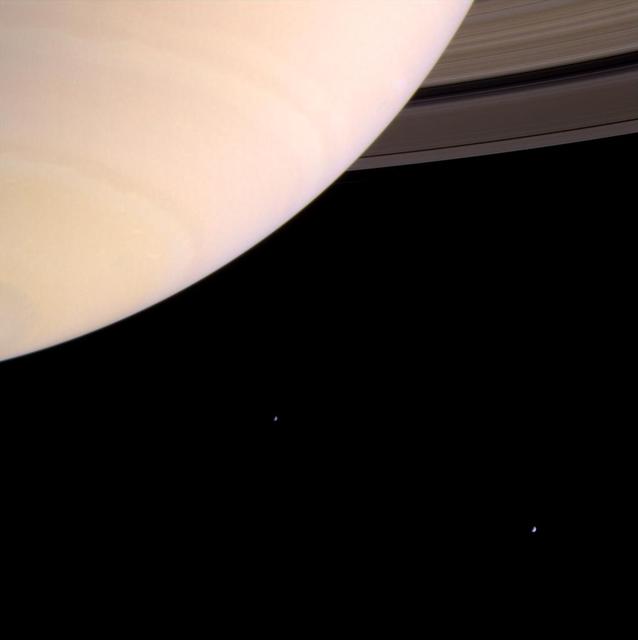
Ver en NASA ↗Saturn small moons Atlas, Prometheus, and Epimetheus keep each other company in this image from NASA Cassini spacecraft of the planet night side. It seems fitting that they should do so since in Greek mythology, their namesakes were brothers.
Ver en NASA ↗NASA's Juno mission captured this view of Jupiter's intriguing, icy moon Europa during a close pass on September 29, 2022.
Ver en NASA ↗This infrared image of the southern hemisphere of Jupiter's moon Io was derived from data collected by the Jovian Infrared Auroral Mapper (JIRAM) instrument aboard NASA's Juno spacecraft on Dec. 16, 2017.
Ver en NASA ↗art001e002264 (Dec. 9, 2022) Orion’s distance from the Moon continues to increase on flight day 24 of the Artemis I mission as it heads back to Earth and a splashdown at 12:40 p.m. Sunday, Dec. 11. When this photo was taken using a camera mounted on one of Or…
Ver en NASA ↗art001e001933 (Dec. 2, 2022) A camera mounted on one of Orion’s four solar arrays captured this image of the Moon on flight day 17 of the 25.5-day Artemis I mission from a distance of more than 222,000 miles from Earth. Orion has exited the distant lunar orbi…
Ver en NASA ↗art001e002262 (Dec. 9, 2022) Orion’s distance from the Moon continues to increase on flight day 24 of the Artemis I mission as it heads back to Earth and a splashdown at 12:40 p.m. Sunday, Dec. 11. When this photo was taken using a camera mounted on one of Or…
Ver en NASA ↗art001e002263 (Dec. 9, 2022) Orion’s distance from the Moon continues to increase on flight day 24 of the Artemis I mission as it heads back to Earth and a splashdown at 12:40 p.m. Sunday, Dec. 11. When this photo was taken using a camera mounted on one of Or…
Ver en NASA ↗AS10-27-3956 (24 May 1969) --- This photograph of the moon was taken after trans-Earth insertion when the Apollo 10 spacecraft was high above the lunar equator near 27 degrees east longitude. North is about 20 degrees left of the top of the photograph. Apollo…
Ver en NASA ↗015A7556.NEF
Ver en NASA ↗015B0454.NEF
Ver en NASA ↗art001e001713 (Nov. 29, 2022) Orion’s solar arrays split the difference between Earth and the Moon on flight day 14 of the Artemis I mission in this image captured by a camera on the tip of one of the spacecraft’s four solar arrays.
Ver en NASA ↗art001e001712 (Nov. 29, 2022) Orion’s solar arrays split the difference between Earth and the Moon on flight day 14 of the Artemis I mission in this image captured by a camera on the tip of one of the spacecraft’s four solar arrays.
Ver en NASA ↗STS061-57-021 (2-12 Dec 1993) --- This scene, captured with a 35mm camera from inside the Space Shuttle Endeavour, shows the Earth-orbiting Hubble Space Telescope (HST) and the Moon together.
Ver en NASA ↗art001e001714 (Nov. 29, 2022) Orion’s solar arrays split the difference between Earth and the Moon on flight day 14 of the Artemis I mission in this image captured by a camera on the tip of one of the spacecraft’s four solar arrays.
Ver en NASA ↗Catherine Koerner, deputy associate administrator for NASA's Exploration Systems Development Mission Directorate, center, is seen alongside Nujoud Merancy, architecture lead for NASA's Exploration Systems Development Mission Directorate, left, and Patrick For…
Ver en NASA ↗Catherine Koerner, deputy associate administrator for NASA's Exploration Systems Development Mission Directorate, center, is seen alongside Nujoud Merancy, architecture lead for NASA's Exploration Systems Development Mission Directorate, left, and Patrick For…
Ver en NASA ↗An American Sweetgum sapling grown from a seed that was flown around the Moon during the Artemis I mission is seen before a Moon tree dedication ceremony, Tuesday, June 4, 2024 at the United States Capitol in Washington. Photo Credit: (NASA/Aubrey Gemignani)
Ver en NASA ↗The leaves of an American Sweetgum sapling grown from a seed that was flown around the Moon during the Artemis I mission is seen before a Moon tree dedication ceremony, Tuesday, June 4, 2024 at the United States Capitol in Washington. Photo Credit: (NASA/Aubr…
Ver en NASA ↗An American Sweetgum sapling grown from a seed that was flown around the Moon during the Artemis I mission is seen before a Moon tree dedication ceremony, Tuesday, June 4, 2024 at the United States Capitol in Washington. Photo Credit: (NASA/Aubrey Gemignani)
Ver en NASA ↗Contenido y metadatos proporcionados por la NASA Image and Video Library.