





/NASA’s%20Artemis%20III%20Announcement%20(Official%20NASA%20Trailer)~thumb.jpg)

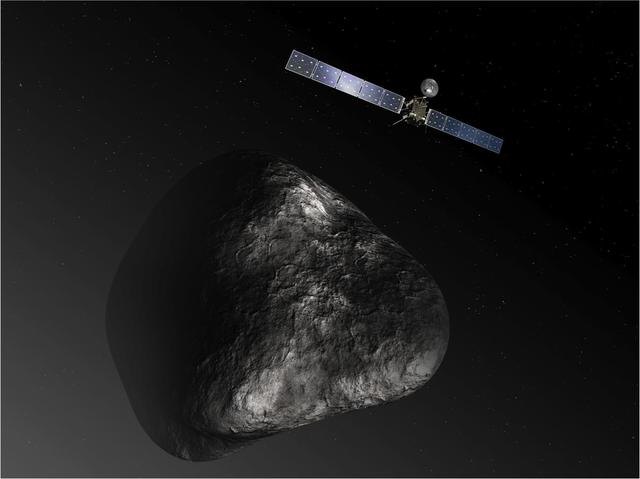
This image was taken by the Optical, Spectroscopic, and Infrared Remote Imaging System, Rosetta main onboard scientific imaging system, on Sept. 10, 2014. Jets of cometary activity can be seen along almost the entire body of the comet.
Ver en NASA ↗🚀 Biblioteca espacial oficial
Imágenes y vídeos de NASA
Explora el catálogo multimedia público de NASA sin salir de TuPortalNews.
Explora temas destacados
Selecciona un tema o realiza una búsqueda personalizada.
1.036 resultados en NASA
On January 2, 2004 NASA's Stardust spacecraft made a close flyby of comet Wild 2 (pronounced "Vilt-2"). Among the equipment the spacecraft carried on board was a navigation camera.
Ver en NASA ↗This graphic depicts the position of the Philae lander of the European Space Agency Rosetta mission, and a nearby cliff photographed by the lander, in the context of topographic modeling of the surface of comet 67P/Churyumov-Gerasimenko nucleus.
Ver en NASA ↗This mosaic of images from the navigation camera on the European Space Agency Rosetta spacecraft shows the nucleus of comet 67P/Churyumov-Gerasimenko as it appeared at 5 a.m. UTC on Dec. 17, 2014 9 p.m. PST on Dec. 16.
Ver en NASA ↗This mosaic of images from the navigation camera on the ESA Rosetta spacecraft shows the nucleus of comet 67P/Churyumov-Gerasimenko as it appeared at in the early morning, Universal Coordinated Time, of Dec. 17, 2014 evening of Dec. 16, PST.
Ver en NASA ↗Images of comet 67P/Churyumov-Gerasimenko taken on July 14, 2014, by the OSIRIS imaging system aboard ESA Rosetta spacecraft have allowed scientists to create this three-dimensional shape model of the nucleus.
Ver en NASA ↗The Philae lander of Europe Rosetta mission has returned the first panoramic image from the surface of a comet. The unprocessed panorama from the lander CIVA-P camera shows a 360-degree view around the point of final touchdown.
Ver en NASA ↗This image shows the most recent observations of the 2-mile-wide 4-kilometer-wide comet 67P/Churyumov-Gerasimenko, which is the upcoming target of the European Space Agency Rosetta mission.
Ver en NASA ↗From the location where it came to rest after bounces, the Philae lander of the European Space Agency Rosetta mission captured this view of a cliff on the nucleus of comet 67P/Churyumov-Gerasimenko. The feature is called Perihelion Cliff.
Ver en NASA ↗This image of comet 67P/Churyumov-Gerasimenko marks the first touchdown point of the Philae lander of the European Space Agency Rosetta mission. The image was taken by on Sept. 14, 2104, nearly two months before Philae Nov. 12 landing.
Ver en NASA ↗The International Space Station, with a crew of five onboard, is seen in this 10 second exposure above comet NEOWISE, Saturday, July 18, 2020 from Keys Gap, W.Va. The comet was discovered by NASA’s Near-Earth Object Wide-field Infrared Survey Explorer, or NEO…
Ver en NASA ↗Several sites of cliff collapse on comet 67P/Churyumov-Gerasimenko were identified during ESA's Rosetta mission. The yellow arrows mark the fractures where the detachment occurred.
Ver en NASA ↗Hubble measured the size, shape and rotational period of the Rosetta mission backup target, comet 67P/Churyumov-Gerasimenko 67P/C-G.
Ver en NASA ↗Comet NEOWISE passing over the Little Joe II rocket at NASA Johnson Space Center’s Rocket Park on July 22nd, 2020.
Ver en NASA ↗The Philae lander of the European Space Agency Rosetta mission captured this view during its first bounce after hitting the surface of comet 67P/Churyumov-Gerasimenko on Nov. 12, 2014, with blurring as a result of the lander own motion. The image from
Ver en NASA ↗This view shows Comet 67P/Churyumov-Gerasimenko as seen by the OSIRIS wide-angle camera on ESA's Rosetta spacecraft on September 29, 2016, when Rosetta was at an altitude of 14 miles 23 kilometers.
Ver en NASA ↗This observation from ESA Rosetta spacecraft shows that comet 67P/Churyumov-Gerasimenko has a two-part shape. The image on the left is from OSIRIS; the image on the right is enhanced with interpolated data.
Ver en NASA ↗This composite NASA Hubble Space Telescope Image captures the positions of comet Siding Spring and Mars in a never-before-seen close passage of a comet by the Red Planet, which happened at 2:28 p.m. EDT October 19, 2014. The comet passed by Mars at approximat…
Ver en NASA ↗The descent of its comet lander Philae was captured by ESA Rosetta spacecraft main camera as the lander approached -- and then rebounded off -- the comet surface.
Ver en NASA ↗Anatomy of a Torn Comet
Ver en NASA ↗Comets and Enceladus - Similar Chemistry
Ver en NASA ↗During its one-year mission, NASA Wide-field Infrared Survey Explorer, mapped the entire sky in infrared light. Among the multitudes of astronomical bodies that have been discovered by the NEOWISE portion of the WISE mission are 20 comets.
Ver en NASA ↗Dr. Michael A'Hearn, Principal Investigator, EPOXI Comet Encounter Mission, speaks during a symposium commemorating a quarter-century of comet discoveries, Friday, Sept. 10, 2010, in the Knight studio at the Newseum in Washington. The International Sun-Earth …
Ver en NASA ↗On clear nights in January 2015, comet C/2014 Q2 Lovejoy is visible in the Taurus region of the sky to observers using binoculars. This chart indicates where to look for it on different dates during the month.
Ver en NASA ↗Contenido y metadatos proporcionados por la NASA Image and Video Library.